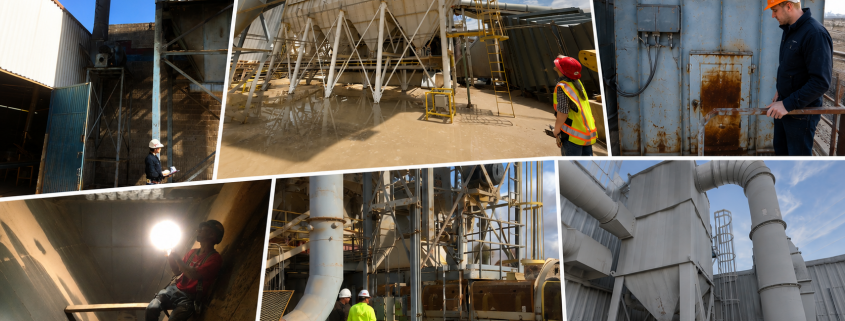
Inside the Mind of a Dust Collection Expert — Interview with Dominick Dal Santo

Dominick Dal Santo works as a Sales Manager and Dust Collection Expert at Baghouse.com

Over the years, Dominick has helped hundreds of facilities across North America troubleshoot dust collection problems, design new systems, train maintenance teams, and perform comprehensive system audits. Having worked in marketing, field service, installations, welding, system design, and now sales management, he brings a unique perspective that combines practical experience with engineering knowledge.

We recently sat down with Dominick to discuss his journey into the dust collection industry, the importance of education, and some of the exciting experiences he’s encountered while helping customers improve their systems.

— How did you get started in the dust collection industry?

Dominick: “Well… I was kind of forced into it,” he laughs.

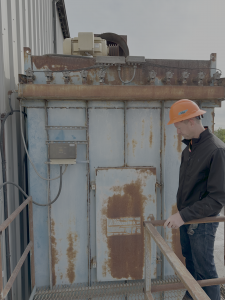
Young Dominick Dal Santo during an inspection“My father, Dave Dal Santo,, founded the company more than forty years ago, so growing up, working at Baghouse during the summer was just how we earned a little spending money. I spent some time working in other industries first, but eventually came back in my early twenties. Ironically, I didn’t start on the engineering side—I actually started in marketing.”

“Today I work with customers from the very beginning of a project, helping determine the best solution for their application. Having spent years actually installing and troubleshooting systems gives you a different perspective when recommending equipment.”

▶ Mira su respuesta completa a continuación.

— What do you enjoy most about your job?

Dominick: “Honestly, it’s educating customers. One thing we’ve noticed over the years is that dust collection seems to be one of those subjects that many facilities never receive proper training on.”

“When we visit a facility, I don’t just want to tell someone that they need to replace a filter or adjust a setting. I’d rather explain why something is happening. When people understand how their system actually works, they begin solving problems on their own.”

▶ Mira su respuesta completa a continuación.

Any funny or interesting anecdotes from your first jobs?

Dominick: “There are quite a few. We were working for one of the largest pistachio producers in the world. Now, of all the foods I don’t particularly enjoy… pistachios are probably at the top of the list. So naturally, one of our biggest customers turns out to be a pistachio producer, and I’m literally spending my days climbing around mountains of pistachios.”

But not every memorable experience was humorous. “We were performing a dust collection audit at a woodworking facility. During the inspection, I noticed they had built a homemade after-filter assembly on a return-air duct. When I explained that it represented a serious combustible dust fire and explosion hazard, one of the maintenance managers looked at me and said…’Why would it be a fire hazard? It’s just wood dust.’ It wasn’t that they were ignoring safety. They genuinely didn’t know wood dust could explode.”

▶ Mira su respuesta completa a continuación.

— What are the most common problems you see when you walk into a plant for the first time?

Dominick: “It’s interesting because after visiting so many facilities, you begin noticing the same patterns over and over again.”

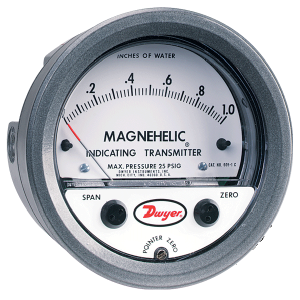
Magnehelic pressure gauge

Si los operadores tienen lecturas incorrectas, podría resultar en daños al sistema, un aumento de las emisiones o incluso en riesgos de incendio y polvo combustible

“The very first question we ask is always, ‘What’s your la presión diferencial?'” Almost every plant has some kind of issue with its differential pressure monitoring. The gauge might be broken, full of water, or simply inaccurate because the pressure-sensing lines have never been cleaned. If you can’t trust your differential pressure reading, you really can’t make good maintenance decisions. When it’s accurate, it tells you an incredible amount about what’s happening inside your dust collector.”

▶ Mira su respuesta completa a continuación.

— If you could give one piece of advice to plant managers, engineers, and maintenance teams, what would it be?

Dominick: “Invest the time to learn how your dust collection system actually works.”

One practice he cautions against is relying exclusively on what he jokingly calls “old man fiddle knowledge.” Institutional knowledge is incredibly valuable. Over the years, procedures have become simplified, advice gets passed from one generation to the next and sometimes details are forgotten. Sometimes practices that were considered acceptable twenty years ago simply aren’t the best approach anymore.

“When people understand why something works—not just how they’ve always done it—they make better decisions, troubleshoot problems faster, and they become much more confident maintaining the system.”

▶ Mira su respuesta completa a continuación.

— Why do you recommend combining operator training with a system audit?

Dominick: “During the audit, we’ll identify physical issues. Maybe the collector is undersized. Maybe there’s damaged ductwork, poor airflow, plugged hoppers, or equipment that’s been modified over the years. But the majority of the problems we identify usually trace back to how the system is being operated or maintained.”

That’s where the second day becomes just as valuable.

dust collection maintenance training class“During the training sessions, we spend several hours with maintenance personnel, operators, engineers, and supervisors discussing how the system actually works. Management may tell us that a particular maintenance procedure is always followed. But once you’re sitting in the classroom talking with the technicians who work on the equipment every day, you sometimes discover that’s not actually what happens.”

“The final report doesn’t simply say, ‘Replace this valve,’ or ‘Repair this duct. It identifies physical improvements, maintenance improvements, operational improvements, and training opportunities. You’re solving both the mechanical issues and the knowledge gaps at the same time.”

▶ Mira su respuesta completa a continuación.

— What makes Baghouse.com different from other dust collection providers?

Dominick: “We have experience with every stage of the process. We design complete systems, manufacture equipment, install it, inspect existing systems and train maintenance teams. Many equipment suppliers are manufacturer representatives who only sell one particular brand or product line. Naturally, they’re limited to the products they represent.”

“Our goal is to recommend the solution that makes the most sense for the customer’s application. We’re willing to talk ourselves out of selling equipment if that’s honestly the best answer.”

▶ Mira su respuesta completa a continuación.

— Any final thoughts for someone considering Baghouse.com for their next dust collection project?

Dominick: “Take a look at our experience. Spend some time on our website. Look at the industries we’ve worked in, read through the case studies. And then talk to us.”

“When you call us, you’re not getting someone reading specifications out of a catalog. You’re talking with people who’ve spent years inside manufacturing plants solving these problems.”

“And we work with customers to develop a solution that fits their application, their budget, and their long-term goals. At the end of the day, long-term relationships are built on trust.”

▶ Mira su respuesta completa a continuación.

Aprende de décadas de experiencia

Throughout this interview, Dominick returns to one recurring theme: the majority of dust collection problems aren’t caused by equipment—they’re caused by a lack of understanding.

That’s why Baghouse.com approaches every project as more than an equipment sale. By combining engineering expertise, field experience, comprehensive system audits, operator training, and practical troubleshooting, the company helps customers improve reliability, reduce maintenance costs, and maximize the performance of their existing systems before recommending major capital investments.

As Dominick puts it, “We don’t sell products—we sell solutions.”

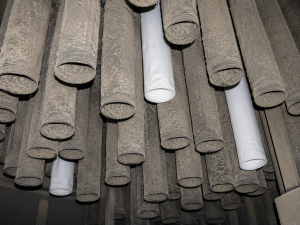
Inside an industrial baghouse showing mostly dirty filter bags with three new replacement filter bags installed among them during maintenance.

Should I Change All My Filter Bags at Once or Just Spot Change as Needed?

“Do I really need to replace every filter bag, or can I just change the bad ones?”

It’s a fair question. Replacing a complete set of filter bags is a significant investment, especially on large baghouses with hundreds or even thousands of filters. From a maintenance standpoint, replacing only the few bags that are leaking seems like the obvious way to save money.

In some situations, it is. In many others, however, spot-changing filters actually ends up costing considerably more over the life of the dust collector.

The key is understanding why the filters are being replaced in the first place.

Not Every Failed Filter Has Reached the End of Its Life

Before deciding how many filters to replace, the first question should be:

What caused the filter failure?

“We always try to determine whether we’re looking at an isolated failure or a system-wide issue,” comenta Scott Omann, Aftermarket Division Manager at Baghouse.com. “Changing filters without understanding why they failed often means we’ll be back doing the same repair a few weeks later.”

During inspections, Baghouse.com typically sees two very different situations. The first is fallas prematuras.. This happens when one or several filters are damaged by something abnormal:

  • ⦿ A torn bag from improper installation
  • ⦿ A broken or rusted cage
  • ⦿ Spark or ember damage
  • ⦿ Abrasive wear near the inlet
  • ⦿ Chemical attack from an upset condition
  • ⦿ A maintenance accident during previous work

In these cases, replacing only the damaged filters usually makes perfect sense because the remaining filters may still have years of useful life left.

When the Entire Filter Set Has Aged Together

Every filter slowly accumulates fine dust deep within the media over years of operation. Unlike the dust cake on the surface, this embedded dust cannot be removed by pulse cleaning. Eventually, every filter becomes more restrictive, la presión diferencial gradually increases, airflow slowly decreases, and cleaning becomes less effective. At some point, the filters have simply reached the end of their useful life.

“When the entire set has aged together, replacing only the leaking bags is usually a temporary fix,” explica Matt Coughlin, President of Baghouse.com. “The new bags may solve the immediate leak, but the older bags are still restricting airflow. Before long, you’ll be chasing another failure somewhere else.”

Why Spot Changing Can Create New Problems

Inside an industrial baghouse showing mostly dirty filter bags with three new replacement filter bags installed among them during maintenance.

New filter bags have very low resistance, so the system will naturally try to pull more airflow through the new filters.

Many people assume every filter inside the baghouse operates independently. In reality, they’re all connected through the same fan and the same airflow. New filter bags have very low resistance, whereas older bags usually have much higher resistance because they’ve accumulated years of embedded dust. The result is that the system naturally tries to pull more airflow through the new filters.

That additional airflow often means faster dust loading, higher cleaning frequency, increased abrasion, uneven filter wear and shorter life for the replacement bags. Instead of lasting five or six years like the original set, the new filters may fail much sooner because they’re doing more of the work.

It’s similar to replacing one worn tire on a vehicle while leaving the other three nearly bald. The new tire isn’t necessarily defective…it simply ends up carrying a disproportionate share of the load.

Differential Pressure Tells an Important Part of the Story

One of the easiest ways to determine whether a full changeout is approaching is by looking at the differential pressure trend. If differential pressure has steadily increased over several years and no amount of cleaning brings it back down, the filters may simply be loaded with embedded fines. Likewise, if emissions begin increasing without obvious holes in the bags, the media itself may have reached the end of its service life. These are signs that replacing only the visibly damaged filters is unlikely to restore the collector’s original performance.

Infographic showing differential pressure trends in a baghouse over time, illustrating how filters reach the end of their useful life when pulse cleaning no longer reduces differential pressure.

There Are Times When Spot Changing Is Absolutely the Right Choice

Spot replacement is often recommended when:

  • ⦿ A small number of bags were damaged during maintenance.
  • ⦿ An isolated spark burned several filters.
  • ⦿ One compartment experienced localized abrasion.
  • ⦿ A broken cage damaged a few bags.
  • ⦿ A foreign object entered the collector.
  • ⦿ The remaining filters are relatively new.

In these situations, replacing only the affected filters can be the most economical decision. If you must replace only a few filters, ensure it’s less than 5% of the total filters to avoid imbalances. Mixing old and new filters can create airflow distribution problems, causing some filters to clog faster than others.

Consider the Cost of Downtime

Another factor that’s frequently overlooked is labor. Replacing ten bags today and another twenty next month may seem less expensive than replacing all 600 at once. When these costs are added together, multiple small changeouts can easily exceed the cost of one planned replacement. Many facilities schedule complete filter replacements during annual shutdowns specifically to avoid repeated interruptions throughout the year.

Don't Forget the Cages

Any cages that are bent, rusty, or have shape edges should be discarded and replaced. Filters that are installed onto damaged cages will suffer early filter failure.

Cualquier jaula que esté doblada, oxidada o tenga bordes deformados debe ser descartada y reemplazada. Los filtros instalados en jaulas dañadas sufrirán fallos prematuros

Whenever filters are replaced, the cages deserve just as much attention. Rust, broken welds, bent wires, worn venturis, or sharp edges can quickly damage brand-new filters. One of the most common mistakes technicians see is installing new bags over old cages that have already reached the end of their own service life. If the cages are questionable, replacing both components together is often the better long-term investment.

Conclusión

Spot-changing filter bags can be an excellent maintenance strategy when dealing with isolated damage or relatively new filter sets. However, once the entire filter population begins reaching the end of its service life, replacing only the visibly damaged bags often postpones—rather than solves—the problem.

Before ordering replacement filters, take the time to understand what your dust collector is trying to tell you. In many cases, a thorough inspection can save far more than the cost of the filters themselves.

Our engineers have inspected thousands of dust collection systems across North America. If you’re unsure whether it’s time for a complete filter changeout, we’re happy to help.

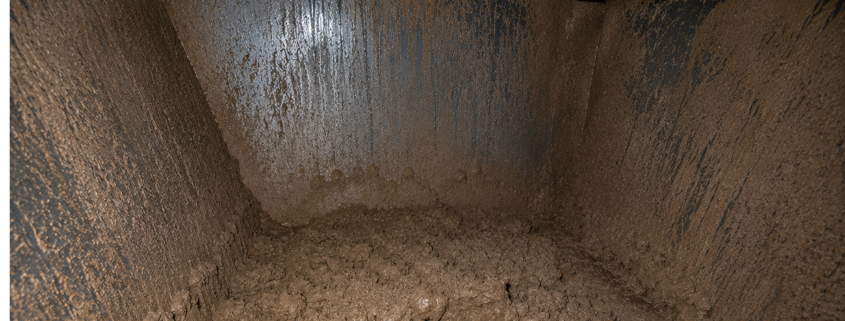
Inside view of an industrial dust collector hopper showing severe dust bridging caused by moisture and condensation, restricting material discharge.

How to Prevent Condensation in Your Baghouse

One of the quickest ways to turn a healthy dust collector into a maintenance headache is to allow moisture to enter the system. A small amount of baghouse condensation can set off a chain reaction that leads to plugged filter bags, hopper blockages, corrosion, false instrument readings, and eventually costly downtime. The frustrating part is that condensation often develops gradually, making it difficult to recognize until the dust collector is already struggling.

“We’re often called because a plant has high differential pressure or poor airflow,” says Scott Omann, Aftermarket Division Manager at Baghouse.com. “But many times those are simply the symptoms. Once we inspect the collector, we find moisture has been affecting the system for weeks or even months.”

The good news is that condensation is largely preventable. Understanding why it forms (and taking a few practical steps during design, operation, and maintenance) can dramatically improve dust collector performance and extend equipment life.

Why Does Condensation Form Inside a Baghouse?

Condensation forms whenever the temperature of the process gas or the collector surfaces falls below the dew point. At that point, moisture suspended in the air condenses into liquid water.

This usually occurs during startup and shutdown, cold weather, overnight cooling, seasonal temperature swings, or anytime outside air enters the system unexpectedly.

Many facilities think only about humidity, but moisture problems often begin with temperature. Warm process air may contain a large amount of water vapor without causing any issues. As soon as that air cools enough, however, the moisture comes out of suspension and begins collecting on filter bags, hopper walls, ductwork, and other internal surfaces.

How Moisture Affects Dust Collection Performance

Some of the most common consequences include:

  • ⦿ Filter bag blinding
  • ⦿ High differential pressure
  • ⦿ Reduced airflow
  • ⦿ Hopper bridging
  • ⦿ Rotary airlock plugging
  • ⦿ Dust buildup inside ductwork
  • ⦿ Corrosion of collector components
  • ⦿ Premature filter replacement
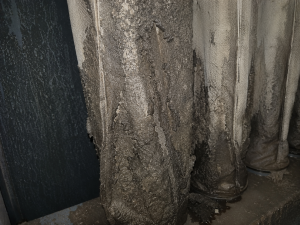
Close-up of industrial baghouse filter bags blinded by moisture and dust buildup caused by condensation inside a dust collection system.

Moisture inside a baghouse can cause dust to adhere to the filter media, creating a hardened dust cake that blinds the filters. This reduces airflow, increases differential pressure, shortens filter life, and often leads to hopper plugging, corrosion, and costly maintenance.

As moisture mixes with dust, it creates a sticky layer that becomes increasingly difficult to remove with pulse cleaning. Eventually, the filter media loses permeability, causing differential pressure to rise while airflow drops. Continued operation under these conditions often shortens filter life dramatically.

Matt Coughlin, President of Baghouse.com, explains it this way: “People sometimes assume the filters are simply worn out. In reality, the filters may have become blinded because condensation allowed the dust to cake onto the media. Replacing the filters without fixing the moisture source usually means the same problem comes back.”

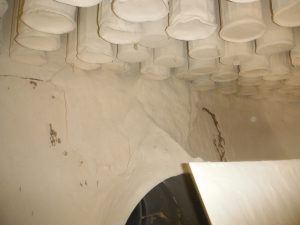
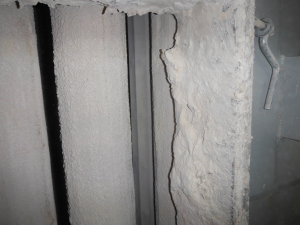
In these images, we can see damaged door gaskets allowing cold, moist air to filter in and causing dust accumulation on the walls and even in the filters.

Common Sources of Moisture in Dust Collection Systems

Every facility is different, but several moisture sources appear repeatedly during dust collection inspections.

Air Leaks

One of the most overlooked causes is infiltration of outside air through worn door seals, leaking access panels, damaged expansion joints, cracked welds, or deteriorated ductwork. Every leak allows cool, humid outside air to enter the system. As it mixes with warmer process gases, condensation can develop inside the collector. Even small leaks reduce system performance because the fan begins pulling air through the leak instead of from the process where dust should be captured.

What can you do: Inspect the collector for leaking access doors, worn gaskets, damaged expansion joints, loose inspection covers, and cracked ductwork that allows cool outside air to enter the system. 

Wet Compressed Air

Pulse-jet collectors rely on compressed air to clean the filters. If that compressed air contains moisture, every cleaning pulse introduces water directly onto the clean side of the filters.

What can you do: Regularly inspect compressed air dryers, moisture separators, drain valves, and filters to ensure water is not being introduced directly onto the clean side of the filter bags. Some systems benefit from automatic purge valves or inline air filters that remove moisture before it reaches the pulse valves.

The Process Itself

Dryers, coolers, chemical processes, food manufacturing, biomass facilities, wastewater treatment, mineral processing, and many cement applications all introduce water vapor into the gas stream.

What can you do: Insulate equipment where necessary. In colder climates or high-humidity applications, insulating ductwork, hoppers, and collector walls helps minimize temperature differences that promote condensation. In some applications, hopper heaters or trace heating systems may also be appropriate.

One of the simplest rules in dust collection design is to keep process temperatures safely above the dew point.

Many engineers recommend maintaining gas temperatures approximately 15°C (27°F) above the dew point whenever possible to avoid condensation during normal operation. That margin becomes especially important during winter months or whenever equipment cycles on and off.

“If you’re operating close to the dew point, small temperature changes can create big problems,” comenta Dominick Dal Santo, Sales Director at Baghouse.com. “Sometimes just moving the collector closer to the process or insulating the ductwork is enough to eliminate years of moisture issues.”

What can you do: When the process air enters the dust collector at or near ambient temperature and contains significant moisture, simply insulating the ductwork may not be enough to prevent condensation. One common solution is to install a duct heater or inline process air heater upstream of the baghouse. Depending on the application, these heaters may use electricity, natural gas, steam, thermal oil, or indirect-fired heat exchangers to gently raise the gas temperature without affecting the process itself. Facilities handling outdoor air or operating in cold climates sometimes install make-up air heaters to temper incoming ventilation air before it enters the process.

Don't Ignore the Hopper

hopper dust accumulationAs dust falls from the filters, it contacts the cool walls of the hopper before discharging. If condensation has formed there, the dust quickly sticks, builds up, and eventually bridges across the hopper outlet. Once bridging begins, dust can no longer discharge properly. Material backs up into the collector, increases system resistance, and creates even more operating problems.

Dust Buildup Near Inlet due to moist and humid airWhat can you do: Make sure rotary airlocks, screw conveyors, vibrators, and aeration devices are functioning properly so that collected material is removed continuously.

In particularly challenging environments, hopper heaters, heat tracing, o heated collector walls may also be used to prevent cold surfaces from dropping below the dew point, where condensation is most likely to form.

📖 Lee también: More Reasons Not To Store Dust In Your Dust Collector Hopper

Choosing the Right Filter Media for Humid Applications

Humid Bag DamageStandard polyester bags work well in many applications, but facilities handling moisture, corrosive gases, or frequent condensation may benefit from oil- and water-repellent treatments, PTFE membrane filters, acrylic media, or other specialty materials. Filter selection should always consider temperature, humidity, chemical exposure, and dust characteristics together.

Depending on the process, alternatives may include:

  • ⦿ Oil- and water-repellent treated media
  • ⦿ PTFE membrane filters
  • ⦿ PTFE felt
  • ⦿ Acrylic media
  • ⦿ Other chemically resistant materials

The correct choice depends not only on moisture but also on temperature, chemical exposure, and the dust itself. As moisture combines with acids or alkaline compounds in the gas stream, some synthetic filter materials can degrade much faster than expected.

Startup and Shutdown Procedures That Reduce Condensation

As equipment cools after shutdown, temperatures gradually pass through the dew point. Moisture then condenses inside the collector, often remaining until the next startup.

Several simple operating practices can reduce this risk:

  • ⦿ Continue running the fan for 20–30 minutes after production stops to remove warm, moist air.
  • ⦿ Shut off water sprays before shutdown so remaining moisture has time to evaporate.
  • ⦿ Avoid abrupt cooling whenever possible.
  • ⦿ During startup, allow process temperatures to stabilize before exposing the collector to high moisture loads.

These procedures are especially valuable in colder climates where overnight temperature drops are significant.

📖 Lee también: How to Protect Your Filter Bags During Startup

Monitoring Your System Before Problems Develop

Routine inspections should include:

What can you do: One simple field test involves collecting dust from the collector wall, wrapping it in a paper towel, and squeezing it. If moisture or oily residue transfers to the paper towel, further investigation is warranted.

If differential pressure begins increasing unexpectedly, rust appears inside the collector, or dust starts sticking to internal surfaces, investigate immediately before a small moisture problem becomes a major maintenance issue.

📖 Lee también: Cómo prolongar la vida útil de un colector con recubrimiento cerámico

Conclusión

The most effective strategy is to prevent condensation before it starts by maintaining process temperatures above the dew point, eliminating air leaks, keeping compressed air dry, selecting filter media suited to the application, and following proper startup and shutdown procedures. When these fundamentals are combined with regular inspections and condition monitoring, a baghouse will operate more reliably, require less maintenance, and provide years of dependable service.

Inside the Mind of a Dust Collection Engineer – Interview with Matt Coughlin

Inside the Mind of a Dust Collection Engineer – Interview with Matt CoughlinRecientemente nos sentamos a conversar con Matthew Coughlin,presidente e ingeniero de Baghouse.com, para hablar sobre algunas de las preguntas más frecuentes que los clientes hacen acerca de los sistemas industriales de control de polvo. Basándose en su experiencia en ingeniería aeroespacial, manufactura y optimización de procesos industriales, Matt comparte ideas prácticas sobre lo que diferencia a un sistema de control de polvo confiable de otro que termina convirtiéndose en una fuente constante de problemas de mantenimiento. (Si quieres ver los videos subtitulados, puedes agregar subtitulos en español)
— Matt, ¿cómo comenzaste en la industria del control de polvo y cómo fue que terminaste trabajando con Baghouse.com?

Matt: "En realidad, mi experiencia comenzó en la industria aeroespacial. Antes de unirme a Baghouse.com, trabajé alrededor de 15 años en manufactura aeroespacial y turbomaquinaria, donde aprendí la importancia de la ingeniería, los procesos de manufactura y la resolución de problemas técnicos complejos. Cuando surgió la oportunidad de dirigir Baghouse.com, sentí que era el paso natural. Me permitió aplicar toda esa experiencia en ingeniería a una industria que tiene un impacto directo en la manufactura, la seguridad de los trabajadores y el medio ambiente."

▶ Mira su respuesta completa a continuación.

— Desde tu perspectiva, ¿qué es lo que la mayoría de las personas no entiende sobre los sistemas industriales de control de polvo?

Matt: "Creo que la idea equivocada más común es pensar que el sistema de control de polvo es solo un equipo periférico. La gente suele concentrarse en los equipos de producción porque son los que fabrican el producto, pero si el colector de polvo no funciona correctamente, tarde o temprano los equipos de producción también dejarán de hacerlo. El sistema de control de polvo influye en todo: el mantenimiento, la seguridad, el cumplimiento de las normativas ambientales, la calidad del producto y, en última instancia, la producción misma."

▶ Mira su respuesta completa a continuación.

— ¿Por qué los gerentes de planta y los ingenieros deberían considerar el sistema de control de polvo como parte del proceso de producción?

Matt: "El sistema de control de polvo no está separado de la producción; forma parte del proceso. En muchas plantas, incluso se recupera producto valioso. En otras, protege los equipos, evita la contaminación o garantiza que los empleados puedan trabajar de manera segura. Cuando el colector de polvo empieza a tener problemas, normalmente la producción también comienza a resentirse. Ambos están mucho más relacionados de lo que la mayoría imagina."

▶ Mira su respuesta completa a continuación.

— ¿Cuáles son los problemas más comunes que encuentras cuando visitas una planta por primera vez?

Matt: "Generalmente puedo darme cuenta en pocos minutos si una planta tiene problemas con su sistema de control de polvo. Es común ver acumulaciones de polvo donde no deberían existir, ductos con fugas, tolvas obstruidas, presión diferencial elevada o sistemas que han sido modificados durante años sin que nadie se haya detenido a revisar el diseño completo. Una de las cosas que siempre les digo a los clientes es que el colector de polvo muchas veces es la víctima, no la causa del problema. El verdadero origen casi siempre está en otra parte del sistema."

▶ Mira su respuesta completa a continuación.

— Según tu experiencia, ¿cuáles son las señales de que un colector de polvo no está funcionando correctamente?

Matt: "El principal indicador es la presión diferencial. Si no sabes cuál es su comportamiento —o peor aún, si el manómetro no funciona— es prácticamente imposible tomar buenas decisiones de mantenimiento. Además de eso, busco problemas como bajo flujo de aire, exceso de polvo dentro de la planta, ductos obstruidos, corta vida útil de los filtros o personal de operación que constantemente tiene que luchar con el sistema simplemente para mantener la producción en marcha."

▶ Mira su respuesta completa a continuación.

— ¿Cuáles son algunos de los errores más costosos que cometen las empresas cuando intentan ahorrar dinero en sus sistemas de control de polvo?

Matt: "El error más grande es enfocarse únicamente en el precio de compra. Comprar un colector más pequeño o posponer el mantenimiento puede representar un ahorro hoy, pero normalmente terminará costando mucho más en consumo de aire comprimido, reemplazo de filtros, interrupción del proceso y pérdida de producción. Un sistema bien diseñado casi siempre resulta mucho más económico durante toda su vida útil."

▶ Mira su respuesta completa a continuación.

— ¿Qué prácticas de mantenimiento debería implementar cualquier planta para su sistema de control de polvo?

Matt: "Toda instalación debería contar con un programa estructurado de mantenimiento. Revisar periódicamente la presión diferencial, inspeccionar los filtros, monitorear los ventiladores, buscar fugas, verificar que las válvulas rotativas estén funcionando correctamente y, sobre todo, recorrer físicamente el sistema. Los problemas pequeños son mucho más fáciles —y mucho más económicos— de solucionar antes de que se conviertan en fallas importantes."

▶ Mira su respuesta completa a continuación.

— ¿Cuáles son las medidas de protección contra explosiones por polvo combustible que con mayor frecuencia ves que se pasan por alto?

Matt: "Muchas empresas creen que instalar un panel de venteo es suficiente. En realidad, la protección contra explosiones por polvo combustible debe entenderse como un sistema completo. Hay que considerar el aislamiento de explosiones, la detección de chispas, los sistemas de supresión, el diseño del sistema de ductos, los equipos de descarga y asegurarse de que todo funcione de manera integrada. Cada aplicación es diferente, por eso un Análisis de Riesgo de Polvo (DHA) es tan importante."

▶ Mira su respuesta completa a continuación.

— Cuando evalúas una planta, ¿cómo determinas si la mejor solución es una reparación, una modernización (retrofit) o un reemplazo completo?

Matt: "Esa es una de las primeras preguntas que buscamos responder durante una auditoría. En ocasiones, el colector de polvo todavía se encuentra en buenas condiciones y lo único que se necesita es una modernización (retrofit) o algunos ajustes operativos. En otros casos, el proceso ha cambiado tanto que el sistema original simplemente ya no tiene la capacidad para cumplir con los nuevos requerimientos. Toda recomendación comienza por entender cómo opera realmente la planta en la actualidad."

▶ Mira su respuesta completa a continuación.

— Si pudieras darle un consejo a los gerentes de planta, ingenieros y equipos de mantenimiento responsables de los sistemas de control de polvo, ¿cuál sería?

Matt: "No esperen a que algo se rompa. Con el paso de los años, los sistemas de control de polvo se van alejando poco a poco de la función específica para lo que fueron diseñados originalmente, a medida que cambian los procesos de producción y se modifican los equipos. Contar con un especialista en control de polvo antes de que aparezca un problema importante casi siempre representa un ahorro considerable a largo plazo."

▶ Mira su respuesta completa a continuación.

— ¿Hacia dónde crees que se dirige el futuro del control de polvo en términos de monitoreo, mantenimiento y diseño de sistemas?

Matt: "Nos dirigimos hacia sistemas cada vez más inteligentes. El monitoreo remoto, el Internet Industrial de las Cosas (IIoT), el mantenimiento predictivo, los sensores de emisiones y el análisis de datos impulsado por inteligencia artificial nos permiten detectar problemas antes de que provoquen paros de producción. Creo que el futuro consiste menos en reaccionar ante las fallas y mucho más en prevenirlas."

▶ Mira su respuesta completa a continuación.

— ¿Cómo puede una auditoría mejorar la eficiencia de un colector de polvo sin realizar grandes inversiones?

Matt: "Algo que suele sorprender a muchas personas es la cantidad de mejoras que pueden lograrse sin reemplazar equipos. Una auditoría permite identificar problemas de flujo de aire, prácticas de mantenimiento, parámetros de operación y deficiencias de diseño que, en muchos casos, pueden corregirse con cambios relativamente sencillos. A veces, las mejoras más importantes se obtienen simplemente optimizando el sistema que ya tienes."

▶ Mira su respuesta completa a continuación.

— ¿Qué beneficios tiene incluir capacitación para el personal como parte de una auditoría?

Matt: "Los equipos no se mantienen solos; las personas son quienes los mantienen funcionando. Puedes instalar el mejor colector de polvo del mundo, pero si nadie entiende cómo funciona o por qué ciertas prácticas de mantenimiento son importantes, con el tiempo el desempeño del sistema terminará deteriorándose. La capacitación brinda al personal de mantenimiento los conocimientos y la confianza necesarios para tomar mejores decisiones mucho después de que nosotros hayamos terminado nuestro trabajo en la planta."

▶ Mira su respuesta completa a continuación.

— ¿Qué diferencia a Baghouse.com de otros proveedores?

Matt: "Nosotros no solo vendemos colectores de polvo. Los diseñamos, los fabricamos, los instalamos, los inspeccionamos, les damos mantenimiento, capacitamos a los operadores y resolvemos problemas en sistemas que otras empresas no pudieron solucionar. Toda esa experiencia de campo nos da una perspectiva diferente, porque hemos visto qué funciona realmente —y qué no— en cientos de instalaciones industriales."

▶ Mira su respuesta completa a continuación.

— ¿Algún comentario final para quienes están evaluando mejorar su sistema de control de polvo?

Matt: "Ya sea que estés planeando un sistema nuevo, resolviendo problemas en uno existente o simplemente buscando una segunda opinión, no dudes en comunicarte con nosotros. El control de polvo es lo que hacemos todos los días y realmente disfrutamos ayudar a nuestros clientes a resolver problemas complejos. Si existe una mejor solución para tu instalación, te ayudaremos a encontrarla."

▶ Mira su respuesta completa a continuación.

Aprende de décadas de experiencia

Como Matt destaca a lo largo de toda la entrevista, los sistemas con mejor desempeño son aquellos que cuentan con un buen diseño de ingeniería, un programa de mantenimiento proactivo y personal capacitado que entiende cómo funciona cada componente y cómo todos trabajan en conjunto.

Hood design article

Cuando las personas consideran en el desempeño de un sistema de control de polvo, normalmente se enfocan en el colector. Hablan de los filtros, del tamaño del ventilador, de las válvulas de pulso, del consumo de aire comprimido o de la presión diferencial. Aunque todos estos componentes son importantes, la realidad es que todo sistema de control de polvo comienza con el diseño de la campana de captación. Si la campana no logra capturar el polvo, nada de lo que ocurra en el resto del sistema podrá corregir el problema.

En Baghouse.com, inspeccionamos con frecuencia sistemas donde se culpa al colector de polvo por un bajo desempeño, cuando el verdadero problema se encuentra en el punto de captación. En muchos casos, mejorar el diseño de la campana incrementa significativamente la eficiencia del sistema sin necesidad de reemplazar el colector ni aumentar el flujo de aire.

¿Qué es una campana de captación?

Dust-laden air is captured at the source at one or more pickups or drop points, which can be hoods over dust sources or ducting directly connected to equipment.

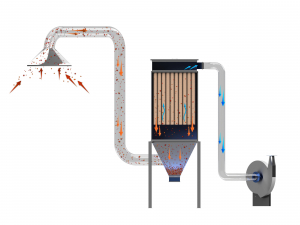
Diagrama que muestra un sistema de colección de polvo completo, desde la tomada del aire sucio, los filtros y el ventilador

Una campana es la interfaz entre el proceso y el sistema de control de polvo. Ubicada al final de un ramal de ductos, su función es capturar el polvo suspendido, humos o material particulado generado por una máquina o proceso industrial y dirigirlo hacia el sistema de ductos.

Su trabajo parece sencillo: capturar el polvo antes de que escape. Sin embargo, en la práctica, el diseño de campanas es uno de los aspectos más incomprendidos de la ventilación industrial.

Las normas de la industria suelen buscar eficiencias de captación superiores al 90%; sin embargo, muchas plantas operan con campanas que apenas capturan un pequeño poecentaje del polvo que generan.

La diferencia normalmente depende de tres factores:

  • ⦿ Diseño de la campana
  • ⦿ Ubicación de la campana
  • ⦿ Manejo del flujo de aire

Leé nuestro artículo: Cómo controlar las fuentes secundarias de polvo

El error más común: intentar capturar el polvo después de que ya escapó

Uno de los problemas que encontramos con mayor frecuencia durante nuestras inspecciones es que la campana está instalada donde resulta más conveniente y no donde realmente se genera el polvo.

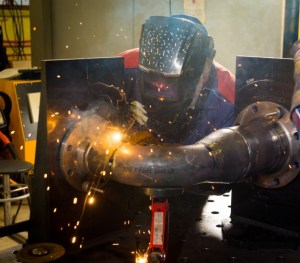
Un ejemplo muy común son las aplicaciones de soldadura. Muchas empresas instalan brazos de extracción con la mejor intención. La campana se coloca cerca de la estación de trabajo, el colector está correctamente dimensionado y, en teoria, todo parece estar bien.

Sin embargo, el soldador se desplaza alrededor de una estructura grande, realiza soldaduras verticales o trabaja en una pieza de seis metros de longitud. Mientras tanto, el brazo de extracción permanece en el mismo lugar y la soldadura ocurre en otra posición. La campana técnicamente sigue funcionando, pero ya no está capturando los humos. Hemos visto casos donde el brazo de extracción quedó colocado detrás del soldador mientras los humos ascendían directamente hacia su zona de respiración.

Hood location
La mejor campana del mundo será ineficaz si no está colocada exactamente donde se genera el contaminante.

Capturar el polvo en la fuente siempre es la mejor estrategia

Cuanto más cerca se encuentre la campana de la fuente donde se genera el polvo, menor será el flujo de aire necesario para lograr una captación eficiente. De acuerdo con las guía de Ventilación Industrial de la ACGIH, el caudal requerido aumenta exponencialmente conforme la campana se aleja de la fuente.

Veamos un ejemplo sencillo:

Una campana de borde recto ubicada a 12 pulgadas de la fuente de polvo puede requerir aproximadamente 1,000 CFM para lograr una velocidad de captación de 100 pies por minuto. Si esa misma campana se acerca solamente seis pulgadas, el flujo requerido disminuye aproximadamente a 260 CFM. La distancia se redujo a la mitad, pero el caudal necesario disminuyó alrededor de un 75 %.

Esta diferencia influye directamente en:

  • ⦿ El tamaño del ventilador.
  • ⦿ El tamaño de los ductos.
  • ⦿ El tamaño del colector de polvo.
  • ⦿ El consumo de energía.
  • ⦿ El costo de instalación.
  • ⦿ El costo de operación a largo plazo.

Mover una campana apenas unos centímetros puede representar un ahorro de miles de dólares en equipos y consumo energético.

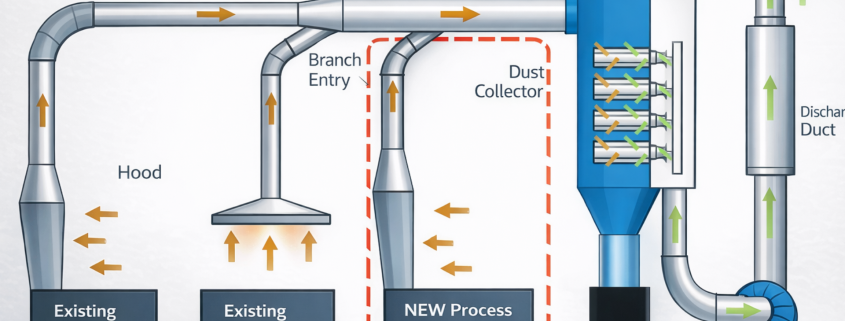
Ductwork diagram new process
Agregar un nuevo ramal al sistema existente puede afectar la succión disponible en todos los puntos de captación.

Comprendiendo los diferentes diseños de campanas

Raw edge hoodCampana de borde recto

La campana de borde recto no es más que un ducto con el extremo abierto. Es económica y fácil de fabricar, razón por la cual es tan común en la industria. Sin embargo, también es el diseño menos eficiente. El aire entra desde todas las direcciones, generando turbulencia y reduciendo la capacidad de captación.

Flanged hoodCampana con brida

Agregar una brida alrededor de la abertura de la campana mejora inmediatamente su desempeño. La brida evita que el aire entre por la parte posterior de la campana y concentra la succión hacia la fuente de generación del polvo. Esta sencilla modificación suele mejorar la captación mientras reduce el flujo de aire necesario.

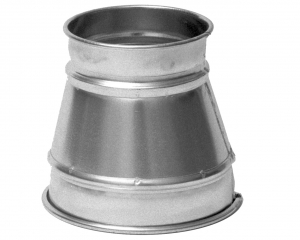
Tapered hoodCampana cónica de transición
Una campana de transición cónica pasa gradualmente de una abertura más grande a la conexión con el ducto. Este cambio gradual permite que el aire fluya de manera más uniforme, reduciendo la turbulencia y las pérdidas de energía. El resultado es un mejor desempeño con menores costos de operación.
Campana cónica

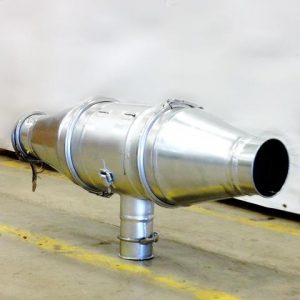
Conical hood

Las campanas cónicas siguen el mismo principio, pero con una geometría de transición aún más uniforme. 

Al reducir la turbulencia también disminuyen las pérdidas de presión, mejorando la eficiencia del flujo de aire.

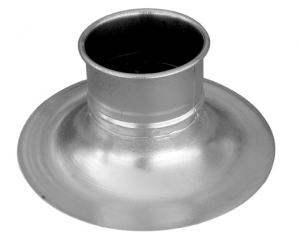
Boca acampanada

Entre las campanas de captación externas, la campana tipo bell-mouth suele considerarse la más eficiente. Su entrada curva y de transición suave minimiza la turbulencia y maximiza la eficiencia del flujo de aire.

Bell mouth hood

Aunque su fabricación tiene un costo mayor, la reducción en el caudal requerido y el menor consumo de energía del ventilador suelen compensar esa inversión a lo largo de la vida útil del sistema.

El diseño de la campana también depende de las características del polvo

Well-designed hoods should minimize turbulence, maintain smooth airflow, and include air locks to prevent blowback into the system.

Las campanas bien diseñadas deben minimizar la turbulencia, mantener un flujo de aire uniforme e incluir compuertas de aire para
evitar el retroceso hacia el sistema.

El tipo de polvo que se va a captar también influye directamente en el diseño de la campana. No todos los materiales se comportan igual. Los humos de soldadura son muy diferentes a las virutas de madera. El polvo de cemento se comporta de manera distinta al polvo de granos. El polvo generado durante el esmerilado de metales no se mueve igual que el polvo del papel.

Basta recorrer distintas plantas de manufactura para darse cuenta de que cada proceso presenta desafíos completamente diferentes.

Aplicaciones en la industria de la madera

Ductwork Case Study MCLB

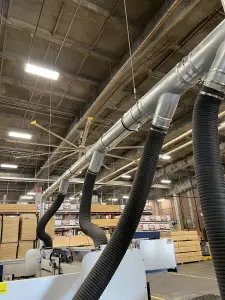
Manguera flexible conectada a maquinaria

En las plantas de carpintería, el polvo suele ir acompañado de virutas y astillas de mayor tamaño que salen despedidas de sierras, routers, cepillos y lijadoras a gran velocidad. Estas partículas no simplemente flotan hasta la campana. Continúan desplazándose en la misma dirección en la que fueron expulsadas.

Esto significa que no basta con colocar una campana cerca del equipo esperando que capture todo el material. Debe ubicarse exactamente donde las partículas salen disparadas. Una campana bien diseñada intercepta la trayectoria de las virutas y del polvo antes de que tengan oportunidad de dispersarse por toda la planta.

Por esta razón, muchos fabricantes de maquinaria incorporan las campanas de captación directamente en el diseño de sus equipos. Ellos conocen exactamente dónde se genera el material y hacia dónde se desplaza.

Aplicaciones de esmerilado

Las operaciones de esmerilado presentan un desafío completamente distinto. Cualquiera que haya trabajado junto a una rueda de esmeril sabe que las chispas y el polvo no ascienden lentamente en el aire. Son proyectados a gran velocidad y, en la mayoría de los casos, siguen una trayectoria bastante predecible alejándose de la rueda.

Hemos encontrado instalaciones que invirtieron en grandes sistemas de control de polvo, pero colocaron la campana del lado equivocado del proceso de esmerilado. Técnicamente existía suficiente flujo de aire, pero las partículas eran lanzadas en dirección opuesta mucho más rápido de lo que la campana podía capturarlas.

Peor aún, una campana mal ubicada puede provocar que las partículas impacten contra ella y reboten nuevamente hacia el área de trabajo, generando problemas tanto de limpieza como de exposición para los trabajadores. Los diseños exitosos de campanas para esmerilado aprovechan la trayectoria natural de las partículas, en lugar de intentar luchar contra ella.

Aplicaciones para el manejo de materiales a granel

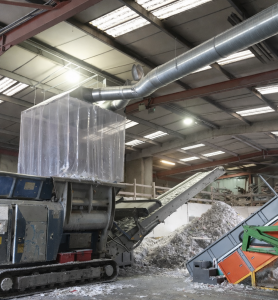
Adding additional PVC curtain strips to the shredder dust extraction capture hood serves two purposes; firstly to help contain any airborne dust particles within this enclosure and secondary to enable manual loading of the shredder hopper.

Agregar tiras adicionales de cortina de PVC a la campana de captación del sistema de extracción de polvo de la trituradora cumple dos propósitos; en primer lugar, ayuda a contener cualquier partícula de polvo en suspensión dentro de este recinto y, en segundo lugar, permite la carga manual de la tolva de la trituradora.

Los sistemas para el manejo de materiales a granel presentan sus propios desafíos. Ya sea que se trate de granos, cemento, minerales, fertilizantes, pellets de plástico u otros materiales secos, los puntos de transferencia son conocidos por generar grandes nubes de polvo. Cada vez que el material cae de una banda transportadora a otra, entra a un elevador de cangilones o se descarga en una tolva, el aire es desplazado y arrastra consigo partículas de polvo.

En este tipo de aplicaciones, colocar simplemente una campana sobre el punto de transferencia rara vez es suficiente. Los diseños más eficientes suelen combinar la campana con cerramientos parciales que contienen la nube de polvo antes de que tenga oportunidad de dispersarse por toda la instalación. Al mantener el polvo confinado en un espacio más reducido, la campana puede capturarlo con mucha mayor eficiencia y utilizando un menor flujo de aire que un diseño completamente abierto.

Este enfoque no solo mejora la eficiencia de captación, sino que también puede reducir la potencia requerida del ventilador y disminuir los costos de operación.

Aplicaciones de soldadura

Welding Dust Collectors

La captación en la fuente cobra una importancia aún mayor cuando se trabaja con humos de soldadura.

A diferencia de las partículas de polvo más pesadas, los humos de soldadura están formados por partículas extremadamente finas que ascienden naturalmente debido al calor generado por el arco de soldadura. Por ello, capturarlos directamente en el punto donde se generan resulta fundamental.

Cuanto más cerca esté ubicada la campana de la soldadura, más fácil será capturar la columna de humos antes de que se disperse por el área de trabajo. De hecho, acercar la campana apenas unos centímetros puede aumentar considerablemente la eficiencia de captación y, al mismo tiempo, reducir el flujo de aire necesario.

Por esta razón, tanto los soldadores con experiencia como los especialistas en sistemas de control de polvo suelen decir que la ubicación de la campana es más importante que el tamaño del ventilador. Una campana correctamente posicionada con un flujo de aire moderado normalmente ofrecerá mejores resultados que una campana mal ubicada conectada a un colector mucho más grande.

ductwork design
El diseño del sistema de ductos desempeña un papel fundamental para mantener un flujo de aire uniforme y sin obstrucciones.

Desbalance del sistema

You might have to readjust the dampers throughout the lifespan of the filters

Con el paso del tiempo, el personal de mantenimiento realiza modificaciones y la distribución del flujo de aire cambia.

Incluso una campana perfectamente diseñada puede dejar de funcionar correctamente si el sistema pierde su balance. Esto ocurre con mucha frecuencia en instalaciones que cuentan con múltiples puntos de captación, siendo las plantas de carpintería uno de los mejores ejemplos.

Un taller puede tener decenas de máquinas conectadas a un mismo sistema de control de polvo. Conforme pasa el tiempo, los operadores abren y cierran las compuertas de cada equipo, el personal realiza ajustes y el flujo de aire deja de distribuirse de manera uniforme. Como resultado, algunas campanas reciben demasiado flujo de aire mientras que otras reciben muy poco, provocando un control de polvo inconsistente en toda la planta.

Una estrategia muy efectiva consiste en utilizar dos juegos de compuertas:

  • ⦿ Una compuerta de balance ubicada cerca de la conexión con el ducto principal, que permanece fija una vez ajustada.
  • ⦿ Una compuerta de operación ubicada junto a la máquina, que el operador utiliza durante el trabajo diario.

De esta manera, los equipos pueden encenderse o apagarse sin alterar el balance general del sistema.

Conclusión

La campana de captación es el primer componente y, probablemente, el más importante de cualquier sistema industrial de control de polvo. Una campana correctamente diseñada captura el polvo directamente en la fuente, permitiendo que todo el sistema opere con mayor eficiencia.

Ya sea que estés diseñando un sistema nuevo o resolviendo problemas en uno existente, evaluar el diseño de la campana siempre debe ser uno de los primeros pasos.

En Baghouse.com, hemos comprobado que algunas de las mejoras más significativas en el desempeño de un sistema de control de polvo no se logran reemplazando colectores ni aumentando el flujo de aire, sino optimizando la forma en que el polvo se captura desde el principio.

Preguntas frecuentes sobre el diseño de campanas

La respuesta es: tan cerca como sea posible, siempre que no interfiera con la operación del proceso. El objetivo es colocar la campana lo suficientemente cerca para capturar el polvo, los humos o los vapores antes de que se dispersen en el área de trabajo, pero sin obstaculizar el funcionamiento del equipo ni las actividades del operador.

No existe una distancia universal que funcione para todas las aplicaciones. La ubicación ideal de una campana depende de las características del polvo, de las condiciones del proceso y de la velocidad de captación que se necesite.

Existen varias formas de evaluar el desempeño de una campana de captación. La más sencilla es mediante la observación:

  • ⦿ ¿El polvo está escapando del proceso?
  • ⦿ ¿Se está acumulando polvo sobre los pisos, los equipos o las estructuras cercanas?
  • ⦿ ¿Los operadores han notado un aumento en la cantidad de polvo suspendido en el aire?

Si la respuesta a alguna de estas preguntas es sí, es posible que la campana no esté recibiendo el flujo de aire suficiente. Para realizar una evaluación más precisa, es recomendable efectuar pruebas de flujo de aire utilizando instrumentos como tubos Pitot, medidores de velocidad del aire o manómetros de presión diferencial. Estas mediciones permiten verificar si la velocidad del aire y el caudal que circulan por los ductos corresponden con los valores para los que fue diseñado el sistema.

Otro indicador importante es la acumulación de polvo dentro de los ductos. Si el polvo comienza a depositarse en los tramos horizontales o en los codos, es probable que la velocidad de transporte sea insuficiente, lo que puede indicar que una o varias campanas no están recibiendo el flujo de aire necesario.

En muchas instalaciones, la combinación de inspecciones visuales periódicas y pruebas de flujo de aire es la forma más confiable de evaluar el desempeño de las campanas de captación.

Sí, pero deben utilizarse con mucho cuidado. En aplicaciones de captación en la fuente, como estaciones de esmerilado o brazos de extracción para soldadura, agregar un ventilador puede generar patrones de flujo de aire que compitan entre sí. En lugar de ayudar a la campana, el ventilador puede terminar alejando el polvo o los humos de la zona de captación.

Sin embargo, en aplicaciones de captación ambiental dentro de áreas amplias, los ventiladores colocados estratégicamente pueden ofrecer excelentes resultados. Muchos sistemas exitosos de captación ambiental de humos de soldadura utilizan una combinación de:

  • ⦿ Ductos de captación instalados a gran altura.
  • ⦿ Ductos de retorno de aire limpio ubicados cerca del piso.
  • ⦿ Ventiladores de recirculación cuidadosamente distribuidos.

Este enfoque favorece una renovación uniforme del aire en toda la nave industrial y mejora la captación de los contaminantes.

Un sistema de ventilación push-pull suministra aire limpio desde un lado de la instalación mientras extrae el aire contaminado por el lado opuesto. Aunque este concepto puede funcionar en determinadas aplicaciones, muchos especialistas en sistemas de control de polvo consideran que suele ser menos efectivo que los sistemas diseñados para lograr una circulación completa del aire dentro de la nave.

En aplicaciones de soldadura y en procesos donde se generan partículas suspendidas en el aire, una de las mejores prácticas consiste en:

  • ⦿ Captar el aire contaminado cerca del techo, donde los humos tienden a ascender de forma natural.
  • ⦿ Regresar el aire filtrado cerca del nivel del piso, donde se encuentran los trabajadores.

Este diseño crea un flujo ascendente continuo de aire en toda la instalación, mejorando la calidad del aire y reduciendo las zonas donde el aire permanece estancado.

En muchos casos, el problema no está en la campana. La causa suele encontrarse en otra parte del sistema de control de polvo, por ejemplo:

  • ⦿ Compuertas de balance mal ajustadas.
  • ⦿ Cambios en el proceso o en la maquinaria.
  • ⦿ Nuevos puntos de captación agregados después de la instalación.
  • ⦿ Ductos dañados.
  • ⦿ Fugas de aire.
  • ⦿ Problemas en el desempeño del ventilador.
  • ⦿ Filtros obstruidos.

Con el paso del tiempo, todos estos factores pueden modificar la distribución del flujo de aire y provocar que el sistema pierda su balance. Una campana que funcionaba perfectamente cuando se instaló puede recibir mucho menos flujo de aire años después simplemente porque otras partes del sistema han cambiado. Por esta razón, realizar periódicamente un balanceo del sistema y verificar el flujo de aire es fundamental para mantener un desempeño óptimo.

Las compuertas de balance (slide gates) son dispositivos ajustables que se instalan dentro del sistema de ductos para regular el flujo de aire.

Se utilizan principalmente para:

  • ⦿ Balancear el flujo de aire entre múltiples puntos de captación.
  • ⦿ Incrementar el flujo de aire hacia los ramales más alejados del sistema.
  • ⦿ Reducir el flujo de aire en los ramales que están recibiendo demasiada succión.

En instalaciones con numerosos puntos de captación, ajustar correctamente las compuertas de balance es fundamental para mantener el sistema funcionando de manera eficiente. Sin estos dispositivos, algunas campanas pueden recibir un exceso de flujo de aire mientras que otras reciben muy poco, lo que se traduce en una captación deficiente del polvo.

En muchos casos, sí. Las plantas de carpintería suelen tener muchas más máquinas que operadores. A medida que las máquinas se encienden y se apagan durante la jornada, las condiciones del flujo de aire cambian constantemente.

Una práctica ampliamente recomendada consiste en utilizar dos compuertas de balance:

Compuerta de balance

  • ⦿ Se instala cerca de la conexión con el ducto principal.
  • ⦿ Se ajusta durante la puesta en marcha del sistema.
  • ⦿ Permanece en esa posición para conservar el balance adecuado del sistema.
Compuerta de operación

  • ⦿ Se instala cerca de la máquina.
  • ⦿ El operador la abre o la cierra según sea necesario durante la operación diaria.
Este enfoque permite que los operadores controlen el flujo de aire de cada máquina sin afectar el balance general del sistema.

En la mayoría de los casos, no. Las campanas de captación, por sí mismas, normalmente no representan una fuente importante de ruido. Sin embargo, una campana con un diseño inadecuado puede producir silbidos, turbulencia o ruido causado por velocidades excesivas del aire. Estos problemas generalmente pueden corregirse modificando la geometría de la campana o reduciendo la velocidad del aire.

La mayoría de los problemas de ruido en un sistema de control de polvo provienen de otros componentes, como:

  • ⦿ Ventiladores.
  • ⦿ Descargas del ventilador.
  • ⦿ Sistemas de retorno de aire.
  • ⦿ Transiciones en el sistema de ductos.

Por lo general, no. Uno de los errores más comunes en los sistemas de control de polvo es intentar solucionar un problema de diseño de la campana simplemente aumentando el flujo de aire. Si una campana está mal ubicada, normalmente seguirá siendo ineficiente, aunque se incremente el caudal.

En algunos casos, aumentar el flujo de aire incluso puede generar nuevos problemas, entre ellos:

  • ⦿ Pérdida de producto.
  • ⦿ Consumo excesivo de energía.
  • ⦿ Desgaste prematuro de los filtros.
  • ⦿ Interferencia con el proceso de producción.
  • ⦿ Mayor nivel de ruido.

Una campana bien diseñada y ubicada correctamente casi siempre ofrecerá un mejor desempeño que un ventilador sobredimensionado conectado a una campana con un diseño deficiente.

Dust Collection Glossary

Industrial dust collection and air filtration involve hundreds of technical terms, acronyms, and engineering concepts that can often be confusing—even for experienced maintenance personnel and engineers.

Understanding the terminology is essential for making informed decisions. This glossary brings together many of the most common filtration and separation terms used throughout the industry.

DUST COLLECTION GLOSSARY

Un

Holes in a dust collector filter bag

Trabajar con un excesivo aire comprimido causará un fallo prematuro de las bolsas, a menudo creando problemas de abrasión o incluso provocando agujeros en el material
ABRASION, FLEX: Fabric wear in a creased area caused by excessive bending, usually associated with cage contact used in baghouse filtration.

ABRASION RESISTANCE: Ability of a fiber or fabric to withstand surface wear.

ABSOLUTE: A degree of filtration that guarantees 100% removal of suspended solids over a specified size found in the filtrate.

ABSOLUTE PRESSURE: The pressure above an absolute vacuum. One atmosphere (14.7 psi) greater than gauge pressure. Symbolized as psia when the pressure is in psi units.

ABSORPTION: The taking in, incorporation or reception of gases, liquids, light or heat. Penetration of one substance into the inner structure of another, using filling the void of the matrix. The process of movement of a drug from the site of application into extracellular compartment of the body.

ACTIVATED CARBON: Charcoal activated by heating to 1472-1652ºF a material of high adsorptive gases, vapors, organics, etc. Has a large internal surface area. Removes dissolved color, odor and taste from liquids or gases. Commonly used in the pharmaceutical industry to remove organic contaminants.

ACTIVATED SLUDGE: Biologically active floc from aeration and settling sewage and/or organic matter.

ADSORPTION: The adhesion of a substance to the surface of a solid or liquid. Adsorption is often used to extract pollutants by causing them to be attached to such adsorbents as activated carbon or silica gel.

AEROBIC BACTERIA: Organisms requiring oxygen to live.

AEROSOL: A dispersion of small liquid or solid particles suspended in air, gas or vapor.

Baghouse variables such as airflow, air-to-cloth ratio, etc need to be considered when designing the system.AIR FLOW: Measure of the amount of air that flows through a filter, a variable of the degree of contamination, differential pressure, total porosity and filter area. Commonly expressed in either cubic feet/minute/square foot or liters/minute/square centimeter at a given pressure.

AIR STANDARD: Dry air at 70 degrees F and 29.92” mercury pressure.

.

The air-to-cloth ratio, describes how much dirty gas passes through a given surface area of filter.

La relación aire-tela describe cuánto
aire sucios pasan a través de una determinada
superficie del filtro.

AIR-TO-CLOTH (A/C) RATIO: The ratio of gas volume (acfm) to effective cloth area (sq. ft.). In SI units A/C = m3/m2.

AI PREDICTIVE MAINTENANCE: The use of artificial intelligence to analyze equipment data and predict maintenance needs before failures occur, improving reliability and reducing unplanned downtime.

AMBIENT: Refers to common environmental conditions in which experiment is conducted.

AFFLUENT: Fluid entering the filter or filter system. Commonly described as influent, it is the opposite of effluent.

AGGLOMERATION, PARTICLE Multiple particles joining or clustering together by surface tension to form large particles, usually held by moisture, static charge or particle architecture.

ALKALINITY: The capacity of water to neutralize acids, a property imparted by the water’s content of carbonates, bicarbonates, hydroxides and occasionally borates, silicates and phosphates. It is expressed in milligrams per liter of equivalent calcium carbonate.

ANAEROBIC: Organism capable of growing without the presence of oxygen.

ANGSTROM: A unit of length 1010 meter used to express wave lengths. Used in measurements of RO filtration in the ionic range.

ANTISTATIC: A condition inherent in or applied to a material usually fabric or plastic, which results in a significant reduction in or the absence of electrical charges. (an electrical resistivity of ~10-10ohm/square or higher.

AQUEOUS: Similar to or resembling water. Referring to solution made in water.

ARIZONA ROAD DUST: Standardized test dusts for both liquid and air classified from natural Arizona dust generally referred to an A.C. Fine and A.C. Course Dust. Both dust materials also carry an ISO designation and have a standardized size distribution of particles.

ASHRAE: American Society of Heating, Refrigerating, and Air Conditioning Engineers.

ASYMMETRIC MEMBRANE: A membrane in which the pore size and structure are not the same from one side of the membrane to the other. These membranes are usually considered directional because of difference in flow characteristics depending on which side of the membrane faces the feed stream.

ASME: American Society of Mechanical Engineers. Published code, which governs the design of pressure housings.

Differential pressure controller for dust collector

A controller allows for smart cleaning cycles based on the differential pressure (Clean-On-Demand)

ASSAY: Analytical procedure to determine purity or concentration of a specific substance in a mixture.

AUGMENTATION: In fabric air filtration, the imposition of an electrical field to the collecting surface and.or subjecting the incoming particulate matter to a charging process.

AUTOCLAVE: A chamber for sterilizing with saturated steam filters or equipment by using constant high temperature and pressure.

AUTOMATIC PULSE CONTROLLER: An electronic controller that operates pulse valves to clean filter bags or cartridges automatically, helping maintain proper differential pressure while reducing compressed air consumption.

B

BACKPRESSURE: A backward surge of pressure from downstream to upstream of the filter. Can be the result of closing a valve or air entrapped in a liquid system.

Baghouse top load pulse jet

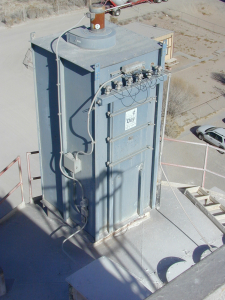
Baghouse collector

BACKWASH: Reversal of a fluid flow through the filtration media to remove solids from the filter. To clean or regenerate a filter.

BACTERIAL CHALLENGE: Testing the bacterial retention of a filter.

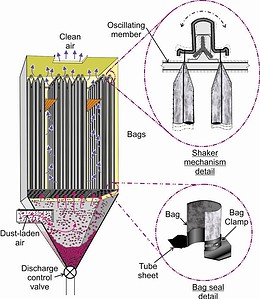
BAGHOUSE: An air filtration structure utilizing fabric filter bags for the purpose of removing solid particulate from the gas stream.

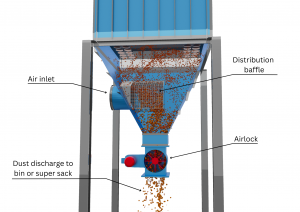
Graphic showing the air inlet to the baghouse, the distribution baffle, the dust bin or super sack and the rotary airlock.

Baffle plate in the inlet of the dirty air

BAFFLE PLATE: A metal plate installed inside a dust collector to redirect airflow, reduce abrasion, and distribute dust evenly across the filter media.

BAG LEAK DETECTOR: An instrument that monitors particulate emissions from a dust collector and detects leaking or damaged filters before emissions become excessive.

BAG LIFE: Time a bag filter performs effectively.

BAR: Unit of pressure. 1 bar = 14.5 psi.

BARREN LIQUOR: Liquor for cake washing, which contains little to no valuable liquor; as barren cyanide solution in gold cake slimes washing.

BASKET: Element of a basket strainer. Normally uses a screen as a medium for removal of course bulk solids.

BELT FILTER PRESS: Akin to a rotary drum and belt filter is an automatic pressure filter, where sludge is compressed on an endless rotating belt, dewatering and providing for very dry cake for discharge.

BETA RATIO: Measurement of filter retention efficiency. Ratio of particles exposed to a filter, as a feed stream to the particles down stream (filtrate).

BIAXIALLY STRETCHED MEMBRANE: A microporous membrane from either polypropylene or PTFE that has been stretched in both the MD and CD direction in a manner to form pores of a controlled size and possessing a narrow pore size distribution.

Bin vent pulse jet baghouse silo

Bin vent

BIN VENT: A compact dust collector designed to filter air displaced from silos, storage bins, weigh hoppers, and other enclosed vessels during material loading. The bin vent captures the dust from this outgoing air while allowing clean air to escape, keeping product inside the vessel and preventing dust emissions. 

BIOBURDEN: The load or level of microorganisms in a substance to be filtered.

BIOHAZARD: Biological refuse, possibly pathogenic in nature.

BIOSAFETY: Biological safety or non-toxicity of a substance to a living organism. For filters used in health care applications.

BIPOLAR: Have two (opposing) poles, (+) and (-) as applied to ionic charges or particles.

BROWNIAN MOTION: The continuous zigzag motion of suspended minuscule particles. The motion is caused by impact of the molecules in the fluid upon the particles.

BLAST GATE: A manually or automatically operated damper used to regulate or shut off airflow through a branch of a dust collection duct system.

BLOW PIPE: A pipe located above the filter bags in a pulse-jet baghouse that distributes compressed air from the pulse valves during filter cleaning.

BLINDING: Blockage by dust, fume or liquid not being discharged by the cleaning mechanism, results in a reduced gas or liquid flow of increased pressure drop across the filter media.

BLOWDOWN: The use of pressure to remove liquids and/or solids from a vessel.

BREAKTHROUGH: Used to describe the passing of solids through the cake build up of a filter medium. Also called breakpoint.

BRIDGING: Material or particulate blockage across an opening, often of a pore or filter medium.

BUBBLE POINT PRESSURE: A test to determine the maximum pore size openings of a filter. The differential gas pressure in which a wetting liquid (e.g. water) is pushed out of the largest pores and a steady stream of gas bubbles are emitted from a wetted filter under specific test conditions. A filter integrity test with specified, validated pressure values for specific pore-size and type filters.

BURST PRESSURE: The pressure causing rupture. The inside-out differential pressure that causes outward pressure on the structural of a filter medium, filter or housing.

BULK DENSITY: The weight of a material per unit volume, including the spaces between particles, commonly used when designing hoppers and conveying equipment.

C

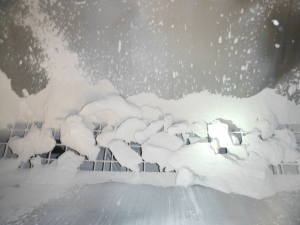
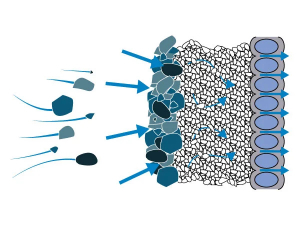
The small white particles in this image represent the dust cake, a layer of fine dust that helps intercept the new incoming dust and makes it easier to be cleaned and reused again

Las pequeñas partículas blancas en esta imagen representan la torta de polvo, una capa de polvo fino que ayuda a interceptar el nuevo polvo entrante y hace que sea más fácil limpiarlo y reutilizarlo nuevamente.

CAKE (FILTER): Solids deposited on the filter media. In many cases the cake may serve as its own filter medium.

CAKE RELEASE: Ability of a medium to allow clean separation of the cake from the medium.

CALENDERING: A manufacturing process where woven and/or nonwoven fabrics are pressed between heavy rollers compressing the fibers. The process reduces the filter medium void volume, pore size rating, flow-rate and dirt-hold capacity of the medium.

CANDLE FILTER: A reusable filter consisting of a tube made from ceramics or metal. Flow is from the outside-in with particulate accumulating on the outside of the candle. The candle can be cleaned by various means, including back-pulsing, heat, chemicals etc.

CAN VELOCITY: The upward air velocity inside the dust collector housing below the filters. Excessive can velocity can re-entrain dust and reduce collection efficiency.

CAPTURE HOOD: A hood or enclosure positioned near a dust source to capture airborne particles before they escape into the workplace.

CAPTURE VELOCITY: The minimum air velocity required at a dust source to effectively capture and transport airborne dust into the collection system.

CAPACITY: Volume of product which a housing will accommodate expressed in gallons or similar units. Also, amount which will filter at a given efficiency and flow rate, expressed in gallons per minute or similar units.

CAPSULES: Disposable devices which have an integrated filter and housing, including inlet and outlet.

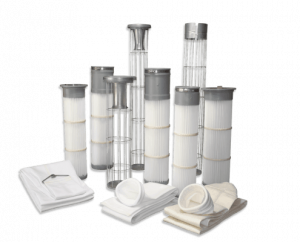
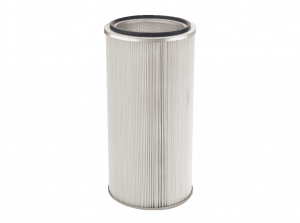
Cartridges-for-Dust-Collection-Systems

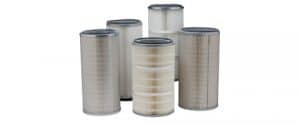
Cartridge filter

CARTRIDGE: Filter devise and medium used in a housing to perform the function of coalescing, filtration or separating. Also referred to as an element.

CATHODE: Negative pole or electrode of an electrolytic system.

CAUSTIC: A class or name given to a class or group of chemicals, usually soda or sodium hydroxide.

CD: Refers to the “cross-machine” manufacturing direction of filtration roll stock.

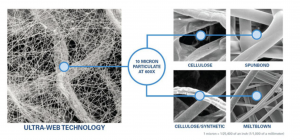
Magnification of fine fiber layer filtration media compared to cellulose, spun-bond, cellulose/synthetic, and meltblown fibers

Magnification of fine fiber layer filtration media compared to cellulose, spun-bond, cellulose/synthetic, and meltblown fibers

CELLULOSE: (1) fibers used to manufacturer wetlaid paper (2) used as a filter aid in highly refined alpha cellulose form or as the slightly more unbleached form.

CENTER CORE or TUBE: Material formed into a cylinder shape for structural purposes to permit a cartridge to retain its original physical form.

CENTER PIPE or ROD: Component of a housing which is used as a mount for cartridges, typically through the center core.

CENTRIFUGATION: Separating two substances of differing densities by high speed spinning to create centrifugal force. Generally used to separate suspended particles from liquid.

CERAMIC COATING: A chemically bonded protective coating that forms a durable ceramic barrier, providing long-term resistance to corrosion, abrasion, chemicals, and high temperatures.

CLEAN AIR PLENUM: The chamber of a dust collector located above the filters where cleaned air collects before leaving the unit.

CLEAN-ON-DEMAND: A filter cleaning method that activates pulse cleaning only when differential pressure reaches a predetermined set point.

COMPRESSED AIR HEADER: The main pipe that supplies compressed air to the pulse valves in a pulse-jet dust collection system.

CHROMATOGRAPHY: Separation of substances in a mixture based on their affinity for certain solvents and solid surfaces.

CLARIFICATION: Clearing a liquid by filtration, by the addition of agents to precipitate solids, or by other means.

CLARIFIER: An apparatus for the removal of settleable solids from a fluid by gravity.

CHARGE POLARITY: A particle, fiber or other material carrying an electrostatic charge.

CLARIFIER: A processing unit using flocculation processes to separate solids from liquid often in a non-turbulent zone where heavy solids settle out of solution. Often used for wastewater.

CLARITY: Amount of contaminate left in a filtered liquid.

CLASS 100 ENVIRONMENT: A room environment maintained by air conditioning and filtration so that fewer than 100 particles of size 1 μm or larger are found in a cubic foot of air.

CLASSIFICATION: Condition in which larger particle settle out below the finer ones. Also referred to as stratification. May also be referred to as the action to sort out particles by various groups or to other established criteria.

CLEANABILITY: The ability of a filter element to withstand repeated cleanings, while maintaining adequate dirt capacity.

CLEAN PRESSURE DROP: Differential pressure (drop) across measured in pounds per square inch at rated flow on new elements with clean product.

COAGULATION: In water and wastewater treatment, the destabilization and initial aggregation of colloidal and finely divided suspended matter by the addition of a floc-forming chemical or by biological processes.

COALESCER: Mechanical device which unites discrete droplets of one phase prior to being separated from a second phase. Can only be accomplished when both phases are immiscible.

COALESCING: Action of uniting small droplets of one liquid preparatory to its being separated from another liquid.

COATING: Immersion of filter media in a solution to provide the fibers with a coating that will lubricate and thereby reduce self-abrasion.

COLD STERILIZATION: Removal of all bacteria by filtration through a sterilizing grade 0.2μm absolute filter.

COLLAPSE PRESSURE: The outside-in differential pressure that causes the structure of a filter medium failure of a filter element.

COLLECTION EFFICIENCY: Percentage of contaminate collected.

COLLOID: Very small, insoluble non-diffusible solid or liquid gelatinous particles that remain suspension in a surrounding liquid. Solids usually on the order of 0.2 μm or less.

COMPATIBILITY: Relation to the non-reactivity of filter materials with a substance to be filtered.

COMPRESSABILITY: Degree of physical change in filter cake particles when subjected to normal pressures.

COMPRESSION BAND: Stainless steel band sewn into the end of a bag to provide a surface to clamp against in the baghouse.

CONCENTRATOR: Removes some of the water from a sample to concentrate substances dissolved or suspended in it; usually used to concentrate solutions of biological macromolecules, (proteins & nucleic acids).

CONTAMINATE: Unwanted foreign matter in a fluid which is accumulated from various sources such as systems dirt, residue from moving parts, atmospheric solids.

CONTINUOUS PHASE: Basic product flowing through a filter or filter separator, which continues on through the system after being subjected to solids and/or other liquid separation.

CORE: Commonly refers to a perforated tube, which serves as the center of a filter cartridge (element).

CORE YARN: Used in filtration with fiberglass or synthetic yarn. Spun or texturized yarns are twisted around a filament (core) yarn, adding yarn strength and stability.

CRITICAL OPERATING PRESSURE: Pressure above which filtration or separation equipment may produce reduced efficiency or fails to function properly.

CROSSFLOW (TANGENTIAL FLOW) FILTRATION: A filtration system in which the feed stream flows across the filter media and exits as a retentate stream. The retentate stream is recycled to merge into the feed stream, while a portion of it passes through the filter media, resulting in concentration of the feed stream.

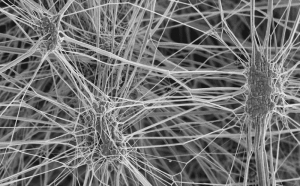
A good cyclone can pull out 80–90% of large aggregate dust before it ever hits the bags.

Un buen ciclón puede remover entre el 80 % y el 90 % de las partículas grandes antes de que lleguen a los filtros.

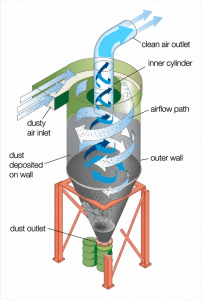
CYCLONE: A conical-shaped vessel for separating mixed sized particulates from the gas stream. The vessel has a tangential entry at the largest diameter allowing the larger particles to drop out and be removed from the bottom of the cone while smaller particulate exits overhead with the majority of the gas stream.

D

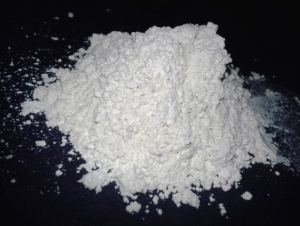
Diatomaceous Earth: Known for its fine particle capture and moisture-absorbing properties.

Diatomaceous Earth: Known for its fine particle capture and moisture-absorbing properties.

DE: Diatomaceous earth. A filter aid from diatomite’s.

DALTON: Measure of molecular mass.

DI WATER: De-ionized water; water processed through an ion exchange process by passing through a mixed resin bed to remove positive and negative ions. The purity of water is measured by its electric resistance.

DEAD END FILTRATION: Feed stream flows in one direction only, perpendicular to and through the filter medium to emerge as product or filtrate.

DEFLAGRATION ISOLATION: A method of preventing a fireball or pressure wave from traveling through ductwork during a combustible dust explosion.

DIFFERENTIAL PRESSURE CONTROLLER: A controller that automatically adjusts filter cleaning based on differential pressure to optimize dust collector performance.

In dilute-phase conveying, materials are suspended in a high-velocity airstream.

Dilute phase conveying system

DILUTE PHASE CONVEYING: A pneumatic conveying method in which material is transported while suspended in a high-velocity stream of air.

DIRTY AIR PLENUM: The section of a dust collector where contaminated process air enters before passing through the filter media.

DUST COLLECTION AUDIT: A comprehensive evaluation of a dust collection system to identify opportunities for improving airflow, filtration efficiency, maintenance practices, and overall performance.

DEHYDRATION: Removal of water or hydrocarbon in vapor from an air or gas; also water fro0m another immiscible liquid. Differs from entrainment removal in that the dew point of a gas stream will be lowered by vapor removal. A form of purification.

DENIER: The weight in grams of 9,000 meters of a fiber.

DENSITY: Mass/unit volume, usually expressed in g/cc, lb./cu. ft or lb./gal.

● Depth filtration captures dust particles within the filter. Many common household water filters work in this way as do HEPA filters and other kinds of panel air filters. These filters are incredibly effective at capturing the smallest of particles. However, once they become filled with dust they become clogged and cannot be cleaned.

Left: Depth-loaded filters. Smaller particles enter deep into media restricting air passages. Eventually filters have to be replaced. Right: This is an example of a proper “dust cake” which aids in the filtration process and prevents smaller particles from entering into the media.

DEPTH FILTRATION: A process that entraps contaminants both within the matrix and on the surface of the filter media.

DESALINATION: Production of fresh (potable) water from sea water, salt or brackish water by one of several processes, e.g. distillation, flash distillation, electrodialysis or reverse osmosis if salt content is not too huge.

DEWATERING: A physical process that removes sufficient water from sludge so that its physical form is changed from essentially that of a fluid to that of a slurry or damp solid.

DESICCANT: Drying agent or medium used in dehydration of air or gas or liquids. Examples: silica gel, activated alumina, molecular sieve etc.

DIALYSIS: The diffusion of solute molecules through a semi-permeable membrane.

DIATOMACEOUS EARTH FILTRATION (D.E.): A filtration method that uses a medium consisting of microscopic shells of single celled plants known as diatoms.

DIATOMITE: Skeletal remains of tiny aquatic plants that lived in the ocean and inland seas millions of years ago.

magnehelic gauge

Un manómetro (magnehelic o photohelic) mide la presión diferencial.

DIFFERENTIAL PRESSURE – Delta (Δ) P: The change in pressure or the pressure drop across a component or device located within the air stream; the difference between static pressure measured at the inlet and outlet of a component device.

DIFFUSION: In liquid cake washing, removing the original liquor around the individual particles by mixing with the wash liquor. In air, the particle at a size within one or two orders of magnitude of the gas-flow molecules, moves in Brownian motion and collides with a fiber or other filter media material during its random path of travel.

DIFFUSION TEST: A test to determine the integrity of a filter. The test is based upon the transition from diffusional flow to bulk flow of a gas, though a wetted filter.

DIFFUSIONAL INTERCEPTION: In gas filtration, at low gas flow velocities, tiny particles are subject to Brownian motion, enabling them to move out of the gas streamlines and become intercepted by the filter.

DIFFUSIONAL FLOW TEST: To determine the integrity of a filter. The test is based on the measurement of the diffusional flow of a gas through a wetted filter. Either the gas or the downstream liquid, displaced by the gas, may be measured. The transition from diffusional flow to bulk flow (bubble point) can be determined.

DIGESTED SLUDGE: Sludge or thickened mixture of water with sewage solids in which the organic matter has been decomposed by anaerobic bacteria.

DIRECT INTERCEPTION: Gas filtration: particles larger than the pores are removed by direct contact with the filter surface. Some particles smaller than pores can be removed as well depending on the proportion to their size hitting the surface.

DIRT (HOLDING) CAPACITY: Amount of dirt or debris retained by a filter in grams per unit area of the filter medium.

DISCONTINUOUS PHASE: Separated phase or product from the continuous phase. Example: water maybe the discontinuous phase when separated from hydrocarbon, air or gas.

DISPERSION: Operation which results in solid or liquid particles entering into suspension in a fluid. Also applies to a two phase system in which one phase, known as the disperse phase, is distributed throughout the other, known as the continuous phase.

DISPOSABLE FILTERS: Those filters not cleaned or reused. Referred to as one-time or single-use filters.

DISOLVED SOLIDS: Any solid material that will dissolve in a liquid that such as sugar in water.

DISTILLATION: Process of vaporizing a liquid and collecting the vapor, which is then usually condensed into a liquid.

DMF: Drug Master File. A written document that explains the formulation of an active ingredient, referenced in an Investigational New Drug (IND), New Drug Application (NDA), or Amendment to New Drug Application (ANDA) from a company.

DOP: Dioctyl phthalate, a plasticizer that can be aerosolized to particles of extremely uniform size. Retention of DOP aerosol is used as standard procedure for pore size rating of air filters. Typically, 99.97% DOP retention indicates HEPA efficiency.

DOWNSTREAM SIDE OF FILTER: The filtrate or product stream side of the filter. Fluid and/or solids that have passed through the filter.

DRY HEAT STERILIZATION: Sterilization at or above 356ºF using a convection or forced air oven without moisture; may concurrently de-pyrogenate if adequate time and elevated temperature are employed.

DRY SCRUBBER: A chemical reaction chamber that neutralizes acids in a gas stream. Two system types: the spray dryer system injects a slurry, whereas dry sorbent injection systems use a dry powder.

DUCT SIZE: El tamaño del ducto se refiere al cálculo del diámetro adecuado para los ductos del sistema, según la cantidad de aire (medida en CFM) que debe transportarse y a qué velocidad (medida en pies por minuto, o FPM). El objetivo es seleccionar un tamaño de ducto que permita un transporte adecuado del polvo sin pérdida excesiva de velocidad por fricción ni que el polvo se asiente en la parte inferior del ducto.

DUPLEX FILTER: Assembly of two filters with a valve for selection of either or both filters.

DUROMTER (SHORE): Measure of hardness. Must be defined as being either A or D scale.

DUST COLLECTION: A term usually associated with an assembly of large pleated elements that collect air-borne particles where large volumes of air flow is found e.g. granaries, cement factories, abrasive production and other manufacturing facilities.

DUST HAZARD ANALYSIS (DHA): A systematic evaluation used to identify and assess the fire, flash-fire, and explosion hazards associated with combustible dust in an industrial facility. Required by NFPA 660 (and previously NFPA 652), a DHA examines processes, equipment, dust collection systems, ignition sources, housekeeping practices, and existing protection measures to determine where combustible dust hazards exist and what controls are needed to reduce risk. 

DYNE: The amount of force that cause a mass of one gram to alter its speed by one centimeter per second for each second during which the force acts.

E

E. coli: Escherichia coli is the most prevalent bacterium in the gastrointestinal tract of humans and animals. It occurs in solids and water as a result of fecal contamination.

END CAP: The end of many types of filter cartridges.

ETO STERILIZATION: Chemical sterilization using ethylene oxide at an elevated temperature of 1500 º F and high relative humidity to facilitate permeation of the ethylene oxide into the material being sterilized.

EFFECTIVE FILTRATION AREA: The portion of filter that fluid flows through during the filtration process.

EFFICIENCY: Degree to which a filter device will perform in removing solids and/or liquids.

EFFLUENT: The fluid which has passed through a filter (filtrate or product stream); outflow from other treatment such as wastewater treatment plants.

ELECTRETS: A dielectric body in which a state of electric polarization is established. An imposed electric field on heated polyolefin following the drawing stage to form a charged fiber or yarn with electrostatic like properties. These properties may decay or by contamination by solvents and materials.

ELECTROCHEMICAL: A process by which electricity is used to effect chemical reaction. The inter-conversion of chemical and electrical energy.

ELECRODIALYSIS: Dialysis (small molecules separated from larger molecules in the same solution/mixture) accelerated by an electromotive force applied to electrodes adjacent to the separating membranes.

ELECTROLYTE: Substances which will conduct an electrical current, either in molten state or in a solution e.g. NaCl in water.

ELECTROPHORESIS: The separation of charged molecules (such as proteins) based on their mobility in an electrical field.

ELECTROSTATICS: Electrical charges on particles and/or fibers in a filter medium create attractive and/or repulsive forces between particles and the fiber/medium. As a direct result, for many types of particles, strong attractive forces produce the intimacy needed to agglomerate even the fines.

ELECTROSTATIC PRECIPITATOR: A type of particulate filtration control that attracts charged particles to oppositely charged surfaces to collect airborne particulates. The particles are charged by ionizing the air with an electric field. The charged particles are then collected by a strong electric field generated between oppositely-charged electrodes.

ELEMENT: Typically a filter, such as a cartridge, pleated or non-pleated.

EMISSION MONITOR: An instrument that continuously measures particulate emissions from a dust collector to verify filter performance and regulatory compliance.

EXPLOSION ISOLATION VALVE: A safety device that automatically prevents an explosion from propagating through connected ductwork.

EXPLOSION SUPPRESSION: A protection system that detects an explosion in its early stages and rapidly discharges suppressant chemicals to extinguish it.

EXPLOSION VENT PANEL: A specially designed panel that opens during an explosion to safely relieve pressure and protect equipment from structural damage.

END CAPS: Components adhered to a filter element with adhesive or other means to contain the filter medium in a form designed for the element.

END POINT: Final objective or, in petroleum distillation, temperature at which the distillation ceases.

ENDOTOXIN: A toxic substance produced by bacteria, but which is released into the surrounding medium only upon the death or disintegration of the bacteria.

ENTRAINED WATER: Discrete water droplets carried by a continuous liquid or gas phase when water is immiscible with the liquid.

epa_logoEPA: Environment Protection Agency regulates environmental monitoring. Establishes and enforces guidelines.

EXTRACTABLES: Chemicals leached from a filter during a filtration process; usually tested for by soaking in water under controlled conditions; may be removed by pre-flushing with suitable liquid.

F

FAN VIBRATION MONITORING: The use of vibration sensors to detect imbalance, bearing wear, or mechanical problems in industrial fans before failures occur.

FERMENTATION: Enzymatically controlled breakdown of an energy rich compound as a sugar to produce ethyl alcohol, carbon dioxide, and energy, by the action of yeasts which carry the necessary enzymes. Bacterial fermentations also occur.

FEED: Materials to be filtered. Also referred to as concentrate, influent, intake, liquor, mud, prefilt, pulp, slime or sludge.

FIBER: Any particle with length greater than or equal to 0.5 micron and at least five times greater than its diameter, leaving substantially parallel sides.

FIBER METAL FELT: A nonwoven media consisting of extremely fine metal fibers (2-20 micron in diameter) which are compressed and sintered. Used to filter molten polymers in the manufacture of fibers and films and hydraulic fluids for use in aerospace filters.

FIBER MIGRATION: Downstream migration of fibers from a filter medium.

FILL: Yarns that run in the filling or cross-machine direction of a woven fabric.

Baghouse.com filter bags and pleated filtersJAULAS (Noun): A specialized piece of equipment for carrying out filtration, consisting of the filter medium and suitable holder for constraining and supporting the filter in the fluid path.

JAULAS: (Verb) Passing a fluid containing particles through a filter medium wherein particles are removed the fluid.

FILTER AID: Small size particle substance of low specific gravity which remains in suspension when mixed with a liquid to be filtered. Increases filtration efficiency of a feed when deposited on a septum by forming a porous cake.

FILTER CAKE: The accumulation of particulate or solids on a surface. Can also mean a pre-coat for filtering.

FILTER CLOTH AREA: Filter cloth area is the total surface area of all the filter bags in a baghouse. This area determines how much air the system can clean and how effectively it can remove dust. It can also help us calculate the amount of leak testing powder and precoat powder do we need.

FILTER EFFICIENCY: A measurement of how well a filter retains particles. The percentage retention of particles of a specific size by a filter.

FILTER LIFE: Measure of a filter’s useful service life based on the amount of standard contaminate required to cause differential pressure to increase to an unacceptable level, typically 2-4 times it initial differential pressure or 50-80% drop in initial flow or the downstream measure of unacceptable particulate.

FILTER MEDIA MIGRATION: Problem caused by a filter medium constructed of a non-continuous or fibrous matrix. Portions of the filter change structure causing fibers to migrate downstream.

FILTER MEDIUM: Permeable material that removes particles from fluid being filtered.

FILTER PAPER: A permeable web of randomly oriented fibers, generally cellulose or glass fiber formed from water draining from a suspension fed in a paper making process. Also, a presentation at a filtration conference.

FILTER PRESS: Mechanical process where wet solids are compressed between two or multiple surfaces in the same equipment forcing water out of the solids, simultaneously compacting and drying the cake.

FILTER BLINDING: The permanent plugging of a filter’s pores by fine dust, restricting airflow and reducing cleaning effectiveness.

FILTER RECEIVER: A dust collector used in pneumatic conveying systems to separate conveyed material from the conveying air.

FLAMELESS EXPLOSION VENT: A pressure relief device that safely vents an explosion while containing flames and hot gases within the unit.

FILTRATE: The end product of the filtration process. The liquid exiting the filtrate outlet.

FILTRATION: Removal of particles from a fluid by passing the fluid through a permeable material.

FILTRATION RATE: The volume of liquid that passes through a given area of filter in a specific time.

FINES: Portion of a powder like material composed of particles smaller then the size specified.

FLOW DECAY: Decrease in flow rate caused by filter plugging or clogging.

FLOCCULATION: Growing together of minute size particles to form larger ones, called floc’s.

FLOW DECAY TEST: Determines flow rate and throughput of a filter type or combination of filters on a specific liquid, usually by using small area filters, to determine the sizing of a filter system.

FLOW FATIGUE RESISTANCE: The ability of a filter element to resist structural failure of the filter medium due to flexing caused by cyclic differential pressure.

FLOW RATE: The speed at which a liquid flows and is measured in gallons or liters per minute. Flow rate of a liquid can be affected by the liquids’ viscosity, differential pressure, temperature and type of filter used. Measuring air diffusion.

FLOW RESISTANCE: Resistance offered by a filter medium to fluid flow.

FLUE GAS DESULFERIZATION: The operation of removing sulfur oxides from exhaust gas streams of a boiler or industrial process. Usually a wet scrubber operation.

FLUID: Includes liquids, air or gas as a general term.

FLUX: Measure of the amount of fluid that flows through a filter, a variable of time, the degree of contamination, differential pressure, total porosity, viscosity and filter area.

FLY ASH: The air borne combustion residue from burning coal or other fuels.

FORWARD FLOW TEST: An integrity test measuring air diffusion at a low pressure (approximately 5 psi). Similar to a pressure hold test.

FRAZIER PERMEOMETER: Porosity testing device. The normal measurement is air flow in CFM passed through one square foot of fabric at 0.5 inch differential water pressure.

FULLERS EARTH: Medium used in some elements, usually a blend of attapulgus and montmorillonite clay. A finely divided hydrous aluminum silicate. Often a filter aid.

G

GAS STREAM: The flow of air or process gas carrying dust particles through a dust collection system.

Air Compressor Gauge in a Pulse Jet Dust Collector

Air Compressor Gauge in a Pulse Jet Dust Collector

GAUGE PRESSURE: Pressure measured by a pressure gauge. Pressure above ambient pressure when the pressure is used in psi units.

GELATINOUS: Used to describe suspended solids that are slimy and deformable, causing rapid filter plugging.

GMP’s: Good Manufacturing Practices. Food and Drug Administration regulations governing the manufacture of drugs. Sometimes referred to as CGMP’s.

GRADIENT DENSITY: A stratified cross-section. Used to describe a filter medium where larger pores are at the upstream side of the medium with finer pores downstream. The configuration increases dirt-holding capacity and improved filter life. The medium may be inverted when a surface filter effect is desired resulting in lower differential pressure across the medium than if the medium has a single density throughout..

GRAVITY FILTER: Filter in which the driving force for filtration is provided solely by the head of liquor above the filter medium.

GRAVITY SEPARATION: Separation of immiscible phases resulting from a difference in specific gravity by coalescing.

GURLEY TEST: Measure of time required to expel 100 cc’s of air though a filter medium placed within an apparatus that can be fitted with a selection of office sizes and weights. Historically used for paper products and more recently for microporous membranes. (ASTM: D-726).

H

HVAC FILTERS: Air filters used in heating and air conditioning locales.

HEAVY METAL: Metallic elements having a high density (> 5g/cm5 ), toxic for the most part.

Different stages of a HEPA after filter

HEPA after-filter serves as a powerful ally when searching for cleaner indoor air quality, particularly in industrial settings

HEPA: An air filter or medium, which captures 99.97% when challenged with DOP 0.3 micron particles under certain laboratory controlled conditions.

HIMA: Health Industry Manufacturer’s Association defines and sets standards governing the validation of filters for sterilizing liquids. . . a trade association, whose membership includes pharmaceutical manufacturers and filter manufacturers.

HOLDING CAPACITY: See Dirt Holding Capacity above.


Well-designed hoods should minimize turbulence, maintain smooth airflow, and include air locks to prevent blowback into the system.

Las campanas bien diseñadas deben minimizar la turbulencia, mantener un flujo de aire uniforme e incluir compuertas de aire para
evitar el retroceso hacia el sistema.

HOOD: A hood is the interface between the process and the dust collection system. Located at the end of a branch duct, the hood captures airborne dust, fumes, smoke, or particulate generated by a machine or industrial process and directs it into the ductwork system.

HOUSING: A metal or plastic tank or tube with an inlet and outlet containing a filter (s), allowing for the flow of a fluid and contaminate through the filter, while containing the process.

HYDROPHILIC: Water accepting or wetting.

HYDROPHOBIC: A membrane or other material which repels and cannot be wetted by aqueous and other high surface tension fluids. When pre-wetted with low surface tension fluid, such as alcohol, the filter will then wet with water.

HYDROMETER: An instrument used to measure the density of a liquid.

I

IMMISCIBLE: Incapable of being mixed; insoluble.

INERTIAL IMPACTION: Gas filtration: Retention mechanism. Inertial Collection. As the gas stream lines bed in the vicinity of the filter, the carried particles continue in a straight line due to their inertia and impact the filter. Effective primarily for particles about 0.3μm and larger, at high gas velocities and low filter porosity.

IMPERMEABLE: Material that does not permit fluids to pass through.

IMPINGEMENT: Process of removing liquid or solid contaminate from a stream of compressed air or gas by causing the flow to impinge on a baffle plate at high velocity.

INDUSTRIAL INTERNET OF THINGS (IIOT): A network of connected sensors and devices that collect real-time operating data to improve monitoring, maintenance, and system performance.

INTERSTITIAL VELOCITY: The upward air velocity between adjacent filter bags or cartridges that influences dust re-entrainment and filter cleaning performance.

INFLUENT: Fluid entering the filter.

IN-LINE FILTER: A filter assembly in which the inlet, outlet & filter element are in line.

INERT: Chemical inactivity; unable to move; totally un-reactive.

INTERIAL IMPACTION: The particle, due to its inertia and usually in stream-line flow, deviates out off the air/gas stream striking a fiber or other material of a filter medium.

INLET PRESSURE: Pressure entering the inlet side of the filter. Also called upstream pressure or line pressure.

INORGANIC MATTER: Chemical substances of mineral origin, not containing carbon to carbon bonding. Generally structured through ionic bonding.

IN-SITU Sterilization or integrity testing of a filter in the system rather than as an ancillary operation such as in autoclave or bubble point stand.

INTEGRITY TEST: Used to predict the functional performance of a filter. The valid use of this test requires that it be correlated to standardized bacterial or particle retention test. Examples: Bubble Point Test, Diffusion Test, Forward Flow Test, Pressure Hold Test.

INTERFACIAL TENSION: Measure of miscibility or solubility of the continuous and discontinuous phases. Increases as miscibility or solubility decreases.

INTERSTICES: Spaces or openings in a filtration medium. Also referred to as pores or voids.

Interstitial velocity is the vertical gas velocity once the flow is at the bottom of the filter bags.

Interstitial velocity is the vertical gas velocity once the flow is at the bottom of the filter bags.

INTERSTITAL: Pertaining to the openings in a filtration medium.

IN-VITRO: In isolation from living organisms in an experimental artificial environment e.g. cells in tissue culture; experiments carried out in test tubes.

IN-VIVO: Within the living organism.

ION(S): An atom or group of atoms that carries a positive or negative electrical charge as a result of having lost or gained one or more of the electrons.

ION EXCHANGE COLUMNS: Vessels filled with ion exchange resin (anion, cation, or mixed) for producing conditioned or DI Water. Also, type of column used for Ion Exchange Chromatography.

ISOTROPIC (SYMMETRIC) MEMBRANE: Membrane in which the pore openings are the same diameter throughout the thickness and on both sides of the membrane. Non-directional, their flow characteristics are independent of which side faces the feed stream.

K

K or k, the symbol for kilo (1,000). Kilogram (kg = 1,000g). Kilometer (km = 1,000m). In computers, 1K = 1024 bits of information. 64K memory = 65,536 bits.

KNIFE EDGE SEAL: Narrow, pointed ridge on the sealing surface of an end cap, center seal or cartridges adaptor which provides a seal by biting into the cartridge gasket.

KST VALUE: A measurement of the explosibility of combustible dust based on the maximum rate of pressure rise during a dust explosion.

L

L-TYPE FILTER: Cartridge filter in which the inlet and outlet port axis are at right angles and the filter elements axis is parallel to either port axis.

LAMINAR FLOW: Term synonymous with streamline flow and viscous flow. A flow regime which the flow characteristics are governed mainly by the viscosity of the fluid.

LEAF: Any flat filter element that has or supports the filter septum.

LEAF FILTER: A filter housing and device consisting of a plurality of leaves, often place in a vertical position.

LEAK TEST: A procedure used to identify leaking filters, tube sheet defects, or sealing problems within a dust collector.

LINE PRESSURE: Inlet pressure, upstream pressure. The pressure in the supply line.

LIQUOR: Material to be filtered. Also referred to as concentrate, feed influent, intake mud, prefilt, slime or sludge.

LIVE STEAM STERILIZATION: Sterilization by flowing saturated steam through a vented vessel or system, usually at 257ºF and 20 psi (Can be performed up to 284ºF and 35 psi.).

LOADED: A filter element that has collected a sufficient quantity of insoluble contaminates such that it can no longer pass rated flow without excessive differential pressure.

LOCK UP: Device that will lock either a column, elements or the body of a housing in place.

LOG REDUCTION VALUE: The logarithm to the base of 10 of the ratio of organisms in the feed to the organisms in the filtrate. Example: Log 1o [10 9/101.7] = 7.3. Also used as a ratio of in/out bioburden in other sterilization methods such as autoclaving.

LOW INTERFACIAL TENSION: Where the interfacial tension of one liquid over the other liquid would be less than 25 dynes/cm at 70 degrees F.

LOX CLEANING: Process of cleaning for liquid oxygen service.

LVM: Low volatile material.

M

MANOMETER: A U-shaped tube filled with a specific liquid. The difference in height between the liquid in each leg of the tube gives directly the difference in pressure on each leg of the tube. Used to monitor differential pressure.

MARTIN’S DIAMETER: Statistical diameter used in particle size analysis; the mean length of the line, parallel to the microscope traverse, diving each particle into two equal diameters.

MASS DISTRIBUTION: Relative frequency distribution of mass within a particle size distribution. Sometimes presented as cumulative percentage undersize.

MASS TRANSFER RATE: Measurement of the movement of matter as a function of atoms etc.

MD: Refers to the “machine-direction” when manufacturing filtration roll stock.

MEAN EFFICIENCY RATING: The measurement of the average efficiency of a filter medium using the Multi-Pass Test where the average filtration (BETA) ration equals 2.0.

MEAN FLOW PORE MEASUREMENT: It is calculated as the diameter of the pore of a membrane partially voided of liquid such that air flow of the partially wetted membrane is equal to 1/2 the dry air flow. (Theoretical diameter of the mean pore).

MEDIA: Material through which fluid passes in the process of filtration and retains particles. Also, nutrients containing solutions in which cells or microorganisms are grown.

MEDIA MIGRATION: Migration of materials making up the filter medium may cause contamination of the filtrate.

MEDIUM: Principle component of a filter element. Material of controlled or uncontrolled pore size or mass through which a fluid stream is passed to remove foreign particles held in suspension or to repel droplets in the case of coalesced water.

MELTBLOWN: A nonwoven manufacturing process for filtration media, where a molten polymer is extruded out of an orifice with high-velocity air to create fine fibers. The fibers can create roll stock or be spray-spun onto porous tubes to create a finished filter.

MEMBRANE: Media through which a liquid is passed; usually associated with an extremely fine or tight type of filtration. Highly engineered thin polymeric film containing a narrow distribution of pores. Used as the separation mechanism in R/O, Electrodialysis (ED), Ultrafiltration (UF), Nanofiltration (NF) & Microfiltration (MF).

PTFE Membrane Baghouse Filters

PTFE Membrane in Baghouse Filters

MEMBRANE FILTER: Continuous matrix with fine pores of defined size or a film allowing for the diffusion of a fluid through its structure; sometimes referred to as a dense film in the case where no pores are present.

MERV (Minimum Efficiency Reporting Values) Rating: A system for rating air filters according to their average particle size efficiency on a scale from 1-16 with 16 being the highest capture efficiency for average particles in the 0.3 to 1.0 micron range. The rating is derived from a test method developed by the American Society of Heating, Refrigerating, and Air Conditioning Engineers (ASHRAE).

MIST COLLECTOR: An air filtration system designed to remove oil mist, coolant mist, smoke, and other liquid aerosols generated during industrial processes.

What is a MERV Rating on Dust Collection?

MESH: A term referring to a woven filtration medium, typically wire cloth or monofilament woven fabric.

MESH COUNT: Number of openings or fractions of openings in a lineal inch of wire cloth or monofilament woven fabric.

MICRON (μm): The common unit of measurement in the filtration industry is the micron or micrometer. One micron equals forty millionths of an inch (0.00004) or expressed differently 25.4 microns equals 0.001 inch.

MICRON RATING: The smallest size of particles a filter can remove.

MICROFILTRATION (MF): Used for clarification, sterilization, to detect or analyze bacteria and other organisms and particulate matter. Separation of particles ranging from 0.1μm to 10μm.

MICROMETER (m): Micron, 1/1,000,000 of a meter. 60gm is approximately the diameter of a human hair.

MICROPOROUS MEMBRANE: Thin polymeric films (e.g. 0.001 to 0.005” thick) often with millions or pores per square inch, aligned as a torturous path, allowing for the passage of a fluid to remove solids. Often used for sterilizing filtration and other fine filtration purposes. Considered a surface filter medium.

MIGRATION: Contaminate released downstream of a filter.

MIL: One thousandth of an inch.

MINIMUM BUBBLE POINT PRESSURE: It is a diffusional flow pressure just before the onset of bulk flow. Minimum critical bubble point pressure: a filter specification derived from diffusional flow, bubble point curves for many filters.

MISCIBLE: Capable of being dissolved. Opposite of immiscible.

MIXED CELLULOSE ESTERS: Synthetic materials derived from naturally occurring cellulose. Materials used in the manufacture of membrane filters. Mixed cellulose esters membranes are used in a wide variety of applications, such as bacteria concentration in water analysis and air sampling.

MOLARITY: The term used to indicate the concentration of dissolved substance in a given solution. The measurement is in moles of dissolved substance per liter of solution.

MOLECULAR WEIGHT: Sum of the atomic weights of all atoms in a molecule. Also, Mole or Mol weight.

MOLECULAR SIEVE: Zeolite, natural or synthetic or similar materials where atoms are arranged in a crystal lattice in such as way that there are a large number of small cavities interconnected by smaller openings or pores of precise uniform size. Used as a drying agent or for absorptive applications.

MONOFILAMENT: Single, large continuous filament of a synthetic yarn. Similar to fishing line in cross-section.

MONOFILAMENT WOVEN FABRIC: Woven fabric from monofilament yarns used as a screen or surface filter. Often used in sifting, belting, medical filters etc. Most common yarns are from polyester, polypropylene and nylon.

MUD: Material to be filtered.

MULLENS BURST TEST: A formal measurement where test specimen (filtration medium) sees a force, which cause it to burst.

MULTIFILAMENT: A number of unbroken continuous fiber stands that run parallel to form a yarn. Typically used to manufacture a woven or knit fabric.

MULTI-PASS: A test system designed to be representative of a typical hydraulic or lubricating circuit. Fresh contaminate is introduced in slurry form into a test reservoir, mixed with the fluid in the reservoir and pumped through the test filter; contaminate not captured by the filter is returned to the reservoir for another pass (or more) though the filter.

N

NEEDLEFELT: A nonwoven fabric where staple fibers are entangled together through a manufacturing process using barbed needles, providing for a heavy weight filter fabric, which can filter air-borne particles for use in baghouses and suspended particles in liquids from lighter weight needlefelt fabrics for use liquid bag filtration.

Standard for Combustible Dusts and Particulate Solids (2025)

NFPA 660: Normativas para polvos combustibles y partículas sólidas (2024)

NFPA (NATIONAL FIRE PROTECTION ASSOCIATION): A nonprofit organization that develops consensus codes and standards aimed at reducing the risk of fire, electrical hazards, and other safety-related incidents. In the dust collection industry, NFPA publishes standards that address the prevention and mitigation of combustible dust fires and explosions, including NFPA 660: Standard for Combustible Dusts. While NFPA standards are not laws by themselves, they are widely adopted by regulatory agencies, insurance providers, and local jurisdictions, making them an important reference for designing, operating, and maintaining safe dust collection systems.

NFR: Non-fiber releasing. A filter or medium, which will not release fibers into the filtrate.

NIOSH: Develops basic methodology for analytical test procedures. National Institute of Occupational Safety and Health.

NO RETURN VALVE (NRV): An explosion isolation device that automatically closes during an explosion to prevent flames and pressure from traveling upstream.

NOMEX®: An aramid filter media commonly used in high-temperature dust collection applications such as dryers, kilns, and asphalt plants.

NOMIMAL: An arbitrary term used to describe the degree of filtration and generally not comparable or interchangeable between products or manufacturers. A user should always ask for a copy the test procedure used and results from the manufacturer’s lab notebook to understand each rating.

NOMINAL FILTRATION RATING: An arbitrary micrometer value indicated by the filter manufacturer. The same ratings from two manufacturers are often different and rarely can be compared.

NONPOLAR: Compound or element that’s electron capacity is satisfied. A neutral condition that will remain un-reactive. Not polar. See Polar.

NONWOVEN: A filter fabric that is formed of natural or synthetic fibers that are randomly oriented in filtration media. Typically, held together with a binder or fibers are entangled.

NYLON: When used as a membrane it is hydrophilic. A thermoplastic, polymeric material that has high mechanical strength & compatibility with different chemicals.

O

OPACITY MONITOR: An instrument that measures the amount of light blocked by exhaust emissions to indicate particulate concentration.

OPEN AREA: Pore area of a filter medium, often expressed as a percentage of the total area.

OSHA (OCCUPATIONAL SAFETY AND HELATH ADMINISTRATION): Is the U.S. federal agency responsible for ensuring safe and healthy working conditions by establishing and enforcing workplace safety standards. OSHA regulates many aspects of industrial dust collection, including employee exposure to airborne contaminants, machine safety, and combustible dust hazards. Facilities are responsible for identifying workplace hazards, implementing appropriate engineering controls, and maintaining dust collection systems that help protect workers and comply with applicable OSHA requirements.

OSMOSIS: Diffusion of a liquid through a semi-permeable membrane from a dilute solution into a more concentrated solution, thus tending to equalize the concentration of each side of the membrane.

OUTLET PRESSURE: Downstream pressure. Pressure exiting the outlet side of the filter.

OVERCLEANING: Excessive filter cleaning that wastes compressed air, reduces dust cake formation, and shortens filter life.

OXIDIZER: A substance that supplies oxygen or otherwise promotes combustion, increasing the likelihood or severity of a fire or explosion.

P

PACKED BED: Discrete particles such as sand, gravel, anthracite, fabricated rings or saddles, assembled in a confined space as a filtration medium for liquids and gases.

PAPER: Filter medium used on filter elements. A general term applied to resin bonded cellulose.

PARALLEL FILTRATION: Branching a filtration setup. Two assemblies of the same pore size are in parallel, to increase flow rate or simplify filter changes.

PARTICLE: Unit of material structure; a mass having observable length, width, thickness, size and shape.

PARTICLE COUNT: Practice of counting particles of solid matter in groups based on relative size contained in a certain area.

PARTICLE SIZE DISTRIBUTION: The size range and quantity of particles which are measurable in a dry or liquid sample. Used to determine the appropriate filter media for a specific process.

PARTICULATE: Any solid or liquid material in the atmosphere.

what is particulate matter?

PARTICULATE UNLOADING: The process whereby a filter, particularly, a depth filter, can become blocked with particulate matter and subsequently release part of this matter downstream.

PERISTALTIC PUMP: A pump functioning by alternate pinching and release of tubing which drives the fluid forward in a pulsing action. The pump is noninvasive. Only the inner wall of the tubing contacts the fluid.

PERLITE: Material similar to volcanic glass with a concentrated shell structure. Used as a filter aid.

PERMEABILITY: A measure of fabric porosity or openness, expressed in cubic feet of air per minute per square foot of fabric at a 0.5” water column pressure differential in air or by specified conditions for liquid.

PERMEABLE: Material that has openings through which a liquid or gas will pass in filtering.

PERMEATE: The fluid which passes through a membrane, a term usually used with ultrafiltration or R/O.

pH: Measure of a substance’s acidity or alkalinity from 1-14 with 7 being neutral. Measure of hydrogen ion concentration.

PHASE: May be continuous, as the basic product flowing through a housing or discontinuous as the material to be removed from the basic product. Both are distinct and separate.

PHENOLIC RESIN: Synthetic thermosetting resins obtained by the concentration of phenol and substituted phenols with aldehydes. Used as a binder in cellulose and glass fibers for form filter media.

PLASTISOL: Suspension of a thermosetting plastic which can be molded into a desired shape. Used as a combination end cap and gasket on an element.

PLEAT SUPPORT/SPACERS: Used to prevent the collapse of pleats in a pleated paper or membrane cartridge when under the action of differential pressure.

PLEATER: Automated equipment that folds a filter medium roll stock vertically for subsequent incorporation into a filter element. Provides for greater media surface area in a limited space. There are many types of pleaters, including pusher bar, rotary, etc.

Pleated-Dust-Collector-Filter-Cartridge

Los filtros plisados

PLEATED FILTER: High-efficiency filter elements made from pleated filter media that provide significantly more filtration surface area than traditional filter bags of a similar size. By increasing filter area, pleated filters can reduce the air-to-cloth ratio, improve dust release, lower differential pressure, and extend filter life. They are particularly effective in applications with light to moderate dust loading and are often used to increase the capacity of an existing dust collection system without replacing the collector itself.

PLUGGING: Filtered out particles filling the openings (pores) in a medium to the extent of shutting down the flow of a fluid. Also referred to as blinding or blocking.

POINT-OF-USE FILTERS: Filters located immediately prior to where a clean effluent is required in a process.

POLAR: Compound or element capable of receiving or giving electrons. See Non-Polar.

POLYELECTROLYTE: Synthetic, water-soluble, linear polymers characterized by the presence of ionizing groups distributed along a molecular length. Used to promote flocculation.

POLYPROPYLENE: A thermoplastic polymeric material, resistant to a broad range of chemicals. When used as a membrane, polypropylene is hydrophobic.

POLYSULFONE: Has excellent flow rates, high mechanical strength, resistant to a broad range of temperatures, can be sterilized and is hydrophilic. Commonly used membrane material, but is not resistant to many organic solvents.

PORE: Opening in a medium. Also referred to as interstices. Size and shape of the openings are controlled by the manufacturer of the filter medium.

PORE SIZE: Diameter of pore in a filter medium.

PORE SIZE-ABSOLUTE RATING: The rated pore size of a filter. Particles equal or larger than the rated pore size are retained with 100% efficiency.

PORE SIZE-NOMINAL RATING: The pore size at which a particle of defined size will be retained with efficiency below 100% (typically 90-98%). Rating methods vary widely between manufacturers.

PORE SIZE DISTRIBUTION: Exclusive to permeable medium: describes the number of pores in various groups of sizes in a way similar to that discussed under particle size distribution.

POROSITY: The percent of open areas per unit volume of a medium whether it be a filter cake or roll stock, such as a paper, membrane, woven textile or nonwoven fabric.

POROUS METAL: Finely ground chards of sintered metal, which serve as a filter medium. Often used in high-pressure and/or temperature applications.

POROUS PLASTIC: Filter media made from finely ground plastic powder. When filled into a mold and heated, the points of powder contact to fuse, while allowing the spaces between the particles to remain open for fluid flow.

POTABLE: Drinkable (water).

PNEUMATIC CONVEYING: The transport of powders or bulk materials through enclosed piping using positive or negative air pressure.

POSITIVE PRESSURE SYSTEM: A dust collection system in which the fan is located upstream of the collector, pushing air through the equipment.

PREDICTIVE MAINTENANCE: A maintenance strategy that uses equipment condition data to identify developing problems before failures occur.

PULSE VALVE: A valve that releases a short burst of compressed air into the blow pipe to clean filter bags or cartridges.

PPM: Parts per million. A unit of concentration.

Precoat powder bag Baghouse.com

El polvo precapa se vende en bolsas de 50 libras (22,7 kilos)

PRECOAT: A deposit of material (usually inert), such as a filter aid on a septum prior to beginning filtration.

PREFILT: Material to be filtered. Also referred to as concentrate, feed, influent, intake, liquor, mud, pulp slime or sludge.

PREFILTER: Filter for removing gross size contaminate before the product stream enters a finer rated filter.

PRESSURE, ABSOLUTE: Gauge pressure plus 14.7 psi.

PRESSURE, PROOF: A test pressure above normal operating pressure to assure that the part will withstand the norm without damage or leakage.

PRESSURE DIFFERENTIAL: Difference in pressure between two points.

PRESSURE DROP (ΔP): Difference in pressure between two points.

PRESSURE DROP, CLEAN: Differential pressure (drop) across a housing measured in psi at rated flow on new elements with clean product.

PRETREATMENT: Changing the properties of a liquid-solid mixture by physical or chemical means to improve its filterability.

PRIMARY SLUDGE: That portion of the raw wastewater solids contained in the raw plant influent, which is directly captured and removed in the primary sedimentation process.

PRODUCT: Continuous phase, either liquid or gas, which is being process through filtration or separation equipment.

PROTEIN BINDING: Adsorption of a protein to a surface such as a cellulose nitrate or nylon membrane due to various types of interactions between protein molecules and the surface.

PSEUDOMONAS DIMINUTA: Bacteria used in sterility testing. One of the smallest bacteria, 0.3μm in diameter, used to challenge a sterilizing grade filter during validation testing.

PSI: Pounds per square inch.

PSIA: Pounds per square inch absolute.

The microporous ePTFE structure shown here allows gases and vapors to pass while blocking liquids and particles.

The microporous ePTFE structure shown here allows gases and vapors to pass while blocking liquids and particles.

PSID: Pounds per square inch differential.

PSIG: Pounds per square inch Gauge.

PULSING BACKFLOW: Intermittent, on-off blowing with or without cake discharge.

PTFE: Highly durable and resistant to range of temperatures and chemicals. PTFE is hydrophobic. Polytetrafluoroethylene is better known as Teflon.

Graphic showing compressed air dislodging the dust cake from the filters

Durante la limpieza por pulsos en un colector tipo Pulse Jet, un flujo inverso de aire comprimido limpio empuja hacia afuera una fila de bolsas, desprendiendo la capa de polvo acumulada en su superficie. Los filtros reaccionan al impacto inicial del aire comprimido, seguido de una expansión en forma de burbuja que se desplaza a lo largo de la bolsa o manga.

PULSE-JET BAGHOUSE: A baghouse using short intermittent bursts of compressed air to clean dust/particulate from filter bags that are supported by cages.

PYROGEN: Any substance that produces a fever. Pyrogens are lipoplysaccharides which are a by-product of the metabolism of certain bacteria.

Q

QUISCENT: State of rest of a body. In entrainment separation, the body would be a liquid. Also used to describe a sump containing evacuated liquids or solids.

R

RATED FLOW: Normal operating flow rate at which a product is passed through a housing; flow rate which a housing and medium are designed to accommodate.

RAW SLUDGE: Untreated sewage sludge.

REAGENT: Solution or substance used in analytical testing purposes or procedures.

RECOVERY: Ability of a filter to recover bacteria (or other defined particles) from a solution.

REENTRAINMENT: Process of rendering particles airborne again after they have been once deposited from an air stream.

RED MUD: Filter cake in sodium aluminate filtration.

REMOTE MONITORING: The ability to view and analyze dust collection system performance, alarms, and sensor data from a remote location.

REVERSE AIR COLLECTOR: A baghouse that cleans filter bags by reversing airflow through the filters, allowing accumulated dust to fall into the hopper.

ROTARY AIRLOCK: A rotating valve installed beneath a dust collector hopper that continuously discharges collected dust while maintaining an air seal.

RETENTION: Ability of a filter to retain particles suspended in a gas or liquid. A percentage of particles originally present.

REGENRATED CELLULOSE: Those rayon’s in which the cellulose raw material is changed physically, but not chemically. Viscose, cuprammonium and nitrocellulose rayon’s are of this type.

REPACK: Cylindrical element used in a single-stage filter separator for removal of one liquid and course solids from another liquid. May be used as a single element, a combination of wafers, or a cluster type. Medium may be excelsior, glass fiber or steel wool; or a combination of glass fibers and metal mesh.

RESIDUE: Solids deposited upon the filter medium during filtration in sufficient thickness to be removed in sizeable pieces. Sometimes referred to as a cake or discharge solids.

RESIDUAL DIRT CAPACITY: The dirt capacity remaining in a service loaded filter element after use, but before cleaning, measured under the same conditions as the dirt capacity of a new filter element.

RETENTION: Ability of a filter medium to retain particles of a given size.

REUSABLE FILTERS: Filters that are washed or cleaned of contaminate, either in-situ or off-line, for additional uses.

REVERSE OSMOSIS (RO): A water treatment method whereby water is forced through a semi-permeable membrane which filters out impurities, such as salt (NaCl) from seawater.

REYNOLDS NUMBER: Any of several dimensionless quantities, of form LVp/N in theory of fluid motion.

ROTARY DRUM: Continuous liquid filter equipment consisting of a large rotating drum covered with a filter cloth and cake, which collects incoming particulate from a contaminated bath or flow. A washing and/or discharge device (scrapper) ultimately cleans the contaminate from the cake as the drum rotates.

S

SAND FILTER: Filter composed of layers of sand, graded in particle size, so that the courser particles face the unfiltered flow.

SAYBOLT SECONDS UNIVERSAL: Units of viscosity as measured by observing the time in seconds required for 60 ml. of a fluid to drain through a tubular orifice 0.483 inches long by 0.0695 inches in diameter at stated conditions of temperature and pressure.

SCAVENGER: A filter or element in the bottom of a filter that recovers the liquid heel that remains in a filter tank at the end of a cycle.

SCREEN: Often a flat filter from wire cloth mesh or monofilament fabric filter used to classify particles of a certain size to “to screen out particles”. Can also cover an element for protection; also used as a basic material for a separator element of basket in a basket strainer.

SCREW BASE: Element base which is threaded to mount by screwing the cartridge onto the cartridge adaptor.

SCRIM: An open weave textile or nonwoven fabric used as a strengthening member incorporated within the matrix of a filtration medium to provide increased tensile or tear properties.

SCRUBBER: Any device in which a contaminant, solid or gaseous, is removed from a gas stream by impacting it with liquid droplets.

SEDIMENTATION: Action of settling of suspended solids.

SEEDING: The application of a relatively course dust, dry dust to an air filter bag before filtration startup to provide an initial filter cake for immediate high efficiency and to protect the bag from blinding.

SELF-CLEANING: Filtering device designed to clean itself by the use of a blowdown or backwash action.

SEPARATION: Action of separating solids or liquids from themselves (e.g. by size, viscosity, density, charge etc,) or liquids or gases from fluids.

SEPTUM: Any permeable material that physically supports the filter media, usually for filter aids.

SERIAL FILTRATION: Filtration through two or more filters of decreasing pore size, one after the other, to increase throughput, filtration efficiency, or to protect the final filter.

SERVICE LIFE: Length of time an element operates before reaching an unacceptable benchmark e.g. maximum allowable pressure drop.

Figure-117-Typical-design-of-a-mechanical-shaker-dust-collector

Shaker Baghouse

SHAKER BAGHOUSE: A baghouse using flexible bags applying a cleaning action accomplished by shaking the bags from the top.

SHELL: Outer wall of a housing. Also referred to as the body of a housing.

SIEVE: A screen filter with straight-though capillary pores and identical dimension.

SILICA DUST: Fine particles of crystalline silica generated during cutting, grinding, crushing, or handling materials such as concrete, stone, and sand.

SILO VENT FILTER: A compact dust collector installed on a silo or storage vessel to filter displaced air during material loading while retaining product inside.

SPARK TRAP: A device installed in ductwork that cools or separates sparks and hot embers before they reach the dust collector.

STATIC PRESSURE: The resistance to airflow within a dust collection system caused by filters, ductwork, hoods, and other system components.

SHIFTING: A separation process which separates solid particles by size, through rapid movement of a screen medium, such as a vibrating action. Used in flour, wheat, abrasive, sugar and aggregate sizing.

SILICIAGEL: regenerated adsorbent, consisting of amorphous silica. Used as a drying agent or dehumidifying agent for gases, liquids or oils.

SILTING INDEX: Measurement of the tendency of a fluid to cause silting in close tolerance devices as a result of fine particles and gelatinous materials being suspended in the fluid; measured by a silting index apparatus.

SINGLE-PASS: This test system is designed to be representative of a typical filter circuit. Fresh contaminates are introduced in a slurry form into the test reservoir, mixed with the fluid and pumped through the test filter. The test is run in such a manner to produce one pass of all fluid and contaminate.

SINTERING: A process of heating materials (e.g. metal or ceramic) to elevated temperature causing mating surfaces to fuse as one.

SIZE DISTRIBUTION: Proportion of particles of each size (by mass, number or volume) in a powder or suspension.

SLIMES: Slurry of fine particles; materials to be filtered. Also referred to as concentrate, feed influent, intake, liquor, mud, prefilt, pulp or sludge.

SLUDGE: A thickened slurry. Municipal sewage is often dewatered to produce a concentrate for disposal. Also, residues and deposits occasionally formed by oils, after extended use.

SLURRY: Thin, watery suspension; a material to be filtered or dewatered.

SOLIDS: Mass or matter contained in a stream, considered an undesirable discontinuous phase and should be removed.

SOLUTE: Liquid which has passed through a filter. Also referred to as discharge liquor, effluent, filtrate, mother liquor or strong liquor.

SOLUTION: Single phase combination of liquid and non-liquid substances of two or more liquids.

SOP: A written document that explains how to complete a specific production-orient-ed task. Standard Operating Procedure.

SPARGING: Steam, compressed air, or gas is forced into a liquid through perforations or nozzles in a pipe as part of fermentation.

SPECIFIC GRAVITY: Ratio of weight of a volume of a substance to the weight of an equal volume of another substance typically compared to water with a specific gravity (Sp.G.) of 1.0.

SPECTROPHOTOMETER: Laboratory instrument which measures the wave length and intensity of a light emitted by most chemical agents. When a sample is atomized and burned, the presence of most elements may be determined by their spectra (wave length) emission down to the parts per million range.

SPIN-ON-FILTER: Cartridge filter in which the filter body and the filter element have been constructed and an integral disposable item. Filter change is rapid by spinning off the used unit from a fixed filter head and rapidly adding on the replacement unit.

Spunbond Polyester

Spunbond Polyester Cartridge Filter

SPUNBOND: A nonwoven fabric formed by producing, laying and self-bonding a web of filament material in one continuous set of processing steps. Usually made of polyester or polyolefin’s.

SS: Abbreviation for stainless steel.

SPUN YARN: A continuous yarn for weaving of textiles consisting of staple fibers.

STACKED DISC FILTER: A filter housing and device consisting of a plurality of leaves place in a horizontal position. Used widely in food and beverage filtration.

STAPLE FIBER: A short length of natural or synthetic fiber typically from 1-4 inches in length, used to manufacture yarns for weaving and various types of nonwoven fabrics, such as needlefelt, airlaid and hydroentangled for use in filtration media.

STERILIZING FILTER: A non-fiber releasing filter which produces an effluent in which no microorganisms are present. Typically microporous membranes at or below 0.2 micron pore size rating have this capability.

STOKE’S DIAMETER: Diameter of a sphere having the same density and the same free falling speed as a particle when moving in a homogeneous fluid of the same density and viscosity, under conditions of laminar flow.

STOKE’S LAW: A physical law, which approximates the viscosity of a particle falling under the action of gravity through a fluid. Friction drag controls the rate of fall at a constant velocity known as the terminal or free-setting velocity.

STRATIFICATION: Condition in which the larger particles settle out below the finer ones. Also referred to as classification.

STREAM: Term sometimes used and synonymous with the words product, liquid, air, gas, fluid etc. in speaking of any matter processed by filtration or separation equipment.

STRING WOUND: An inexpensive filter consisting of textile roving (yarn) wrapped around a center core to form a filter medium and filter cartridge (element).

STRONG LIQUOR: Liquid which has passed though the filter. Also referred to as discharge liquid, effluent, filtrate, mother liquor or solute.

SUBSTRATE: Substance or basic material as a filter media or to which a deposit is added.

SULPA (Super ULPA): An air filter or medium, which captures 99.9999% when challenged with DOP 0.3 micron particles under certain laboratory control conditions.

SUMP: Collecting area of a housing located downstream typically from a coalescer element, in which coalesced droplets of the dispersed phase are deposited; also called water leg. May also be used to collect solids in applications where gross solids are present in a stream; also called mud sump.

SUPERNATANT: Liquid above settled solids.

SURFACE ENERGY: Molecular reaction; the breaking away of ion particles from a mass.

SURFACE FILTER: Filter medium that retains particles wholly on the surface and not in the depth of the cross-section of a filter medium e.g. plain weave wire cloth and monofilament woven fabrics or membrane.

● Depth filtration captures dust particles within the filter. Many common household water filters work in this way as do HEPA filters and other kinds of panel air filters. These filters are incredibly effective at capturing the smallest of particles. However, once they become filled with dust they become clogged and cannot be cleaned.

Left: Depth-loaded filters. Smaller particles enter deep into media restricting air passages. Eventually filters have to be replaced. Right: This is an example of a proper “dust cake” which aids in the filtration process and prevents smaller particles from entering into the media.

SURFACE FILTRATION: A process that traps contaminants larger than the pore size on the top surface of the filter, usually a membrane, wire cloth or monofilament fabric. Contaminants smaller than the specified pore size may pass through the medium or may be captured within the medium by some other mechanism, such as surface affinity, triboelectric potential or other means, which prevents particle penetration.

SURFACE TENSION: Tendency of the surface of a liquid to contract to the smallest area possible under existing circumstances.

SURFACTANT: A soluble compound that reduces the surface tension of a liquid, or reduces interfacial tension between two liquids or between a liquid and a solid.

SURGE: Peak system pressure measured as a function of restricting or blocking fluid flow.

SUSPENDED SOLIDS: Solids that do not dissolve in liquid; those that remain suspended and can be removed by filtration.

SUSPENSION: Any liquid containing un-dissolved solids.

SWING BOLT: Type of housing head closure which reduces service time. Opposite of thru-blot flange where studs are used, such as with ASA type flanges.

T

TANGENTIAL (CROSSFLOW) FILTRATION: See Crossflow (Tangential) Filtration.

TARE: A deduction of weight, allowing for the weight of a container or medium; the initial weight of a filter.

TENSILE STRENGTH: Resistance to breaking. The amount of force required to break a membrane by stretching.

TENSIOMETER: Device used to read the surface tension of a liquid or to reading the interfacial tension between two immiscible liquids.

TERMINAL PRESSURE: Pressure drop across the unit at the time system is shut down or when the maximum allowable pressure drop is reached.

TERMINAL VELOCITY: Steady velocity achieved by a falling particle when gravitational forces are balanced by viscous forces.

THREE-STAGE FILTER SEPARATORS: Liquid prefilter coalescer separators containing three kinds or types of replaceable elements.

THROUGHPUT: The amount of solution which will pass through a filter prior to plugging.

TIPPING PAN FILTER: Process industry equipment which collects particulate from a liquid stream on a screen over a vacuum forming a dewatered cake and discharging the accumulation by tipping the collection screens.

TORTUOUS PATH: Crooked, twisting or winding path which tends to trap or stop solid particles, commonly referenced in relationship to the flow pattern and makeup of a filter medium.

TRAMP OIL: Free oil contained in emulsion type machine tool coolants. May be from machine leakage and from breakdown of the emulsifying agents in the cutting oil.

TRIBOELECTRIC SERIES (POTENTIAL/CHARGE): An inherent natural or induced positive or negative polarity charge that many materials possess. Fibers or a filtration medium with a triboelectric potential will capture charged and potentially neutral particles, assuming both positive and negative properties on the surface of the material. Triboelectric properties only work in air filtration assuming relative humidity below 90 %.

TRIBOELECTRICITY: The charge of electricity that is generated by friction such as rubbing.

Triboelectric leak detector

Con dispositivos como medidores de opacidad o sistemas de detección de fugas triboeléctricos, las plantas pueden medir emisiones con una precisión extrema.

TRIBOELECTRIC BAG DETECTOR: A triboelectric bag detector is an emissions monitoring device used to detect particulate matter escaping from a dust collector, typically due to leaking or damaged filter bags. It works by measuring the electrical charge (triboelectric effect) generated when dust particles pass by a sensor installed in the clean-air duct or exhaust stack. An increase in particle concentration triggers an alarm, alerting operators to potential filter failures before emissions become excessive.

THROUGHPUT: The amount of solution which will pass through a filter before clogging.

TOTAL DISSOLVED SOLIDS: Is the portion of the total solids in the sample that passes through the filter and is indicated by the increase in weight in the vessel after the filtrate has been dried at 356ºF.

TOTAL SOLIDS / SUSPENDED SOLIDS: The material residue left in the vessel after evaporation of a sample and its drying in an oven at 217-221ºF. The increase in weight over that of the empty vessel represents the total solids. Used in analyzing drinking water.

TORTUOUSITY: An continuous path that can be traced from a point on the upstream side of a filter to a point on the downstream side through a twisting pore pathway, traveled by the liquid or gas during filtration.

TRUE DENSITY: Mass of a particle divided by its volume, pores etc. being excluded from the volume calculation.

An accurate measurement of the tubesheet hole will ensure that the snap band of the filter will have a tight fit

Una medición precisa del orificio de la placa tubular garantizará que el anillo del filtro tenga un ajuste firme

TUBE SHEET: The steel plate inside a baghouse that supports the filters and separates the dirty-air plenum from the clean-air plenum.

TURBIDIMETER: An instrument for measurement of turbidity, in which a standard suspension usually is used for reference.

TURBIDITY: Any insoluble particle that imparts opacity to a liquid. A reference point to the total amount of solids contained in a liquid.

TRUBULANT FLOW: Flow regime in which the flow characteristics are governed mainly by the inertia of the fluid. Turbulent flow in ducts is associated with high Reynolds Number (Re). It also gives rise to high drag.

U

U.S.P.: United States Pharmacopeia/National Formulary: The “Bible” of pharmaceutical manufacturer and test protocol for filtration media using Edition/Title XXI as a basis for evaluation.

ULPA: An air filter or medium, which captures 99.999% when challenged with DOP 0.3 micron particles under certain laboratory controlled conditions.

ULTRAFILTRATION (UF): A separation method operating at 50-200 psi in crossflow filtration mode. Efficiency is approximately 90%. Used to separate large molecules according to their molecular weight.

UNIFORMITY COEFFICIENT: Separation factor applied to the sizing of the sand used in water filtration plants.

UNIFORMITY OF FEED: Uniformity of the mixture of the solids in the feed liquid.

UNLOADING: The release of contaminate downstream that was initially captured by the filter medium.

UPSTREAM SIDE: The feed side of the filter. Fluid that has not yet entered the filter.

USEFUL LIFE: Determined when contamination causes a filter or system to have an adverse (lower) flow rate, low efficiency or high differential pressure, providing for an inefficient operation.

V

VACUUM: Depression of pressure below atmospheric pressure.

VALIDATION: Demonstration that a process or product does what it is supposed to do by challenging the system and providing complete documentation.

VAN DER WALS FORCES: The relatively weak attractive forces that are operative between neutral atoms and molecules that arise because of the electric polarization induced in each of the particles by the presence of other particles.

VARIABLE FREQUENCY DRIVE (VFD): An electronic controller that adjusts the speed of an electric motor, commonly used to regulate fan speed, maintain airflow, and reduce energy consumption in dust collection systems.

VENTURI: A nozzle installed above a filter bag that amplifies the cleaning pulse by drawing in additional air, improving filter cleaning efficiency.

VELOCITY: Time rate of motion in a given direction.

VELOCITY HEAD: Velocity pressure or kinetic pressure.

VENT FILTERS: Filters that allow the passage of air while restricting the flow of fluid; typically containing low micron rated microporous membrane media. Common in medical devices and pharmaceutical tanks.

VESSEL: A container, usually used as alternatively to the word housing e.g. filter vessel.

VIBRATORY SIFTER: Process equipment that separates solids by size on a metal screen through a vibrating action. Larger particles remain on the screen as fines fall through, sometimes to one or more higher mesh count screens for further separation of particle size.

VISCOSITY: Degree of fluidity. Resistance to flow as a function of force, or gradual yielding of force. For a given filter and differential pressure, flow rate will decrease as viscosity increases.

VISCOSITY INDEX: Numerical value assigned to a fluid which indicates to what degree the fluid changes in viscosity with change in temperature.

VOID VOLUME: The amount of open or empty area across the full spectrum of a material or substance. A term often used to describe the amount of porosity in a filter medium.

VOLUMETRIC FLOW RATE: Fluid flow expressed as a volume flowing per unit of time (cc.3/sec., ft3/min., etc.)

W

WARP: The yarns that run lengthwise or in the machine direction in woven goods.

WASTE: Material removed, rejected or otherwise lost in various manufacturing processes.

WASTEWATER: Effluent water carried downstream from a filtration or separation process.

WATER BREAKTHROUGH TEST (WBT): An integrity test for hydrophobic filters or filter medium in which the resistance to water flow is overcome by a specific pressure such that water will flow through a specific pore size of the filter or filter medium. Also called Water Intrusion Test.

WATER FLOW/FLUX: Measure of the amount of water that flows through a filter, a variable of time, the degree of contamination, differential pressure, total porosity and filter area.

WATERHEAD: The height of water in a column. Provides a defined amount of pressure on a surface.

WATER INTRUSION TEST: See Water Breakthrough Test above.

WATER LEG: Area of housing for collection of water.

WEIGHT OF SOLIDS: Measure of solid particulate matter contained in a fluid sample.

WEIR: (1) A diversion dam (2) A device that has a crest and some side containment of know geometric shape, such as a V, trapezoid or rectangle and is used to measure flow of a liquid.

WET CAST MEMBRANE: A process to manufacture microporous membranes, typically from thermoplastic materials, solvents and non-solvents in the formation of a microporous membrane. 75 to 80% of all microporous membranes manufactured use this process.

WET STRENGTH: Strength of a medium when saturated with water.

WETTING AGENT: A surfactant added to a filter medium to insure complete intrusion (wetting) by a high surface tension fluid such as water.

WIRE CLOTH: Woven fabric from metal wire used as a screen, surface filter or media support. Often used in sifting, belting, hydraulic filtration etc. Most common wire used is stainless steel.

WOUND TUBES: Also referred to as string wound filters.

Y

YOKE: End cap used to hold a cartridge in place.

Z

ZETA POTENTIAL: The potential across the diffuse layer of ions surrounding a charged colloidal particle.

We regularly update this glossary as new technologies, filtration methods, and industry standards continue to evolve.

If you’re looking to expand your knowledge beyond these definitions, be sure to explore our library of technical articles, training resources, webinars, and Todo Sobre Control de Polvo Industrial videos. And if you have questions about any of the topics covered here—or need assistance with your dust collection system—the engineers and dust collection specialists at Baghouse.com are always available to help you find practical solutions for your facility.