
How Do I Know If My Plant Has Outgrown Its Dust Collection System?

Your plant may have outgrown its dust collection system if production has increased, new pickup points have been added, or processes have changed while the original collector, fan, and ductwork remain essentially the same. Common signs include poor capture at distant hoods, dust buildup, higher filter loading, frequent cleaning, and airflow that no longer meets the process requirements.

We run into this fairly often during dust collection system inspections. The collector may have worked well when it was installed. Ten years later, the plant is producing more material, conveyors have been added, and three new branches are connected to the ductwork.

Meanwhile, the same fan and collector are expected to handle everything.

What Happens When You Add More Pickup Points?

Every pickup point needs a certain amount of airflow. If an existing system was designed for 15,000 CFM and you add equipment requiring another 5,000 CFM, you don’t automatically have a 20,000 CFM system. That additional air has to come from somewhere.

If the fan and system cannot provide it, airflow gets redistributed. Some hoods may still work reasonably well while others lose capture. Duct velocities can also fall below the level needed to transport the dust effectively.

This is especially important with combustible dust systems because modifying or adding branches changes airflow elsewhere in the network.

“When we inspect an older system, one of the first things I want to know is what has changed since it was originally installed. A lot of times, the collector didn't get smaller. Production increased."

⏯️ Watch the following interview with Matt Coughlin, President and Engineer at Baghouse.com, where he gives tips on how to know if your dust collector is underperforming.

What Are the Signs That the System Is Running Out of Capacity?

The following table with help you troubleshoot your system.

How Do I Know If My Plant Has Outgrown Its Dust Collection System

Can the Collector Be Big Enough but the System Still Perform Poorly?

Ground-mount fan for SpaceXAbsolutely. Suppose your collector can handle 25,000 CFM, but the fan can only deliver 19,000 CFM against the resistance of the current system. Or perhaps the fan is adequate, but years of ductwork modifications have created restrictions and poor branch balancing.

That’s why we measure systems in the field rather than deciding collector capacity from the nameplate. Fan performance depends on both airflow and system resistance, and the fan needs to operate at the appropriate point on its performance curve.
A Recent Example From the a Limestone Quarry Inspection

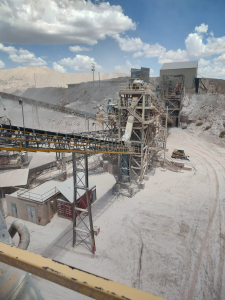
limestone quarry conveyor beltWe recently inspected a limestone quarry and lime production facility where processing capacity had increased over the years. Additional conveying equipment and pickup points had been added, but the existing cartridge collector remained.

By the time we inspected it, that collector was serving roughly five to six pickup points under a substantially higher dust load. The ductwork also contained routing and branch-connection issues that were consuming static pressure.

The collector itself was in good condition. It simply wasn’t the right collector for what the plant was asking it to do anymore. Our recommendation was to properly size a new baghouse for the current application and reuse the existing cartridge collector somewhere else in the facility where its capacity made sense.

Should You Replace the Collector or Upgrade the Existing System?

Before recommending a replacement, we would typically want to know the actual CFM at key pickup points, duct velocities, collector differential pressure, system static pressure, fan RPM/current, filter condition, and current process requirements.

Sometimes the solution is a larger collector. Other times it may involve fan changes, ductwork modifications, rebalancing, better hood design, or separating part of the process onto another collector. The objective is to find where the system is running out of capacity.

⏯️ In the following video, Dominick Dal Santo, Sales Director & Technical Advisor, Baghouse.com reviews the key to monitor a dust collector performance.

If your plant has expanded but your dust collection system hasn’t, Baghouse.com can perform a system inspection and airflow evaluation to determine where the current limitations are before you invest in new equipment.

Frequently Asked Questions

Possibly, but don’t assume that an unused connection or available space on the ductwork means the system has spare capacity. Adding another pickup point changes the airflow distribution throughout the system.

Before adding it, determine the new pickup’s required CFM and verify that the fan, collector, and ductwork can handle the additional airflow while maintaining adequate conveying velocity in the existing branches. If the system is already operating near its design capacity, the new pickup may simply take airflow away from other hoods.

No. An undersized collector is only one possible cause. Low airflow can also result from a fan operating below its intended speed, a VFD setting, worn or slipping belts, duct buildup, partially closed dampers, poorly designed branch connections, air leaks, or changes made to the ductwork over the years. We normally recommend measuring airflow and static pressure at several locations before concluding that the collector itself needs to be replaced.

Yes. Higher production often means more dust entering the collector, and sometimes additional airflow as well. Both can increase the load placed on the filters.

You may notice differential pressure climbing faster between cleaning cycles, more frequent pulsing, shorter filter life, or filters that no longer recover to their previous baseline DP. The current dust loading and air-to-cloth ratio should be compared with the conditions the collector was originally designed to handle.

Yes. Field airflow measurements can help determine whether the collector is actually the limiting component. Measure CFM at important pickup points and evaluate duct velocity, system static pressure, collector differential pressure, and fan operation. For example, if the collector is rated for the required airflow but the fan is operating far below its expected CFM, replacing the collector alone may leave you with exactly the same capture problem.

Sometimes, but increasing fan capacity should be evaluated as a system change. More airflow can increase the collector’s air-to-cloth ratio, filter differential pressure, duct velocities, abrasion, motor requirements, and stress on existing components. The ductwork and hoods may also need to be rebalanced. Before installing a larger fan, calculate the required CFM and static pressure and verify that the collector and duct network can safely operate at the proposed airflow.

There isn’t a universal number of years. A better trigger is a significant change to the process. Reevaluate the dust collection system when production increases substantially, new machines or conveying lines are installed, pickup points are added or removed, ductwork is modified, the handled material changes, or operators begin reporting poorer dust capture. Comparing new airflow and pressure measurements with commissioning or historical baseline data can show whether the system still matches the plant’s current needs.

Share this article

Related Articles

Get a quote today!