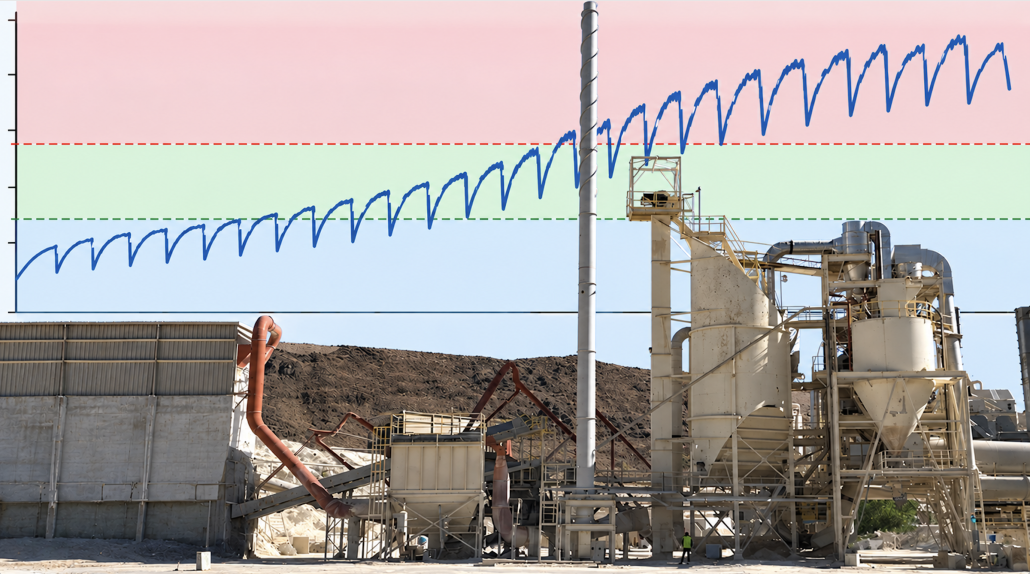
In this third installment of our Dust Collection Explained, we answer 20 practical questions about why filter bags fail, how different cleaning systems work, what differential pressure can tell you, and how airflow and system design affect baghouse performance.
ARTICLE QUESTIONS
- How Does Heat Damage Baghouse Filters?
- What Causes Abrasion Damage on Filter Bags?
- What Causes Chemical Damage to Filter Bags?
- How Does a Filter Bag Reach the End of Its Life?
- What’s the Difference Between Online and Offline Filter Cleaning?
- Why Should I Precoat My New Dust Collector Filter Bags?
- How Does My Pulse-Jet Baghouse Actually Clean the Filter Bags?
- How Does the Compressed Air System Work in My Pulse-Jet Baghouse?
- How Do My Baghouse Solenoid and Pulse Valves Work Together?
- Should I Clean My Baghouse Filters on a Timer or Based on Differential Pressure?
- How Can I Install a Snap-Band Filter Bag Correctly?
- How Do I Measure My Baghouse Filter Bags for Replacement?
- How Does a Reverse-Air Pulse Cleaning System Work?
- What Does Differential Pressure Tell Me About My Baghouse?
- What Differential Pressure Should I Run My Pulse-Jet Baghouse At?
- How Do I Determine How Much CFM My Dust Collection System Needs?
- How Do I Calculate Static Pressure for My Dust Collection System?
- What Is Minimum Conveying Velocity and Why Is It So Important?
- How Does a Spark Trap Work?
- How Do I Calculate the Air-to-Cloth Ratio for My Baghouse?
1. How Does Heat Damage Baghouse Filters?
Heat can damage a filter bag even when the bag doesn’t look burned or melted. Exceeding the filter media’s recommended operating temperature can weaken the fibers and significantly shorten filter life.
Extreme temperatures can melt or burn some filter materials, but a more difficult problem is a shorter temperature excursion. A process upset may push the baghouse above the filter’s temperature limit for 30 minutes or an hour before temperatures return to normal. The bags may still look fine afterward, even though their fibers have been weakened.
Once damaged, the repeated movement associated with filter cleaning can gradually break down those weakened fibers, resulting in failures weeks or months later. Localized heat damage can also occur when a hot particle or spark reaches a filter and burns a hole through the media.
Related article: Designing High-Temperature Baghouse Systems
▶ Watch the full answer below.
2. What Causes Abrasion Damage on Filter Bags?
Abrasion occurs when something repeatedly rubs against or strikes the filter media until a hole develops. It can come from neighboring bags, damaged cages, or even the dust entering the collector.
Filter bags are installed relatively close together. If a bag or cage is bent, the movement created during repeated cleaning cycles can cause adjacent bags to rub against each other. It may not cause noticeable damage immediately, but hundreds of cleaning cycles per day can eventually wear through the fabric.
The incoming dust itself can also cause abrasion. Highly abrasive material entering at high velocity may repeatedly strike filters near the inlet. When failures consistently appear in the same area of a baghouse, particularly near the inlet or at the bottoms of the bags, the location of those failures can provide an important clue about what’s actually causing them.
▶ Watch the full answer below.
3. What Causes Chemical Damage to Filter Bags?
Moisture is particularly important. Water vapor may pass through a hot baghouse without causing problems, but if the gas temperature falls far enough for condensation to occur, the situation changes.
Condensation can interact with chemicals in the gas stream and contribute to corrosive conditions. Depending on the process, acidic compounds can attack both the filter media and the steel components of the collector. That’s one reason a baghouse may look relatively good from the outside while showing significant corrosion internally.
Related article: How to Prevent Condensation in Your Baghouse
▶ Watch the full answer below.
4. How Does a Filter Bag Reach the End of Its Life?
Over time, fine particles can become embedded within the depth of the filter media, creating permanent resistance to airflow.
A healthy dust cake forms primarily on the surface of the filter. The cleaning system periodically removes much of that surface cake so airflow can recover. Over months or years, however, some fine particles can work their way deeper into the media. Eventually, enough material becomes embedded that cleaning the surface no longer restores the filter’s original permeability. This condition is commonly referred to as filter blinding.
▶ Watch the full answer below.
5. What's the Difference Between Online and Offline Filter Cleaning?
Online cleaning takes place while the process airflow continues through the collector. Offline cleaning temporarily removes airflow from the filters being cleaned.
Offline cleaning can mean shutting down the system fan before cleaning. In a compartmentalized baghouse, however, one compartment can sometimes be isolated while airflow continues through the remaining compartments.
With online cleaning, the collector continues operating while the filters are cleaned. Air is still being pulled through the bags while the cleaning mechanism tries to fracture and release the dust cake.
▶ Watch the full answer below.
6. Why Should I Precoat My New Dust Collector Filter Bags?
Precoat powder creates an initial protective layer on new filter bags before fine process dust reaches the clean filter media.
Brand-new filters don’t yet have the protective dust cake that develops during normal operation. In applications with very fine dust, particles can penetrate the clean media and become embedded before a stable surface cake has time to form.
Not every application needs precoat. Coarser dusts may naturally establish a suitable initial cake. The decision should be based on the dust, filter media, and application.
Related article: Precoating: A Simple Step To Boost Performance In Filters
▶ Watch the full answer below.
7. How Does My Pulse-Jet Baghouse Actually Clean the Filter Bags?
A pulse-jet system cleans primarily by rapidly expanding and flexing the filter bag so that the dust cake fractures and falls away.
The compressed-air pulse creates a rapid movement through the bag. The fabric expands away from the cage and then snaps back, producing a shock-like action that travels down the filter. That movement breaks the surface dust cake into larger pieces that fall into the hopper.
▶ Watch the full answer below.
8. How Does the Compressed Air System Work in My Pulse-Jet Baghouse?
The compressed-air system stores a volume of pressurized air and releases short bursts through the blowpipes to clean rows of filters.
Plant compressed air feeds an air header, which acts as a reservoir. When the cleaning controller calls for a pulse, a diaphragm pulse valve opens and rapidly releases compressed air into the blowpipe.
The blowpipe has openings positioned above the filters. That pulse is directed into a row of filter bags, creating the expansion and contraction needed to fracture the dust cake. Only one row or group is typically pulsed at a time, giving the compressed-air header time to recover between pulses.
Related article: The Importance of Correct Compressed Air Pressure in a Pulse Jet Dust Collector
▶ Watch the full answer below.
9. How Do My Baghouse Solenoid and Pulse Valves Work Together?
The solenoid valve provides the control signal that causes the larger diaphragm pulse valve to release compressed air for filter cleaning.
When the controller calls for a pulse, it energizes the solenoid. That small pneumatic/electrical action causes the diaphragm inside the pulse valve to open rapidly, releasing the compressed air stored in the header into the blowpipe.
Think of the solenoid as the trigger and the diaphragm pulse valve as the component doing the heavy work. Because diaphragms repeatedly open and close over thousands of cleaning cycles, they’re also common maintenance items.
▶ Watch the full answer below.
10. Should I Clean My Baghouse Filters on a Timer or Based on Differential Pressure?
For many pulse-jet baghouses, cleaning based on differential pressure adapts better to actual filter conditions than cleaning continuously at fixed time intervals.
A timer board cleans according to a preset sequence, whether the filters need cleaning or not. That can work, but the actual dust load isn’t always constant.
A clean-on-demand controller uses differential pressure to decide when cleaning should start and stop. As dust accumulates and resistance increases, cleaning begins. Once the differential pressure falls sufficiently, cleaning stops.
The goal is to avoid both extremes: under-cleaning, which allows excessive restriction to develop, and over-cleaning, which wastes compressed air and subjects the filters to unnecessary cleaning cycles.
Related article: Why Set Cleaning Based on Differential Pressure Instead of a Timer Setting?
▶ Watch the full answer below.
11. How Can I Install a Snap-Band Filter Bag Correctly?
A snap-band filter bag needs to be fully and evenly seated in the tubesheet hole before the cage is installed.
The snap band is designed to lock into the tubesheet opening and create a secure seal. If part of the band remains above or below the tubesheet, the bag may look installed while actually being crooked or partially seated.
That can create a path for dust to bypass the filter and can also cause mechanical problems once the cage is installed.
After installation, check that the band is evenly seated around the entire circumference. The bag should feel secure rather than loose or easily rotated in the opening.
▶ Watch the full answer below.
12. How Do I Measure My Baghouse Filter Bags for Replacement?
Important measurements include the tubesheet-hole diameter, snap-band dimensions, bag flat width, overall bag length, cage dimensions, bottom construction, and other attachment details.
You also need to identify the filter material, fabric weight, finish or treatment, and operating requirements. When possible, use accurate measuring tools such as calipers for critical dimensions rather than estimating with a tape measure.
Related article: How to Measure Your Baghouse Filters & Cages
▶ Watch the full answer below.
13. How Does a Reverse-Air Pulse Cleaning System Work?
A reverse-air pulse system uses a relatively large volume of lower-pressure air to flex the filters and release accumulated dust.
Instead of the short, high-pressure compressed-air pulse associated with a conventional pulse-jet collector, this design typically uses a separate blower or air source to deliver lower-pressure, higher-volume cleaning air through a rotating cleaning mechanism.
The resulting cleaning action is gentler on the filters. That can make this style of cleaning useful in certain applications where aggressive cleaning isn’t necessary or desirable, including some food-processing and woodworking applications.
Related article: What is the Difference Between Medium Low-Pressure Reverse Air and Pulse-Jet Baghouses?
▶ Watch the full answer below.
14. What Does Differential Pressure Tell Me About My Baghouse?
Differential pressure tells you how much resistance the filters are creating as air passes through the baghouse.
It’s measured as the pressure difference between the dirty and clean sides of the collector, commonly in inches of water column (in. w.c.).
As dust accumulates on the filters, resistance normally increases. Cleaning removes part of the surface dust cake and helps control that resistance.
Related article: How Do You Use Differential Pressure to Monitor and Troubleshoot a Dust Collector? (Part 1)
▶ Watch the full answer below.
15. What Differential Pressure Should I Run My Pulse-Jet Baghouse At?
There is no universal differential-pressure setpoint that’s correct for every pulse-jet baghouse.
We recommend approximately 3–5 in. w.c. as a practical operating example, but the correct range depends on the collector design, filter media, dust, airflow requirements, fan, cleaning system, and process.
Instead of applying one number to every collector, establish the appropriate operating range for your specific system and watch how DP behaves over time.
▶ Watch the full answer below.
16. How Do I Determine How Much CFM My Dust Collection System Needs?
CFM, or cubic feet per minute, measures the volume of air the system moves. Each pickup point requires enough airflow to capture or receive the dust generated by the process.
If one machine requires 10,000 CFM and three additional pickup points require 5,000 CFM each, the combined requirement would be 25,000 CFM when all four are operating simultaneously.
That total airflow affects much more than the fan. It influences duct sizing, conveying velocity, collector size, required filter area, air-to-cloth ratio, and ultimately the performance of the entire system.
▶ Watch the full answer below.
17. How Do I Calculate Static Pressure for My Dust Collection System?
Static pressure represents the resistance the fan must overcome to move the required airflow through the dust collection system.
Ductwork creates resistance through friction, elbows, transitions, hoods, and other components. The dust collector creates additional resistance, much of it associated with forcing air through the filters.
▶ Watch the full answer below.
18. What Is Minimum Conveying Velocity and Why Is It So Important?
Minimum conveying velocity is the airflow velocity needed to keep collected material moving through the ductwork instead of settling out.
If duct velocity falls too low for the material, particles can settle in horizontal runs, elbows, and other areas. Accumulation can restrict the duct, reduce airflow, create housekeeping problems, and in some applications introduce additional hazards.
Related article: How to Size Dust Collection Ductwork for Proper Air Velocity
▶ Watch the full answer below.
19. How Does a Spark Trap Work?
A spark trap uses changes in airflow direction and particle momentum to help separate larger or heavier particles from the airstream before they reach the dust collector.
As dusty air passes through the spark trap, internal baffles force the airflow to change direction. Those particles are redirected, slowed, or separated from the main airflow before the remaining air continues toward the collector.
A spark trap can therefore provide an additional layer of protection in processes that may generate hot or glowing particles.
▶ Watch the full answer below.
20. How Do I Calculate the Air-to-Cloth Ratio for My Baghouse?
Air-to-cloth ratio compares the amount of airflow entering a baghouse with the total available filter-media area.
The basic calculation is:
Air-to-Cloth Ratio = Airflow (CFM) ÷ Total Filter Area (ft²)
But there isn’t one ideal air-to-cloth ratio for every baghouse. Appropriate ratios depend on factors such as dust characteristics, loading, filter media, cleaning method, temperature, moisture, particle size, and process conditions.
Use our free Air-to-Cloth Ratio Calculator.
▶ Watch the full answer below.
An Educated Customer Makes Better Decisions
That’s the goal of our Dust Collection Explained series: to break down industrial dust collection one practical question at a time and help plant operators, maintenance teams, and engineers better understand what’s happening inside their systems.
Have another dust collection question you’d like us to answer? Contact Baghouse.com or send us your question. It may become one of the next topics in the series.

Dust Collection Expert, Technical Writer & Editor at Baghouse.com
Andy Biancotti believes that knowledge is one of the best investments any company can make. As Editor and Marketing Manager at Baghouse.com, he enjoys interviewing engineers, technicians, and customers to capture the real-world lessons behind successful dust collection projects and turn them into practical resources that others can learn from. With more than two decades of experience in industrial maintenance, operations, and technical communication, his goal is simple: help people better understand their systems so they can work safer, smarter, and more efficiently.