Something is not right with my pulse-jet baghouse. Should I change the filters? Should I upgrade the whole system? Wait! Before spending thousands of dollars on new filters or equipment, let’s look together at how the existing system is operating.

Throughout our years of experience in the dust collection field, Baghouse.com technicians have seen plenty of instances where a dust collector could perform better with a few simple adjustments. Many of the most common problems can be corrected without a major investment.

Here we share five practical ways to improve your pulse-jet baghouse‘s performance, reduce compressed air consumption, and extend filter life.

1. Make Sure Your Filter Bags Are Installed Correctly

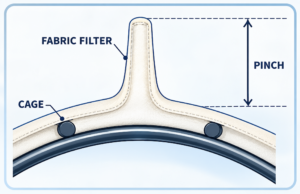
Technical diagram showing filter bag pinch, the excess fabric between a baghouse filter and its support cage, with measurement arrows.

Filter bag pinch is an important measurement when matching filter bags to their support cages. Incorrect sizing can contribute to premature filter wear.

It might sound obvious, but improper filter installation is one of the easiest ways to create problems inside a baghouse. A filter bag that doesn’t fit its cage correctly can experience excessive movement during cleaning. Over time, this can cause abrasion, premature failure, and particulate emissions.

One important measurement is the filter bag pinch, which refers to the amount of excess fabric when the bag is fitted around its support cage. Why is the bag pinch so important? Because it helps the dust cake release after the compressed air hits the bag, inflating it.

You can calculate it using this formula:

Pinch = (Bag Circumference − Cage Circumference) ÷ 2

The correct amount depends on the filter material and cage design.

Comparison table showing recommended filter bag pinch measurements and support cage types for felt, ePTFE membrane, PPS, P84, and fiberglass filters.

Snap-band filters should sit evenly in the tubesheet without wrinkles or gaps. Gaskets and O-rings shouldn’t be pinched by clamps, and flanges or cuffs should lie smoothly against the cage.

For bottom-loading designs, we recommend positioning seams 180 degrees from the cage collar gap. Also, orient bag seams approximately 45 degrees from the aisle and clamps 90 degrees from the seams, where the filter design allows.

Keeping seams and clamps consistently oriented can also make future inspections easier.

2. Switch to Clean-on-Demand Pulse Cleaning

Many older pulse-jet baghouses clean their filters using a fixed timer, regardless of whether the filters actually need cleaning. Others depend on an operator to manually start and stop the cleaning cycle. Both approaches can waste a lot of compressed air (which can be very expensive on your electric bill!)
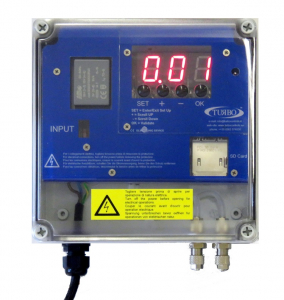
Differential pressure controller for dust collector

A controller allows for smart cleaning cycles based on the differential pressure (Clean-On-Demand)

A more efficient option is a clean-on-demand controller, which automatically activates the pulse-cleaning system based on differential pressure. A differential pressure gauge or switch, such as a Photohelic, monitors the pressure difference between the dirty-air and clean-air sides of the baghouse. When differential pressure reaches a predetermined high setting, the controller starts the cleaning cycle. Once pressure falls to the lower setting, cleaning stops.

Why is this useful?

Because cleaning only when necessary reduces compressed air consumption and unnecessary filter wear. It can also help maintain a more consistent differential pressure without requiring operators to continually adjust the cleaning system.

If your baghouse still relies on manual cleaning or a basic timer, upgrading the controller may be one of the most cost-effective improvements available.


3. Optimize the Pulse-Cleaning Sequence

Even with automatic cleaning, the way your baghouse pulses its filters can affect performance. In some systems, the controller cleans adjacent rows one after another. The problem is that dust released from one row can be carried by internal airflow and deposited onto filters that were just cleaned. This is especially troublesome in baghouses with high can velocity or limited space between filters. Repeated redeposition can contribute to filter blinding, increased differential pressure, and shorter filter life.

One solution is to adjust the pulse sequence cleaning so that adjacent rows aren’t cleaned immediately after one another. For example, instead of cleaning ten rows in numerical order, a controller might use the following sequence:

1, 4, 7, 10 → 2, 5, 8 → 3, 6, 9

This gives dislodged dust more opportunity to settle before nearby rows are pulsed.

Another important consideration is compressed air header pressure. If the header hasn’t recovered sufficiently between pulses, some rows may receive weaker cleaning pulses than others. A controller that verifies adequate header pressure before firing can improve cleaning consistency.

Pulse duration matters too. Many systems use short pulses around 0.1 seconds, although the appropriate duration depends on the valve, blowpipe, and collector design. Longer pulses don’t automatically mean better cleaning. They may simply consume more compressed air.

4. Consider Precoat Powder When Installing New Filters

With conventional fabric filtration, a layer of collected dust gradually develops on the filter surface. This dust cake helps capture fine particles.

When brand-new filters are installed, that protective layer hasn’t formed yet. In certain applications, particularly those involving moisture or difficult dust characteristics, this can create problems during startup.

Applying a suitable filter precoat powder can help establish an initial filtration layer before process dust reaches the filters. Precoat can also help protect the media from certain sticky or moisture-related deposits, potentially reducing premature blinding.

However, precoat is not always recommended. For example, membrane filters such as ePTFE operate primarily through surface filtration and don’t depend on a conventional dust cake in the same way as standard felt filters.

Before applying precoat, verify compatibility with the filter media, collected material, and process conditions. For suitable applications, though, precoating new filters can be a relatively inexpensive way to improve startup performance and protect your investment.

Line graph comparing baghouse differential pressure with and without precoat powder, showing a rising pressure trend without precoat and a more stable trend with precoat.

5. Use Leak Detection Testing and Better Monitoring

Sometimes a baghouse appears to be operating normally, but particulate emissions are increasing. A damaged filter bag, poorly seated snap-band, leaking gasket, or cracked tubesheet can allow dust to bypass the filtration system.

The challenge is finding the source. Manually inspecting hundreds or thousands of filter bags can take considerable time, and small holes or damaged seams aren’t always visible.

A fluorescent leak detection test offers a practical alternative. During the test, specially formulated fluorescent powder is introduced into the dirty-air side of the collector. After following the appropriate test procedure and safely shutting down and isolating the equipment, technicians inspect the clean-air plenum using a compatible ultraviolet or blue inspection light.

Where powder has passed through a leak, it becomes visible under the inspection light. This can help locate damaged filter bags, leaking seams, improperly installed filters, and defects around tubesheets or welded joints. It’s often much faster than removing every filter to search for a small leak.

Beyond leak testing, consider integrating your baghouse controls into a central monitoring system. Differential pressure readings, cleaning cycles, timer settings, and other operating information can be displayed through a control panel or connected to a PLC.

Having this information available in one place makes it easier to identify unusual operating trends before they develop into expensive problems.

Small Improvements Can Add Up to Significant Savings

Improving baghouse efficiency doesn’t always require a new collector, larger fan, or complete filter replacement. Sometimes, the best improvements come from one of these 5 points we shared.

At Baghouse.com, we help industrial facilities troubleshoot existing dust collection systems and identify practical improvements that make sense for their equipment and operating conditions.

Want to improve your pulse-jet baghouse performance without investing in a complete replacement?

Share this article

Related Articles

Get a quote today!