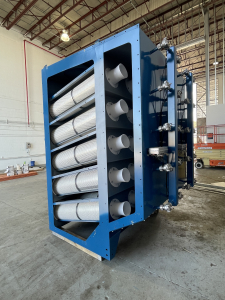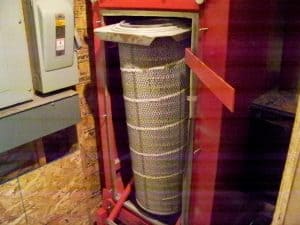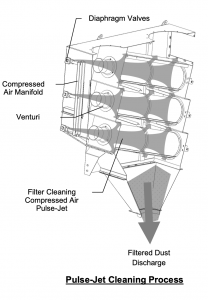
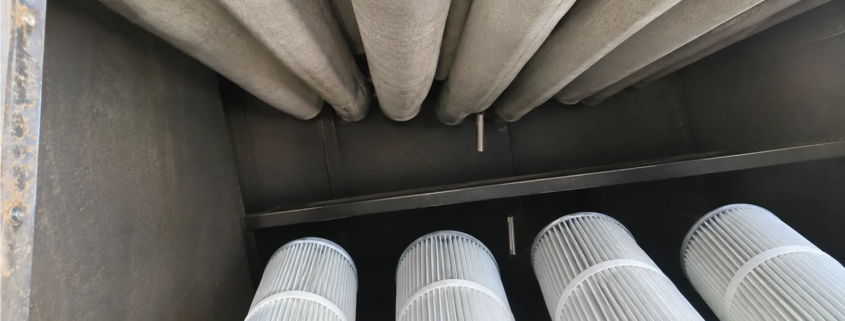
Traditional fabric filter bags and pleated filter elements installed inside an industrial baghouse dust collection system.

Want to find out more about pleated filters?

How much can converting to pleated dust collector filters potentially save?

Take a look at a sample cost benefit analysis for one of our customers to find out.

Save Money By Converting to Pleated Dust Collector Filters

Pleated dust collector filters are one of the most advanced innovations in dust collector technology in decades. With a host of advantages over traditional bag and cage technology, pleated filters deserve the attention of all dust collector operators. In many cases, it is possible to retrofit older pulse jet dust collectors to use pleated filters.

Converting from traditional bags and cages often brings many benefits:

Improve Operation – Increase Capacity, Decrease Emissions, Decrease Electricity Usage, Combine Multiple Systems

Use Less Compressed Air to Clean Filters

Pleated Filters Last Longer Than Bags

Reduce Total Number of Filters in Unit

Easier Installation – Faster Changeout, Less System Downtime, Lower Labor Costs

Reduce Filter Abrasion and Lower Grain Loading

Reduce Inventory – Consolidate Several Different Filters Into One Style

Pleated filter

Want to see how much you could save by converting to pleated dust collector filters?

Just give us a call at (702)  848-3990 or email us and one of our baghouse engineers will be happy to assist you in determining if your dust collector is a candidate for conversion.

Many Baghouse.com customers have taken advantage of this new technology and seen significant benefits be doing so. If possible for your system, we invite you consider the costs of converting your dust collector to use pleated filters, and see whether or not the benefits are worth it for you. Often times, our customers find that the reward is worth far more than the initial costs.

We invite you to take a look at a real cost-benefit analysis that we performed for one of our customers. It highlights how even in just 3 – 6 years, it is possible to reap impressive benefits with pleated dust collector filters.

Pleated Dust Collector Filter Conversion – Cost-Benefit Analysis

NOTE: This report has been modified from its original form to withhold any sensitive information.
For a full PDF version, please click here: Pleated Dust Collector Filter Conversion Cost Benefit Analysis – PDF Download

Summary

This report will outline how NAME WITHHELD can see substantial savings associated with the operation and maintenance of their dust collection systems by switching from their current filter bag and cage technology to newer pleated filter elements in their pulse jet baghouse dust collection systems.

Primarily, NAME WITHHELD would benefit in two main areas: reductions in purchases made on replacement filters every maintenance cycle and a reduction in total man-hours needed to replace the filters in each of the main collectors. Additionally, operations of the various units will be improved and capacity for the entire system could easily be increased to meet demand for greater production at the plant.

In total, NAME WITHHELD would begin to see returns on this investment within 3 – 6 months. Furthermore, savings will only continue to increase over time as maintenance costs decrease and filter life, performance and capacity increase.

Introduction

What is a Pleated Baghouse Filter Element?

Pleated filter elements are the latest and most advanced industrial dust collection technology on the market today. A great number of industries are switching en masse to pleated technology from traditional bag and cage technology. Pleated filter elements are essentially filter bags that are arranged to have many different folds of fabric in a smaller area than a traditional bag. Pleated elements also combine the bag and cage into a one-piece construction that removes the need for separate cages.

What are The Advantages of Pleated Elements Vs. Standard Filter Bags and Cages?

The main advantage of pleated elements carry over traditional bags and cages is that they offer on average 2 – 3 times the filter cloth area of a standard bag at half the average length of a standard bag and cage. Example: you have a standard 6.25” diameter x 10’ long pulse jet bag (a very common size). If cut open and laid flat the bag would have approximately 16.4 sq/ft of filter area. A pleated element of the same diameter and only 2 meters long (approx. 78-3/4”) would have approximately 44.3‘ sq/ft of filter area. Thus, a pleated filter with the same diameter but about half the length has 270% more filter area than a standard filter bag!

This has dramatic implications for operating and maintaining these dust collection systems. Consider just some of the following:

Improve Operation – Increase Capacity, Decrease Emissions, Decrease Electricity, Combine Multiple Systems
Pleated elements greatly improve baghouse operation. Pleated elements can effectively increase the capacity of a baghouse by as much as 200%. This allows for the combining several dust collection systems into one large unit (more economical in many cases). Or production can increase online without having to incur the large capital expenditure of a new baghouse to avoid production bottlenecks. Or, you can use less filters to improve performance and reduce energy usage by turn the system fan to a lower setting. Further, pleated filters on average have better emissions than traditional dust collector bags, an ever-increasing need with tougher Federal and State environmental regulations newly in force.

Use Less Compressed Air To Clean Filters
With more filter area the elements also load dust better and are easier to clean. This equals less cleaning cycles, which uses less expensive compressed air to run the baghouse. Reductions of 30% – 50% in compressed air use are common when converting to pleated elements.

Pleated-Dust-Collector-Filter

Pleated Filters Last Longer Than Bags
Since the pleated filters are cleaned less they experience less wear and tear during operation. Pleated elements commonly last from 25% – 75% longer than filter bags in the same application, sometimes as much as 2 to 3 times as long! This means you replace your filters less often than traditional filter bags.

Reduce Total Number of Filters
With more filter area you need less pleated elements to do the same work as bags. You can often replace bags with elements at a 2:1 ratio of bags to elements. This means less filters to replace. This is not possible in all cases, as interstitial velocity (air velocity between filters) and can velocity (air velocity coming up out of filters) will rise when removing filters. High interstitial velocity causes dust reentrainment (dust pulsed off backs in unable to fall down to due to high air speeds pushing it back on to the filters)

Easier Installation: Less Time, Less Downtime, Less Labor
Changing dust collector filters is very expensive for most facilities. Many need to hire outside contractors due to the manpower required. Replacing filters also leads to shutdowns and system downtime that costs much in lost production and maintenance.

One of the greatest cost saving benefits of pleated elements is the ease of replacing them compared to traditional filter bags and cages. With traditional bags and cages, much effort is needed to remove the cage and bag assembly from the baghouse, and then replace the long cumbersome assembly back into the baghouse, and down into the tubesheet hole. With pleated elements all of this is eliminated. Compared to the complicated bag and cage assembly, the one-piece element is easy to handle and takes approximately 50% of the time to change compared to a traditional filter bag. Additionally, if the total number of filters has been reduced (See above) then less filters will need to be changed in total.

Reduce Filter Abrasion and Lower Grain Loading
Many applications with abrasive compounds (sand, metal dusts, silica, asphalt, cement, etc.) have problems with incoming dust-laden air wearing out the bottoms of the filters. Switching to pleated filters will help prevent filter abrasion., Pleated filter elements are shorter than the bags they replace, this means they sit higher in the dust collector, out of the way of high speed, incoming air laden with abrasive dusts. In addition to moving the filters out of the way of incoming abrasive air, pleated filters also create a larger knockout chamber beneath the filters that slows the air down, allowing for larger particles to drop of of the air before even making contact with the filters. Less dust will reach the filters (i.e. lower grain loading) leading to lower pressure drop, fewer cleaning cycles, lower emissions, and longer filter service life.

Reduce Inventory – Consolidate Several Different Filters Into One Style
Pleated filters can also replace several different types of filter bags with only one pleated element for use in several collectors. For example, imagine four collectors that all use a 5.75” diameter filter bag, but each one is a different length. This means the plant needs to keep on hand four different bag types for these collectors, and must have different pricing for all four. With a pleated element, you could easily replace all four filter styles with one pleated element. This would mean only needing to stock enough to replace one collector at any time (emergency requirement for many plants) and that avoiding bottlenecking the system an entire set of filters needed replacement. This also frees up warehouse space at the facility and reduces the work when ordering replacement filters.

Potential Barriers To Use
Pleated filter elements cannot be used in every dust collection application. They are sensitive to very high temperatures and certain corrosive gases. Additionally, certain applications require special construction materials that can end up making pleated elements much more expensive than comparable bag technology. Further, the reduction of the total number of filters in a dust collector using pleated filters will raise the can and interstitial velocities. These must be kept under certain thresholds in order for the system to function correctly.

The good news is that for applications like those found at NAME WITHHELD, these issues are not an issue. With relatively lower temperatures throughout the process and no difficult to collect dusts or corrosive gases, pleated filter elements can be deployed comparatively easy into these applications.

Pleated-Filters-Install-Step-1
Pleated-Filters-Avoid-Abrasion-2

Pleated Dust Collector Filter: Cost – Benefit Analysis

I recommend the plant to look to convert to pleated filters in two stages. The first involves all “low temperature” baghouse units. These are the main systems in the plant and are vital to running the production line.

Converting to pleated elements on these would be relatively simple and the elements would not be much more expensive than the current filter bag and cage setup currently in place. The second would be the three “high temperature” kettle units. These would require a little bit more engineering to get the right filter element. Further, the high cost of high temperature elements would place the return on investment for these units further out into the future.
For the this report we will only analyze the low temp units:

PLANT DUST COLLECTORS VALUE
Pleated elements needed to replace low temp filters $639
High temp filters & cages $432
Pleated elements needed to replace high temp filters $216
Low temp filters & cages $1,277
Estimated cost per pleated element (low temp) $65
Average cost per filter and cage $50
Labor per man hour - estimated $30
Estimated cost per pleated element (high temp) $125
Compressed Air Costs $0.14467 per 1,000 cubic feet
OPERATING COSTS BAGS AND CAGES PLEATED DUST COLLECTOR FILTERS
Replacement - New Bags Every 2 years - 1,277 x $50 = $63,850 Every 3 years - 639 x $65 = $41,535
Replacement - Labor 4 bags per man hour x 1,277 = 319.25 man hours = $9,577.50 8 bags per man hour x 639 = 79.875 man hours - $2,396.25
Cost Over 6 Years $191,550.00 + $28,732.50 $83,070.00 + $4,792.50
Total: $220,282.50 Total: $87,862.50
PLANT DUST COLLECTORS VALUE
Air Usage Between 30% - 100% reduction
Inventory 200 elements on hand vs. 770 bags and cages
System Capacity If replaced at 1:2 ratio capacity could increase by 15% | Additional savings to be had by expanding capacity at certain units and consolidating others systems into less units.
Emissions Along with system repairs reductions of PM 2.5 emissions by 10% or more are possible

Conclusion: Converting low temperature dust collectors to pleated filters will save NAME WITHHELD $132,420.00 within six years.

By converting to pleated filter elements, NAME WITHHELD potentially could see a cost savings of an estimated $132,420.00 every 6 years. These estimates do not include the potential savings from decreased compressed air use, less system downtime due to less frequent changeouts, reduced energy costs associated with operating the baghouses, or the benefits of increasing production levels and lower emissions. When these are included the benefits could potentially reach $1 million or more.

The estimated time it would take to recoup the initial investment to convert to pleated elements would be essentially immediately as the cost of replacing the filters and cages is likely greater than the cost of the pleated elements.

Baghouse.com filter bags and pleated filters

Case Study Shows Potential For Savings From Converting To Pleated Filters

As we have clearly seen from the above case study, switching to pleated dust collector filters from traditional bag filters means huge savings! If you would like to see if your dust collector or a series of dust collectors could benefit from converting to pleated filters, Baghouse.com would be happy to assist you. Please give us a call at (702)  848-3990 or email us at info@baghouse.com.

Want to find out more about pleated filters?

Industrial cartridge dust collector surrounded by 10 icons representing common problems, including poor suction, clogged filters, high differential pressure, dust leaks, and pulse-cleaning failures.
Infographic showing 10 common cartridge dust collector problems, including poor suction, dust leaks, high differential pressure, clogged filters, startup failures, and pulse-cleaning issues.

Most cartridge collector problems can be traced to a handful of common causes. The challenge for cartridge dust collection troubleshooting is identifying the actual cause before spending money on unnecessary repairs or replacement filters. 

Cartridge Collector Case Study SpaceX

At Baghouse.com, our technicians have spent decades working with industrial dust collection systems across metalworking, manufacturing, food processing, chemical processing, and many other applications. And as always, we love to share what we have learned with individuals working in the dust collection field. So, thanks for reading! We hope these 10 common cartridge dust collector problems, along with practical troubleshooting advice, help you identify what’s going wrong at your facility and determine your next steps.

Before troubleshooting: Always follow the manufacturer’s instructions and your facility’s safety procedures. Shut down and properly lock out/tag out equipment before opening access panels or performing maintenance. Isolate and depressurize compressed air systems before servicing pulse-cleaning components, and use appropriate PPE for the collected dust. Electrical diagnostics should be performed by qualified personnel. If your system handles combustible or otherwise hazardous dust, follow the applicable procedures for those hazards.

Watch the following clip of one of our virtual trainings by Dominick Dal Santo, Sales Director & Baghouse Expert.

1. Why Is My Cartridge Dust Collector Losing Suction?

One of the most common complaints we hear is, “The dust collector is running, but it isn’t pulling enough air.” When airflow drops, dust starts escaping from hoods, workstations, or production equipment. The immediate assumption is often that the cartridges are plugged. That’s certainly possible, but it isn’t the only explanation.

Baghouse.com personnel monitoring the differential pressure in a cartridge collector

Regularly monitoring the differential pressure will give us insight on how our system is operating

What to check:

  • ⦿ Differential pressure: Compare the current pressure drop across the filters with the collector’s normal operating range. A high reading may indicate excessive filter loading or ineffective pulse cleaning.
  • ⦿ Ductwork: Look for accumulated dust, blockages, damaged duct sections, and air leaks.
  • ⦿ Fan performance: Verify that the fan is operating at the intended speed and that the motor, belts, and drive components are functioning properly.
  • ⦿ Dampers: Confirm that manual or automatic dampers are in their intended positions.
  • ⦿ VFD settings: If the system uses a variable frequency drive, verify that its operating speed and control settings match the application.

Our technicians generally recommend checking the entire airflow path before deciding that the filters need replacement. A collector can have relatively clean filters and still deliver inadequate suction if something else is restricting airflow.

2. Why Is Dust Getting Past My Cartridge Filters?

Dust appearing on the clean-air side of a cartridge collector is a warning sign that shouldn’t be ignored. Depending on the system, you might notice visible emissions from the exhaust, dust accumulation in the clean-air plenum, or an alarm from a particulate monitoring device.

The problem is often related to damaged filters or an improper seal.

Cartridge Collector Case Study SpaceXWhat to check:

  • ⦿ Start by verifying that the installed cartridges are the correct size and configuration for the collector. Even a high-quality replacement filter can leak if its dimensions or sealing arrangement don’t match the equipment.
  • ⦿ Inspect the cartridges for tears, holes, damaged end caps, and other visible defects. Pay particular attention to gaskets, mounting surfaces, access doors, and cartridge retention mechanisms.
  • ⦿ A gasket that’s compressed unevenly or a cartridge that hasn’t been fully seated can allow dust to bypass the filter media.
  • ⦿ If the collector has a particulate monitor or broken-filter detector, review its readings and confirm that the instrument is functioning correctly.
  • ⦿ For difficult-to-locate leaks, our technicians may recommend an appropriate leak detection test. The goal is to identify the actual leakage path instead of replacing otherwise serviceable cartridges.

Watch the following clip of one of our virtual trainings by Dominick Dal Santo, Sales Director & Baghouse Expert.

3. Why Is My Cartridge Dust Collector's Differential Pressure So High?

Differential pressure (DP) measures the resistance to airflow through the cartridge filters. As dust accumulates, that resistance generally increases. A gradual increase is expected during normal operation. However, when DP rises beyond the collector’s intended operating range, airflow and dust capture performance can suffer.

What to check:

  • ⦿ First, compare the reading with the manufacturer’s recommended operating range and your system’s established baseline. There is no single differential pressure limit that applies to every cartridge collector.
  • ⦿ If the reading is unusually high, check whether the pulse-cleaning system is operating correctly. A malfunctioning pulse valve, inadequate compressed air supply, or incorrect controller setting can allow dust to accumulate on the cartridges.
  • ⦿ If the filters have reached their recommended replacement condition, install suitable replacements and record the differential pressure after startup.
  • ⦿ What if the cartridges are relatively new? In that situation, check their specifications and installation. Incorrect filter media, unsuitable cartridge dimensions, and excessive dust loading can all contribute to abnormal pressure drop. Also verify the DP instrument and its sensing lines. Plugged tubing or a faulty sensor can produce misleading readings.

One important lesson from the field: Don’t replace cartridges based on one pressure reading alone. Look at the trend, the airflow, the cleaning system, and the operating conditions before making that decision.

4. Why Are My Cartridge Filters Clogging So Quickly?

Cartridge-Collector-FilterIf your cartridge filters used to last a year but now need replacement every few months, something has changed. Sometimes the explanation is straightforward: production increased, a new machine was connected, or the facility started processing a different material. 

What to check:

  • ⦿ Dust loading: Has the amount of dust entering the collector increased? A system originally designed for a particular process may struggle after production capacity expands.
  • ⦿ Filter media: Is the cartridge material appropriate for the dust being collected? Fine, sticky, oily, or moisture-sensitive dust can require special consideration when selecting filter media and surface treatments.
  • ⦿ Pulse cleaning: Are all the valves firing correctly? Is the compressed air supply adequate? Are the cleaning intervals appropriate?
  • ⦿ Airflow distribution: Uneven airflow can cause certain cartridges to accumulate more dust than others.

Our technicians also look at the collector’s air-to-cloth ratio, which compares airflow with the available filtration area. If the system is moving too much air through too little effective filter media, cleaning performance and cartridge life may suffer.

Keep in mind that filter media changes alone cannot solve every difficult dust application. Sticky or hygroscopic dust may require changes to process conditions, moisture control, or collector design.

Watch the following clip of one of our virtual trainings by Dominick Dal Santo, Sales Director & Baghouse Expert.

5. Why Won't My Dust Collector Start?

When a cartridge collector refuses to start, the problem is often electrical or related to the control system. Before assuming the motor has failed, check whether the collector is receiving a start command and whether an alarm or interlock is preventing operation.

What to check:

  • ⦿ Review the control panel for active alarms or fault messages.
  • ⦿ Check whether a motor overload, protective device, or safety interlock has been triggered.
  • ⦿ Verify that the incoming electrical supply is available.
  • ⦿ Confirm that the controller is configured for the intended operating mode.
  • ⦿ Have a qualified technician inspect the motor, wiring, contactors, and start/stop controls as necessary.

6. Why Does My Dust Collector Keep Shutting Off?

A collector that starts normally and then stops a short time later can be particularly frustrating. It could be that the equipment is doing exactly what its controls are programmed to do. Many cartridge collectors are connected to production equipment and operate automatically. When the associated machine stops, the dust collector may shut down after a programmed delay.

What to check:

  • ⦿ First, verify whether the collector is operating in automatic or manual mode.
  • ⦿ If the shutdown is unexpected, review the alarm history. Motor overloads, control faults, safety interlocks, and electrical problems may be responsible.
  • ⦿ A motor that overheats or repeatedly trips its protection needs further investigation. Qualified personnel should check the electrical supply, motor condition, fan operation, and applicable load measurements.
  • ⦿ Inspect the control system for malfunctioning relays, sensors, or interlocks.

Our advice is to pay attention to the timing of the shutdown. Does it happen immediately, after several minutes, or only when production equipment changes operating modes? That pattern can help narrow down the cause.

7. Why Isn't My Pulse-Cleaning System Working Properly?

Cartridge Filters Cleaning ProcessDuring a cleaning cycle, a short burst of compressed air dislodges accumulated dust from the filter surface. When this system stops working correctly, differential pressure may rise and cartridge life can decrease significantly.

What to check:

  • ⦿ Compressed air supply: Verify that the system has the pressure and air volume required by the collector manufacturer.
  • ⦿ Solenoid valves: Confirm that the electrical control signals are reaching the valves and that the valves are functioning correctly.
  • ⦿ Diaphragm valves: Inspect for damaged diaphragms, sticking components, or other failures that prevent proper pulse delivery.
  • ⦿ Pulse controller: Review the cleaning sequence, pulse duration, and timing settings.
  • ⦿ Compressed air leaks: Inspect the pulse header, fittings, and associated piping for leaks.

One issue our technicians frequently emphasize is compressed air quality. Moisture and contamination in the air supply can damage pulse components and interfere with filter cleaning.

Also, more frequent pulsing isn’t automatically better. Excessive cleaning wastes compressed air and may increase filter wear without improving performance.

8. Why Is the Airflow Uneven Throughout My Dust Collection System?

Have you ever noticed that one workstation has excellent suction while another barely captures any dust? That’s often an airflow balancing problem.

A dust collection system is designed to distribute a specific amount of air to each pickup point. When that balance changes, some branches may receive too much airflow while others receive too little.

Dust build up inside a duct connected to a dust collector

Maintaining the minimum conveying velocity in the dust collection system prevents dust drop out and build up inside the ductwork

What to check:

  • ⦿ Inspect the ductwork for restrictions, leaks, and accumulated material.
  • ⦿ Check the fan’s operating condition and verify that dampers are positioned correctly.
  • ⦿ Look for modifications to the system. Adding a new machine, relocating equipment, or changing ductwork can alter airflow distribution throughout the network. Uneven cartridge loading may also provide clues about airflow distribution within the collector itself.

When the problem isn’t obvious, technicians can measure airflow and static pressure at different locations to identify where the system is underperforming. Our experience has shown that airflow adjustments need to account for capture requirements, duct conveying velocities, and the system’s overall operating conditions.

See Duct Sizing Calculator.

9. Why Is My Dust Collector Making Unusual Noises or Vibrating?

A new rattling noise, grinding sound, or noticeable increase in vibration deserves attention. These symptoms can indicate mechanical problems involving the fan, motor, bearings, mounting hardware, or collector housing.

What to check:

  • ⦿ If the noise or vibration is sudden or severe, shut down the collector and follow proper lockout/tagout procedures. Do not restart until the equipment has been inspected and the cause addressed.
  • ⦿ For less severe changes, a qualified technician should inspect the fan and motor assembly for worn bearings, loose components, misalignment, or fan imbalance.
  • ⦿ Also examine access panels, structural supports, and mounting hardware.
  • ⦿ Dust accumulation on fan blades can create an imbalance that increases vibration and places additional stress on bearings and other components.

A useful preventive maintenance practice is to establish normal vibration and noise baselines. Changes are much easier to recognize when you know what the equipment sounds and feels like during healthy operation.

10. Why Isn't My Dust Collector Capturing Dust at the Source?

A collector can have normal differential pressure, functioning pulse valves, and clean cartridges while the capture system is poorly designed or improperly positioned.

What to check:

  • ⦿ Start with the capture hood. Is it close enough to the dust-generating process? Has the equipment been moved or modified?
  • ⦿ Check whether the hood provides adequate enclosure or capture airflow for the application.
  • ⦿ Next, verify that the ductwork is properly sized and that sufficient airflow is reaching the pickup point.
  • ⦿ The dust collector must also have enough capacity for the total system requirements, including the necessary airflow and an appropriate air-to-cloth ratio.
  • ⦿ In some facilities, production changes gradually increase the demand on a dust collection system until it can no longer provide effective capture at every location.

When our technicians encounter this situation, the solution may involve adjusting hoods, balancing airflow, modifying ductwork, upgrading the fan, or evaluating the collector’s capacity.

Read How to Size Your Dust Collection System?

Effective Troubleshooting Starts With Finding the Cause

Baghouse.com personnel performing an inspection that involved a meticulous examination of baghouses, collectors, fans, airlocks, conveyors, ductwork, pickups, and auxiliary equipment.Effective troubleshooting starts with understanding how the complete system is operating.

Instead of treating every problem as a reason to replace filters, establish a baseline for differential pressure, airflow, compressed air pressure, fan performance, and cleaning operation. Keep records of changes and use those trends to recognize developing problems.

A structured preventive maintenance program can help catch many of these issues before they lead to equipment damage, excessive filter consumption, or unplanned shutdowns.

Need Help Troubleshooting Your Cartridge Dust Collector? At Baghouse.com, we work with industrial cartridge collectors from many different manufacturers. Whether your collector needs a simple adjustment or a more extensive system evaluation, our goal is to help you find a practical, cost-effective solution.