
Investing in pleated filter elements can give you lower operating differential pressure, better filtration efficiency, and longer service life
Pleated filter elements can provide significantly more filter area in the same space as conventional filter bags, which can make them an effective retrofit for some existing baghouses.
A pleated baghouse filter shouldn’t be confused with the much larger cartridges used in a cartridge dust collector. Pleated elements are designed with dimensions and mounting arrangements that allow them to fit into a baghouse originally designed for conventional bags.
Because the media is folded into pleats, more filter surface can fit into the available space. In some applications, a conversion can double or even triple the available filter area without modifying the collector itself. That can be particularly useful when an existing baghouse is struggling with increased airflow demands or no longer has enough filtration capacity for the process.
Pleated filters aren’t automatically better for every application, however. Dust characteristics, loading, cleaning system, temperature, moisture, and available space all need to be considered before making a conversion.
▶ Watch the full answer below.
The full system normally includes pickup points or hoods, ductwork, the dust collector, filters, a fan, dust-discharge equipment, controls, and an exhaust or return-air arrangement.
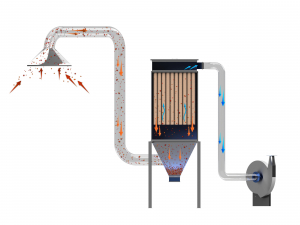
Diagram showing dust collection system from the dust pickup to the fan on the clean side of the ductwork
Dust first needs to be captured where it is generated. Branch ducts carry that contaminated air into a main duct and toward the collector. Inside a typical baghouse, dirty air enters the dirty-air plenum and passes through the filters. The tubesheet separates the dirty and clean sides of the collector.
Filtered air then travels through the outlet toward the fan and eventually to an exhaust stack or, in certain systems, back into the building. The hopper beneath the filters receives collected dust, while a rotary airlock, valve, or other discharge device removes it without leaving the collector open to outside air.
The system may also include differential-pressure monitoring, temperature sensors, hopper-level devices, pulse-jet components, conveyors, and other accessories.
▶ Watch the full answer below.
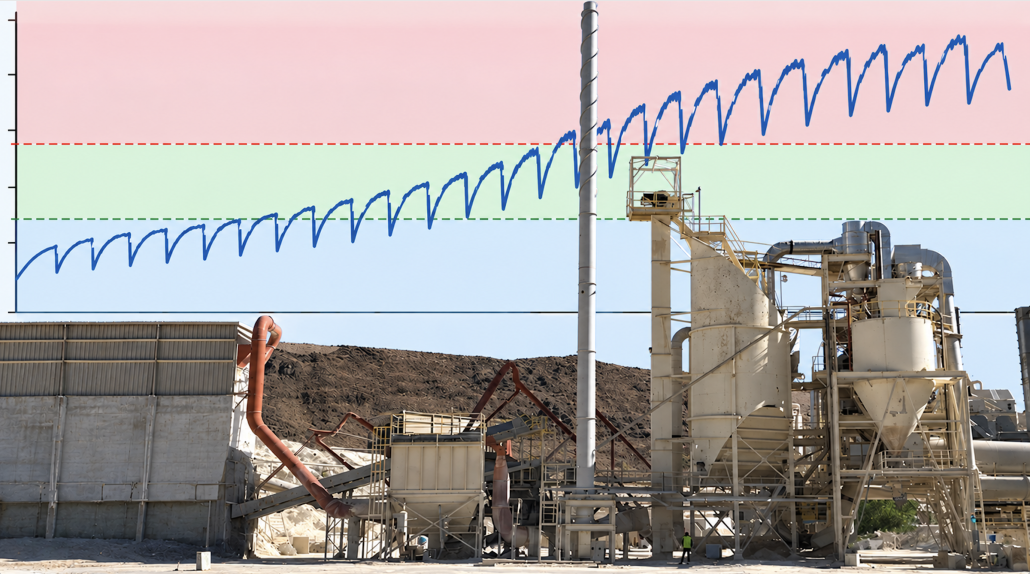
Even when nothing goes wrong with the process, baghouse filters cannot be cleaned indefinitely.
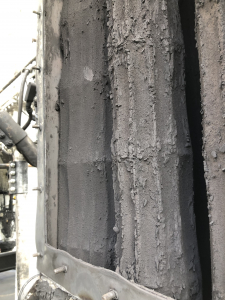 During normal operation, dust accumulates on the surface of the filter and forms a dust cake. The cleaning system periodically removes much of that surface cake. But over thousands of cleaning cycles, some fine particles work their way deeper into the filter media.
Once those particles become embedded in the depth of the material, the normal cleaning cycle can’t remove them.
The result is often increasing differential pressure and decreasing airflow. Even after the filters are cleaned, the pressure drop no longer returns to its previous level because the embedded material is still restricting the path through the media. Increasing particulate emissions can also become another indication that the filters are reaching the end of their useful life.
▶ Watch the full answer below.
A snap-band filter bag needs to be fully seated in the tubesheet so the groove between the beads captures the edge of the tubesheet and creates a proper seal.
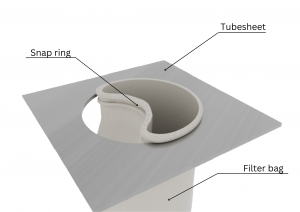
The pressure from the band pushing against the sides of the hole (when aligned correctly) forms an airtight seal.
To install it, carefully flex the snap band into a kidney shape without permanently kinking the internal metal band. Position the groove at the tubesheet and gradually work the snap band into place. As it seats, the band should “snap” into the opening.
There’s also a simple check once you’re finished: try to rotate the bag. A properly installed snap-band bag should be tight and should not freely spin in the tubesheet. The cage can then be installed inside the bag and seated correctly.
▶ Watch the full answer below.
 A cyclone is a mechanical dust separator that removes particles without using filters. Dust-laden air enters the cyclone and is forced into a spinning motion. As the airstream changes direction, particles move toward the outer wall, lose velocity, and fall out of the air.
Cyclones are frequently used as pre-filters ahead of baghouses. By removing larger or heavier particles first, the cyclone reduces the amount of material the downstream filters need to handle.
They can also serve a process function. In mining and cement applications, for example, a cyclone can be sized to separate a particular range of particle sizes. Material within that range can be recovered or returned to the process while finer particles continue downstream.
▶ Watch the full answer below.
A baghouse dust collector is an industrial filtration system that removes particulate matter from an airstream using fabric filter bags.
 Dust-laden air enters the collector and passes through the filters. Dust remains on the dirty side while filtered air passes through the media and exits the collector. As dust accumulates, the filters are periodically cleaned so collected material can fall into the hopper below.
Baghouses are used across a wide range of industrial processes because they can handle applications ranging from relatively small dust sources to very large dust loads and air volumes.
There are several baghouse configurations, and the cleaning system can vary, but the basic objective remains the same: separate particulate from the process airstream so the collected material remains in the system while filtered air exits.
▶ Watch the full answer below.
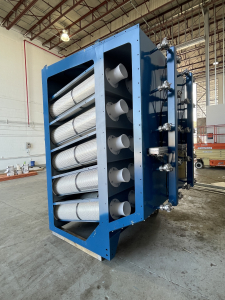 Cartridge collectors are particularly useful when you need to filter a relatively large volume of air without an extremely heavy incoming dust load.
Instead of long filter bags, these collectors use pleated cartridges that pack a large amount of filter area into a relatively compact space. A single cartridge can contain considerably more media than a conventional bag because the media is folded into pleats. That makes cartridge collectors compact and, in the right application, cost-effective.
The tradeoff is that packing so much media into a small space can make the cartridges more difficult to clean when dust loading becomes heavy. For that reason, they aren’t necessarily the best choice for every high-dust-load process.
▶ Watch the full answer below.
A bin vent is a compact dust collector installed on a silo, bin, or other vessel to filter displaced air while keeping the conveyed material inside.
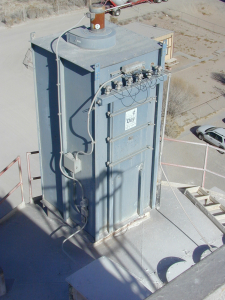
Bin vent
Consider what happens when material is pneumatically conveyed into a silo. As new material and conveying air enter, the air already inside the silo has to go somewhere. Simply sealing the vessel isn’t an option because pressure would build. The bin vent provides that escape path.
As displaced air moves through the bin vent, the filters capture entrained dust while filtered air exits. The collected material can then be cleaned from the filters and returned directly to the vessel below.
Bin vents use many of the same basic components found in other baghouse-style collectors, including filters, cleaning mechanisms, and controllers. What changes is the arrangement and application. Rather than using a conventional hopper and separate fan arrangement, the collector is commonly mounted directly on top of the equipment it is venting.
▶ Watch the full answer below.
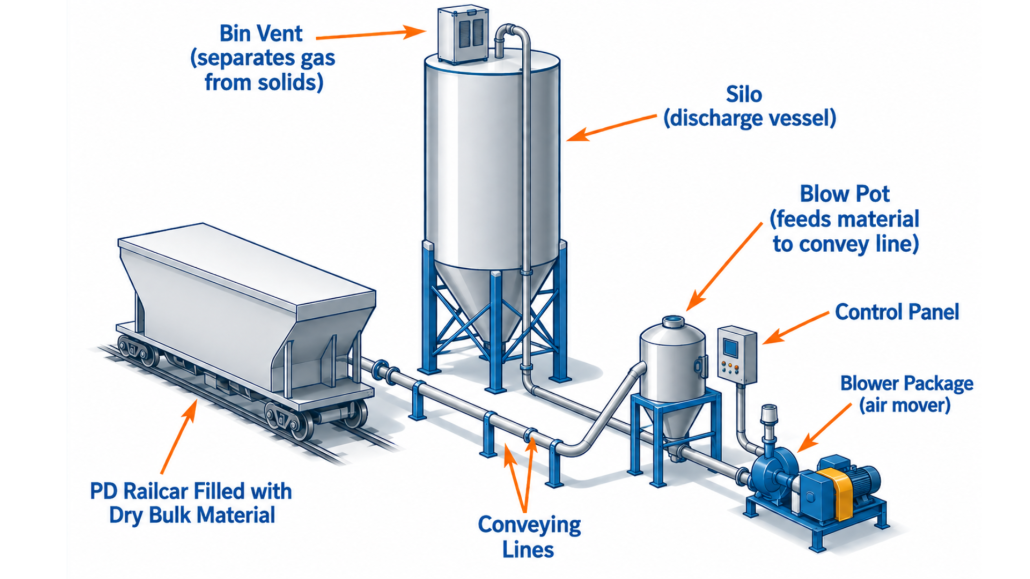
Every time bulk material is transferred, dropped, conveyed, loaded, or unloaded, there is an opportunity for dust to become airborne. That’s why material conveying and dust collection need to be considered together.
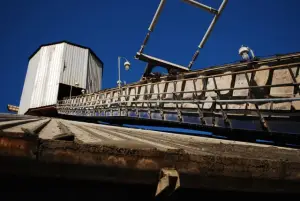 Industrial plants may use belt conveyors, bucket elevators, screw conveyors, or pneumatic conveying systems. Pneumatic conveying adds another challenge because air is intentionally used to transport the material through piping. That conveying air eventually has to be separated from the product.
Depending on the application, the dust collection equipment may take the form of a bin vent, a filter receiver, or another collector connected to the transfer point.
Mechanical conveying creates its own dust-control needs. Belt-to-belt transfers, bucket elevators, discharge points, loading stations, and similar locations can all release fugitive dust if they’re not properly captured.
A plant can therefore have a perfectly functional central baghouse and still experience a dusty facility if the individual material-transfer points aren’t adequately captured.
▶ Watch the full answer below.
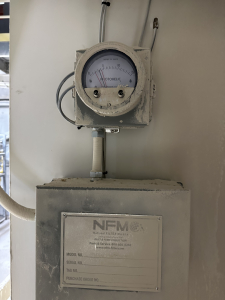 Start with differential pressure. Every dust collector should have a reliable way to measure the pressure difference across the filters because this reading is one of the most useful indicators of filter and system behavior.
Remote differential-pressure transmitters can be especially useful on collectors that are difficult to access, such as bin vents mounted high on silos.
Other useful measurements can include particulate emissions, compressed-air consumption, pulse-valve operation, dust discharge, fan vibration, fan RPM, and process temperature.
▶ Watch the full answer below.
 On a standard pulse-jet collector, the cleaning controller determines when the pulse valves fire. A basic timer controller may activate them at fixed intervals, while a clean-on-demand controller can initiate cleaning based on differential pressure.
A more complete control panel may operate the fan, rotary airlock, screw conveyor, and other equipment. Larger systems can include VFDs for fan motors and other components.
Smart control systems and remote monitoring add another layer by collecting operating data such as temperature, differential pressure, and process flow and transmitting that information for remote monitoring or alarms.
▶ Watch the full answer below.
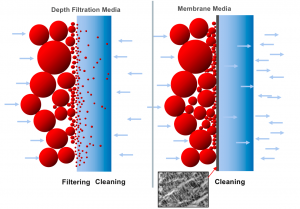
Depth filtration captures particles within multiple layers or throughout the depth of the filter media rather than primarily building a removable dust layer on its surface.
As air moves through the material, it follows increasingly small passages. Air molecules can continue through these paths while particles become trapped within the media.
This method can be extremely effective at capturing very small particles. The drawback for high-dust industrial applications is what happens after those particles accumulate. Once a depth filter becomes loaded, the trapped material generally can’t simply be pulsed off the surface. The filter eventually becomes restricted and must be replaced.
That’s a major limitation in industrial dust collection processes that continuously generate large quantities of particulate.
▶ Watch the full answer below.
Surface filtration captures dust primarily at the surface of the filter media, allowing the accumulated material to be periodically removed so the filter can continue operating.

Blinded filters with large temporary dust cake buildup will have higher leaking
A baghouse filter may use a layer of felted or woven media such as polyester or aramid. Air can pass through the openings in the material while larger particles are captured at the surface.
Dust accumulating on the surface forms a dust cake. Incoming particles then encounter this layer of previously collected material, which becomes an important part of the filtration process.
That dust cake can’t be allowed to grow indefinitely because resistance to airflow will continue increasing. The cleaning system periodically removes part of it, allowing airflow to recover.
This ability to collect dust, clean the surface, and repeat the cycle thousands of times is one of the reasons surface filtration is so useful for industrial dust collection.
▶ Watch the full answer below.

Dust Collection Expert, Technical Writer & Editor at Baghouse.com
Andy Biancotti believes that knowledge is one of the best investments any company can make. As Editor and Marketing Manager at Baghouse.com, he enjoys interviewing engineers, technicians, and customers to capture the real-world lessons behind successful dust collection projects and turn them into practical resources that others can learn from. With more than two decades of experience in industrial maintenance, operations, and technical communication, his goal is simple: help people better understand their systems so they can work safer, smarter, and more efficiently.