Transformación digital

The facility’s process had two main powder-handling areas. The first was the powder blending and packaging side. That part of the operation included three bulk bag unloading stations in the powder mixing room, a bag dump station for 50-pound ingredient bags, a vacuum filter receiver, inclined helix conveyors, a mixer, a mixed powder hopper, a sifter, a helix conveyor inlet hopper, and a powder filler. In simple terms, powders such as whey protein, soy protein, milk protein, maltodextrin, and other ingredients were unloaded, conveyed to the mixer, blended, sifted, and then sent to filling equipment. The second area was the bar kitchen side, where operators manually scaled powdered ingredients, carried them to bar kitchen mixers, and dumped them into mixing tanks with liquids to create dough for nutrition bar production.
What made the project especially interesting was that this was not a standard nuisance-dust application. The powders involved were part of a food process, which meant sanitary materials and food-grade construction mattered, but they were also combustible. So the design had to solve two problems at once: capture dust effectively where operators were creating it, and do it in a way that addressed combustible dust hazards identified in the facility’s dust hazard analysis.
Scope of Work
Our role started with early layout information and concept-level planning. We were given basic 2D CAD drawings, pickup point locations, and general information on the equipment being added. From there, we took the lead on the dust collection side and developed a practical system around how the operation would actually run.
That included engineering the capture hoods for the mixing areas, sizing the ductwork, selecting and sizing the dust collector and fan, and building the design around the real geometry of the equipment. One of the bigger challenges on the front end was that some of the mixing equipment had awkward access points and unusual angles. Product was being poured in manually, and dust was visibly billowing out during loading. Off-the-shelf hood designs were not going to solve that. We designed custom hoods to fit the way the mixers were actually being used, while still giving operators the access they needed.
Because the project was in a food production environment, we also had to account for sanitary construction. That meant stainless steel ducting, stainless hoods, and food-appropriate design choices throughout the collection side of the project. At the same time, we had to build in the combustible dust protection features required for this kind of application.
Combustible Dust Considerations
This project required more than ordinary dust control because the dust being handled was combustible. The facility’s desktop Dust Hazard Analysis reviewed the powder blending and packaging process along with the bar kitchens and identified multiple areas where combustible dust could be present, become airborne, and potentially ignite. That included the bulk bag unloading stations, bag dump station, vacuum filter receiver, mixer, powder hopper, sifter, filler, and parts of the bar kitchen process where powders were dumped into mixing tanks.
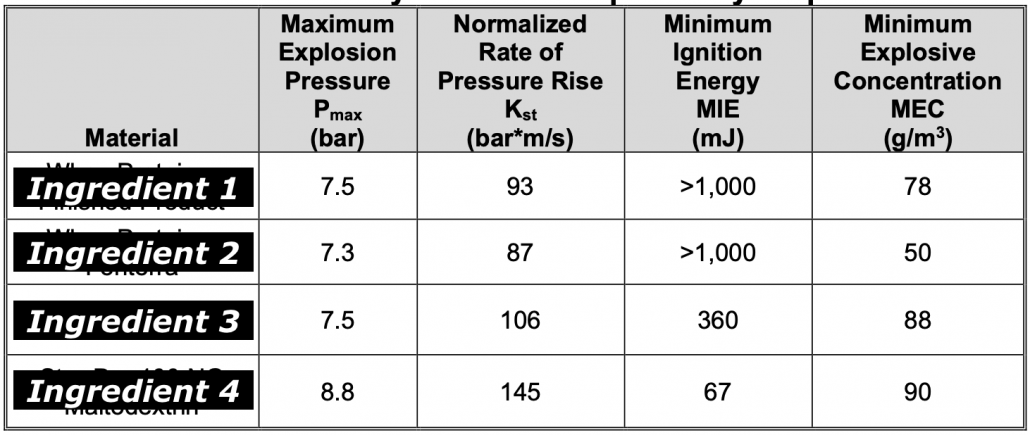
The dust testing behind the DHA showed why this mattered. Several of the ingredients handled at the facility had measurable explosibility values. Whey protein finished product tested with a Pmax of 7.5 bar and a Kst of 93 bar-m/s. A whey protein from Fonterra tested at 7.3 bar and 87 bar-m/s. Caseinate tested at 7.5 bar and 106 bar-m/s. Star-Dry 100 NG maltodextrin tested even higher at 8.8 bar and 145 bar-m/s. These are combustible dust values, and they put the materials in the St-1 range, meaning they are capable of a dust deflagration and need to be treated accordingly.
The DHA also identified process-specific concerns that are common in powder handling but easy to underestimate in food plants: fugitive dust around filling and dumping points, potential tramp metal entering the system at manual bag dump stations, the need for bonding and grounding, the need for proper housekeeping, and the importance of preventing ignition sources from turning a manageable powder-handling system into a fire or explosion event.
To address that, we included combustible dust protection equipment as part of the system design. The final package included explosion vents on the collector, an explosion-rated rotary airlock, and a Vigiflap explosion isolation valve. Those were not add-ons for appearance or for a spec sheet. They were part of making sure the dust collector was appropriate for a food powder application with documented combustible dust risk. Just as important, the overall design supported the broader needs highlighted in the DHA, including better source capture, safer handling of airborne dust, and equipment choices appropriate for a combustible dust environment.
These are some of the values the Dust Explisitivity Test included in the DHA provided. Pmax and Kst values are used for characterizing the explosive properties of a deflagration of the particular powder. The Pmax is the maximum pressure developed from an ignited dust cloud. The Kst is the rate of pressure rise from a deflagration, normalized to the volume of the testing vessel. The MIE is the amount of energy required to ignite a dust cloud. This is useful to determine which potential ignition sources generate enough energy to ignite the material. The MEC is the minimum concentration required for a deflagration.
solución
The final solution was a cartridge-style dust collection system built around an ACT cartridge collector with a top-mounted fan. Because the application needed a slightly larger fan than usual, the collector was reinforced to accommodate it. On the capture side, we designed custom hoods to fit the mixers and loading points where operators were dumping product and generating visible airborne dust. We also sized the ductwork to match those hood requirements and keep the system performing the way it was intended.
For the food side of the application, we supplied stainless steel ducting and stainless custom hoods so the system matched the hygiene expectations of the plant. For the safety side, we incorporated the combustible dust protection equipment needed for this type of powder-handling process. The result was a system that was not just intended to move air, but to capture dust where it was escaping, route it safely, and handle it in a way that fit both the production environment and the hazard profile of the materials.
One thing that helped the project move in the right direction was that the DHA did not just label the dust as combustible and stop there. It gave a clearer picture of where the higher-risk process points were. That helped guide practical design choices. In the powder blending area, the critical points were the bulk bag unloading, bag dumping, mixing, sifting, and filling steps. In the bar kitchens, the critical issue was the temporary dust cloud created when powdered ingredients were dumped into the mixing tanks. That gave us a roadmap for where local capture and properly designed collection mattered most.
Installation Challenges
Like a lot of good industrial projects, this one changed as it moved forward. The early concept work took time because the expansion itself was still being shaped. There was about a year between the early budgetary phase and final completion, with several design revisions along the way. At one point, the original engineering work from Haskell was handed off directly to 1440 Foods, and from there we worked with the customer to update the quote, revise the design, and adapt the system as the project became more defined.
Once the purchase order was released, the schedule moved much faster. Equipment was delivered in about eight weeks, and our crew then went to Jeffersonville for installation. The field work took a couple of weeks, but the install was not a simple drop-in job. Some equipment locations changed late in the process, and some of the final machine configurations were different than the earlier assumptions. That meant we had to stay flexible with the duct arrangement and make field-driven adjustments to some of the custom hood designs.
That kind of change is where a project can either bog down or keep moving. In this case, we were able to adapt without losing the thread of the overall design. The key was understanding not just what the drawing originally said, but what the system needed to do once the equipment was actually in place.
Outcome and Conclusion
The project was completed toward the end of the year, and the system was up and running once installation was finished. 1440 Foods ended up with a dust collection system that fit the real needs of the process: custom capture where powders were being dumped into mixers, properly sized ductwork and airflow, food-grade stainless construction where needed, and combustible dust protection that matched the hazard level of the materials being handled.
What makes this project a good case study is that it was not a cookie-cutter collector sale. It was a food manufacturing expansion with real process details to work around: protein powders, bar kitchen mixers, manual bag dumping, awkward hood geometry, and a DHA that made it clear the dust hazard was real. The solution had to respect production, sanitation, and safety all at once.
From our side, that meant helping define the system early, engineering it around the actual machinery and process flow, incorporating explosion protection equipment, and staying flexible during installation when last-minute field changes came up. In the end, the project was a success because the system was designed around how 1440 Foods actually operates, not around generic assumptions about food dust collection.