The situation at the Bozeman, Montana plant was somewhat different. This plant, which produces all of Gibson’s acoustic guitars, had an existing system that worked well, but that was far too small to account for increased production projections. The expansion of the facility was to take place in two stages: First, a new building was to be built while the existing building and production machines were to keep running. Once the new building was up, the layout of production machines would be completely reworked between the two buildings. Additionally, Gibson asked that the new system be designed and installed in such a way so as to not disrupt existing production and that the changeover be done with little to no downtime. The new system would also need to be able to transition into its expanded role once the facility expansion project was completed in several years.
With these challenging requirements, Baghouse.com set about engineering, supplying, and installing a new dust collection system that: (1) would provide for the current production needs, (2) be capable of nearly 3x capacity when the plant expansion was completed, (3) could be installed without disrupting production, and (4) meet or exceed existing best practice for combustible dust applications.
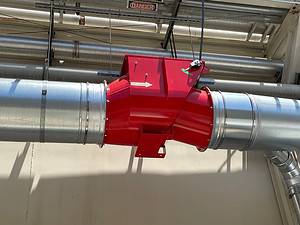
The solution proved to be a much larger multiple compartment pulse jet baghouse capable of handling 75,000 CFM+. The module (i.e. multiple compartment) style was used to provide additional redundancy and minimize downtime when conducting maintenance. Additionally, the system was outfitted with several protection devices to resolve combustible dust hazards such as high speed abort gates, spark detection, NFPA compliant rotary airlocks and explosion venting.
Importantly, during the design stage we proposed locating the new collector and fan adjacent to the existing baghouse so that it could be installed and brought online without decommissioning the existing system. When the switchover was to take place, we were able to simply extend the existing main trunk of the ductwork over to the new collector and connect the new return air ducting into the building through an enlarged wall penetration.
Eventually, once the new plant layout has been completed, a new, larger interior ductwork system will be installed and reconnected to utilize the full capacity of the new baghouse.