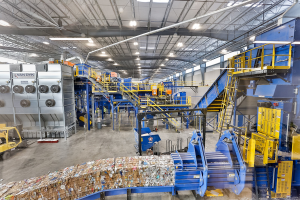
 Cuando se agrega US Ecology, now part of Republic Services, expanded its Beatty, Nevada, hazardous waste stabilization operation, the company needed a dust collection system that would be dependable, easy to operate, and appropriate for a demanding process in a remote desert environment. Baghouse.com had already supported the facility for years with maintenance, filter changeouts, bags, cages, and general dust collector support, so when the expansion project began, the team reached out to us to help define the next phase.
The Beatty site handles hazardous materials from industrial sources. Some materials are treated in other ways, but for this part of the operation, the process involves unloading hazardous material onto large concrete mixing beds and blending it with stabilizing reagents such as lime, lime kiln dust (LKD), bentonite, and similar materials. Once stabilized, the material can be managed safely as part of the site’s disposal process.
According to Dominick Dal Santo of Baghouse.com, the project started with a design role. As he explained, “They actually hired us first to design the specifications for the system and for the bid package that eventually they would send to multiple vendors.” That early involvement gave Baghouse.com the chance to shape the system correctly from the start.
The goal was straightforward: support a new building with three enclosed mixing bays, each needing reliable dust capture, simple airflow paths, and collector equipment robust enough for high dust loading from reagent mixing.
Baghouse.com’s role centered on engineering and supplying a complete dust collection package for the new stabilization building, along with a later-added reagent storage silo system.
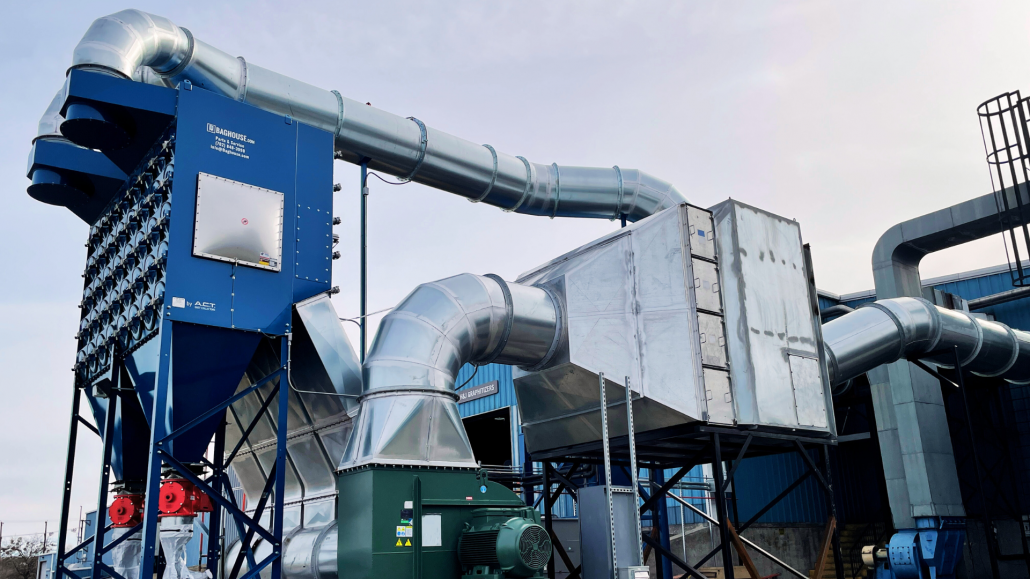
For the main dust collection portion of the project, the package included:
 ⦿ Three pulse-jet baghouse dust collectors
- ⦿ Three New York Blower fan systems
- ⦿ Three complete ductwork systems
- ⦿ Three 50-foot exhaust stacks
- ⦿ Three 14-inch rotary airlocks
Later in the project, the scope expanded to include reagent storage and unloading equipment for the materials being blended into the hazardous waste stream. That package included:
- ⦿ Two reagent storage silos
- ⦿ Two bin vent dust collectors
- ⦿ Two auger screw conveyors
- ⦿ Two slide gates
- ⦿ Truck unloading piping
The project also included engineering support for commissioning and training.
Dominick described the original design goal in very practical terms: “They had worked with somebody else at a different plant, and they had a very complicated system for the dust collection. And they asked us to simplify it and recommend all the specifications for the dust collection system.” That became one of the defining features of the project… Baghouse.com designed a straightforward system that fit the building and the process.
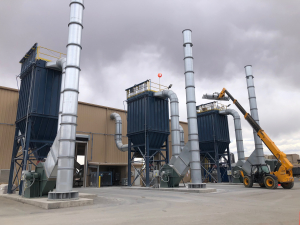 The Beatty Stab 2 project is a good example of how Baghouse.com can contribute well before equipment is built or installed. In this case, the value started with helping define the system itself. Baghouse.com served as the technical dust collection partner during the design phase, created the specification package, supplied the main equipment, and supported the project as it moved from concept to execution.
The result was a three-bay dust collection system built around straightforward source capture, appropriately sized pulse-jet baghouses, properly matched fans, and a supporting silo system for the dry reagents used in stabilization. The design also gave the plant room to operate and maintain the equipment without dealing with unnecessary duct complexity.
Just as importantly, the project built on an existing relationship. Baghouse.com had already supported the site for years before the expansion. That familiarity with the plant and its needs helped make Baghouse.com a more useful engineering partner when it came time to scale up.
For facilities planning a new hazardous materials process, expanding a reagent handling system, or simply trying to avoid overcomplicating a new dust collection installation, this project shows the value of involving dust collection specialists early.