
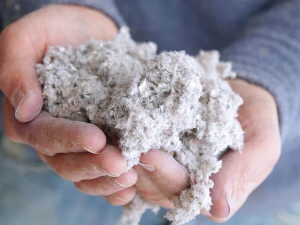
 El polvo de papel y empaque es engañosamente ligero. Las fibras de celulosa, el polvo de tissue y las partículas finas de cartón no caen al suelo como lo hacen otros polvos industriales más pesados. Permanecen suspendidos en el aire, se desplazan por toda la planta y se depositan en lugares que los operadores rara vez inspeccionan. Procesos como corte, rebobinado, troquelado, transporte, enfardado y acabado generan partículas finas que se dispersan rápidamente si las velocidades de captación disminuyen aunque sea un poco.
Aquí es donde muchos sistemas fallan. Las campanas suelen estar subdimensionadas, las velocidades en los ductos y los cálculos de flujo de aire se basan en reglas generales que no consideran el comportamiento del polvo fibroso. Como suele decir Matt Coughlin, dueño de Baghouse.com: “El polvo de papel no te avisa. Si el flujo de aire no es correcto, ¡simplemente vuela! Para cuando lo ves en el piso, ya estuvo en el aire durante todo el turno”. Un control de polvo efectivo en estas instalaciones comienza en la fuente, con un flujo de aire constante y un diseño de ductos que mantenga el material en movimiento en lugar de dejar que se asiente.

Los colectores tipo Baghouse pueden manejar altas cargas de polvo sin perder estabilidad
Los colectores tipo baghouse son especialmente adecuados para polvo de cartón, papel, tissue y empaque porque pueden manejar altas cargas de polvo sin perder estabilidad. A diferencia de los colectores de cartucho, que pueden cegarse rápidamente en aplicaciones fibrosas, los colectores permiten que se forme una torta de polvo que se libera de manera más predecible cuando se limpia correctamente. Esta estabilidad es clave en operaciones donde el flujo de aire debe mantenerse constante para proteger la calidad del corte, la remoción de recortes y el manejo de materiales.
Cuando están equipados con jaulas, protección contra desgaste y sistemas de limpieza controlados por presión diferencial, estos sistemas mantienen una caída de presión más baja y estable, prolongan la vida de los filtros y reducen el consumo de aire comprimido. También se adaptan bien a grandes volúmenes de aire, comunes en operaciones de conversión y corrugado. En instalaciones que manejan mezclas de polvo (fibras de papel, aditivos minerales y partículas plásticas), ofrecen una flexibilidad que otros sistemas más simples no pueden igualar.

NFPA 660: Normativas para polvos combustibles y partículas sólidas (2024)
El polvo de papel y cartón está clasificado como combustible por OSHA y NFPA, lo que significa que los sistemas de control de polvo deben diseñarse considerando el riesgo de explosión. Un colector de polvo es un recipiente cerrado lleno de combustible suspendido; sin la protección adecuada, puede convertirse en el equipo más peligroso de la planta.
La ventilación de explosión,, los dispositivos de aislamiento, las compuertas antirretorno y la correcta conexión a tierra son componentes esenciales de un sistema seguro, especialmente cuando el aire filtrado se recircula al área de trabajo. La experiencia ha demostrado que ignorar esto puede tener consecuencias catastróficas. Como menciona Matt Coughlin: “El control de polvo reduce el riesgo en toda la planta, pero solo si el colector está diseñado para fallar de forma segura”.
¿Por qué el polvo de papel y cartón es tan peligroso?
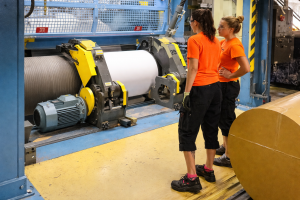 El polvo de papel y cartón es peligroso porque combina tres problemas al mismo tiempo: es respirable, combustible y altamente volátil. Cuando está suspendido en el aire, incluso concentraciones relativamente bajas pueden encenderse si hay una fuente de ignición presente. Cuando se le permite asentarse, el polvo se acumula rápidamente sobre superficies horizontales, creando combustible para explosiones secundarias. Desde el punto de vista de la salud, la exposición prolongada también contribuye a una mala calidad del aire interior y a problemas respiratorios, particularmente en operaciones de papel tissue y papel fino.
¿Las plantas de papel y las instalaciones de empaque realmente necesitan un análisis de riesgo de polvo (DHA)?
Si hay polvo combustible presente, sí. La norma NFPA 660. requiere que las instalaciones que generan, manejan o almacenan polvo combustible realicen y documenten un análisis de riesgo de polvo. Esto no es solo un trámite administrativo. Un DHA correctamente ejecutado identifica dónde se genera el polvo, cómo se mueve a través de la instalación, dónde puede acumularse y qué fuentes de ignición existen. Las instalaciones que omiten este paso a menudo terminan abordando los problemas de manera reactiva después de un incidente o una inspección.
¿Qué hace que el polvo de papel sea más difícil de capturar que el polvo industrial más pesado?
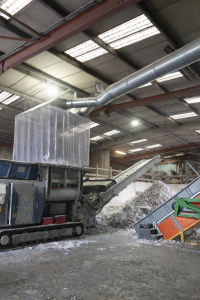
Agregar tiras adicionales de cortina de PVC a la campana de captación del sistema de extracción de polvo de la trituradora cumple dos propósitos; en primer lugar, ayuda a contener cualquier partícula de polvo en suspensión dentro de este recinto y, en segundo lugar, permite la carga manual de la tolva de la trituradora.
El polvo de papel tiene una baja densidad aparente y una estructura fibrosa que le permite permanecer suspendido en el aire por más tiempo y adherirse a las paredes de los ductos. Esto significa que las velocidades de captación deben mantenerse de manera constante, las transiciones en los ductos deben ser suaves y se deben evitar zonas muertas. Pequeñas pérdidas en el flujo de aire que podrían pasar desapercibidas en otras industrias se manifiestan rápidamente como polvo visible en operaciones de papel.
¿Son suficientes los ciclones para el polvo de papel y cartón?
Los ciclones son efectivos para remover recortes y residuos más grandes antes de que el aire llegue al colector, y pueden reducir significativamente la carga sobre los filtros. Sin embargo, no son suficientes por sí solos. El polvo fino de papel requiere filtración de alta eficiencia, que es donde un colector tipo baghouse se vuelve esencial. Los sistemas más confiables utilizan ciclones para una primera filtración y colectores tipo baghouse para la filtración final.
¿Por qué los filtros parecen taparse tan rápido en aplicaciones de papel?
El taponamiento generalmente es un síntoma, no el problema raíz. Las causas comunes incluyen flujo de aire inestable, un método de limpieza incorrecta, jaulas dañadas o reutilizadas que restringen el movimiento del filtro y lecturas inexactas de la presión diferencial. Cuando la limpieza se controla con base en la caída de presión real en lugar de un temporizador, el rendimiento y la vida útil de los filtros mejoran de manera significativa.
¿Con qué frecuencia deben reemplazarse los filtros en plantas de papel?
No existe un intervalo de reemplazo estándar. Los filtros deben cambiarse con base en las tendencias de rendimiento, no en fechas del calendario. Cuando la presión diferencial ya no se estabiliza después de la limpieza, o cuando las emisiones aumentan a pesar de una operación adecuada, es momento de investigar. El monitoreo preciso es clave; sin él, los filtros a menudo se reemplazan demasiado pronto o demasiado tarde.
 ¿El control de polvo realmente puede reducir las interrupciones a la producción en plantas de empaque?
 ¿El control de polvo realmente puede reducir las interrupciones a la producción en plantas de empaque?
Sí, y a menudo de formas que los operadores no relacionan de inmediato con el polvo. Un flujo de aire estable mejora la remoción de recortes, reduce atascos en enfardadoras y transportadores, disminuye el trabajo de limpieza y protege equipos sensibles. Las instalaciones con sistemas de control de polvo bien diseñados pasan menos tiempo reaccionando y más tiempo produciendo.
¿Cómo apoya Baghouse.com a las instalaciones de papel y empaque?
Baghouse.com aborda estas aplicaciones diseñando sistemas en función del comportamiento real del polvo y las demandas de producción, no con tablas genéricas de flujo de aire. Esto incluye un diseño adecuado de campanas, distribución de ductos que resista la acumulación, selección del colector acorde a las características del polvo, protección contra explosiones integrada al sistema desde el inicio y soporte continuo para mantener el rendimiento conforme cambian las condiciones.