Five icons illustrating ways to improve pulse-jet baghouse efficiency through proper filter installation, pulse cleaning, precoat powder, leak detection, and system monitoring.

Something is not right with my pulse-jet baghouse. Should I change the filters? Should I upgrade the whole system? Wait! Before spending thousands of dollars on new filters or equipment, let's look together at how the existing system is operating.

Throughout our years of experience in the dust collection field, Baghouse.com technicians have seen plenty of instances where a dust collector could perform better with a few simple adjustments. Many of the most common problems can be corrected without a major investment.

Five icons illustrating ways to improve pulse-jet baghouse efficiency through proper filter installation, pulse cleaning, precoat powder, leak detection, and system monitoring.

Here we share five practical ways to improve your pulse-jet baghouse‘s performance, reduce compressed air consumption, and extend filter life.

1. Make Sure Your Filter Bags Are Installed Correctly

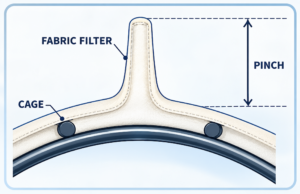
  • Technical diagram showing filter bag pinch, the excess fabric between a baghouse filter and its support cage, with measurement arrows.

    Filter bag pinch is an important measurement when matching filter bags to their support cages. Incorrect sizing can contribute to premature filter wear.

    It might sound obvious, but improper filter installation is one of the easiest ways to create problems inside a baghouse. A filter bag that doesn’t fit its cage correctly can experience excessive movement during cleaning. Over time, this can cause abrasion, premature failure, and particulate emissions.

    One important measurement is the filter bag pinch, which refers to the amount of excess fabric when the bag is fitted around its support cage. Why is the bag pinch so important? Because it helps the dust cake release after the compressed air hits the bag, inflating it.

    You can calculate it using this formula:

    Pinch = (Bag Circumference − Cage Circumference) ÷ 2

    The correct amount depends on the filter material and cage design.

Comparison table showing recommended filter bag pinch measurements and support cage types for felt, ePTFE membrane, PPS, P84, and fiberglass filters.

Snap-band filters should sit evenly in the tubesheet without wrinkles or gaps. Gaskets and O-rings shouldn’t be pinched by clamps, and flanges or cuffs should lie smoothly against the cage.

For bottom-loading designs, we recommend positioning seams 180 degrees from the cage collar gap. Also, orient bag seams approximately 45 degrees from the aisle and clamps 90 degrees from the seams, where the filter design allows.

Keeping seams and clamps consistently oriented can also make future inspections easier.

Watch the following clip from an in-person training class provided by Dominick Dal Santo, Sales Director & Baghouse Expert.

2. Switch to Clean-on-Demand Pulse Cleaning

  • Many older pulse-jet baghouses clean their filters using a fixed timer, regardless of whether the filters actually need cleaning. Others depend on an operator to manually start and stop the cleaning cycle. Both approaches can waste a lot of compressed air (which can be very expensive on your electric bill!)

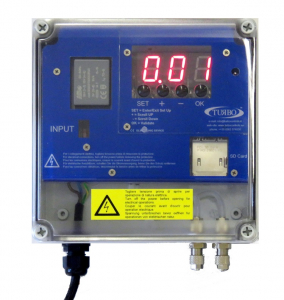
    Differential pressure controller for dust collector

    A controller allows for smart cleaning cycles based on the differential pressure (Clean-On-Demand)

    A more efficient option is a clean-on-demand controller, which automatically activates the pulse-cleaning system based on differential pressure. A differential pressure gauge or switch, such as a Photohelic, monitors the pressure difference between the dirty-air and clean-air sides of the baghouse. When differential pressure reaches a predetermined high setting, the controller starts the cleaning cycle. Once pressure falls to the lower setting, cleaning stops.

    Why is this useful?

    Because cleaning only when necessary reduces compressed air consumption and unnecessary filter wear. It can also help maintain a more consistent differential pressure without requiring operators to continually adjust the cleaning system.

    If your baghouse still relies on manual cleaning or a basic timer, upgrading the controller may be one of the most cost-effective improvements available.

Watch the following clip from an in-person training class provided by Dominick Dal Santo, Sales Director & Baghouse Expert.

3. Optimize the Pulse-Cleaning Sequence

Even with automatic cleaning, the way your baghouse pulses its filters can affect performance. In some systems, the controller cleans adjacent rows one after another. The problem is that dust released from one row can be carried by internal airflow and deposited onto filters that were just cleaned. This is especially troublesome in baghouses with high can velocity or limited space between filters. Repeated redeposition can contribute to filter blinding, increased differential pressure, and shorter filter life.

One solution is to adjust the pulse sequence cleaning so that adjacent rows aren’t cleaned immediately after one another. For example, instead of cleaning ten rows in numerical order, a controller might use the following sequence:

1, 4, 7, 10 → 2, 5, 8 → 3, 6, 9

This gives dislodged dust more opportunity to settle before nearby rows are pulsed.

Another important consideration is compressed air header pressure. If the header hasn’t recovered sufficiently between pulses, some rows may receive weaker cleaning pulses than others. A controller that verifies adequate header pressure before firing can improve cleaning consistency.

Pulse duration matters too. Many systems use short pulses around 0.1 seconds, although the appropriate duration depends on the valve, blowpipe, and collector design. Longer pulses don’t automatically mean better cleaning. They may simply consume more compressed air.

Watch the following clip from one of our Q&A sessions during one of our webinars.

4. Consider Precoat Powder When Installing New Filters

With conventional fabric filtration, a layer of collected dust gradually develops on the filter surface. This dust cake helps capture fine particles.

When brand-new filters are installed, that protective layer hasn’t formed yet. In certain applications, particularly those involving moisture or difficult dust characteristics, this can create problems during startup.

Applying a suitable filter precoat powder can help establish an initial filtration layer before process dust reaches the filters. Precoat can also help protect the media from certain sticky or moisture-related deposits, potentially reducing premature blinding.

However, precoat is not always recommended. For example, membrane filters such as ePTFE operate primarily through surface filtration and don’t depend on a conventional dust cake in the same way as standard felt filters.

Before applying precoat, verify compatibility with the filter media, collected material, and process conditions. For suitable applications, though, precoating new filters can be a relatively inexpensive way to improve startup performance and protect your investment.

Line graph comparing baghouse differential pressure with and without precoat powder, showing a rising pressure trend without precoat and a more stable trend with precoat.

Watch the following clip from an in-person training class provided by Dominick Dal Santo, Sales Director & Baghouse Expert.

5. Use Leak Detection Testing and Better Monitoring

Sometimes a baghouse appears to be operating normally, but particulate emissions are increasing. A damaged filter bag, poorly seated snap-band, leaking gasket, or cracked tubesheet can allow dust to bypass the filtration system.

The challenge is finding the source. Manually inspecting hundreds or thousands of filter bags can take considerable time, and small holes or damaged seams aren’t always visible.

Un fluorescent leak detection test offers a practical alternative. During the test, specially formulated fluorescent powder is introduced into the dirty-air side of the collector. After following the appropriate test procedure and safely shutting down and isolating the equipment, technicians inspect the clean-air plenum using a compatible ultraviolet or blue inspection light.

Where powder has passed through a leak, it becomes visible under the inspection light. This can help locate damaged filter bags, leaking seams, improperly installed filters, and defects around tubesheets or welded joints. It’s often much faster than removing every filter to search for a small leak.

Beyond leak testing, consider integrating your baghouse controls into a central monitoring system. Differential pressure readings, cleaning cycles, timer settings, and other operating information can be displayed through a control panel or connected to a PLC.

Having this information available in one place makes it easier to identify unusual operating trends before they develop into expensive problems.

Watch the following clip from a virtual training class provided by Dominick Dal Santo, Sales Director & Baghouse Expert.

Small Improvements Can Add Up to Significant Savings

Improving baghouse efficiency doesn't always require a new collector, larger fan, or complete filter replacement. Sometimes, the best improvements come from one of these 5 points we shared. At Baghouse.com, we help industrial facilities troubleshoot existing dust collection systems and identify practical improvements that make sense for their equipment and operating conditions.

Four production changes that affect baghouse operation, their impact on dust collector performance, and recommended solutions.

A new production line gets installed, a different material is introduced, or operating hours are extended. Everyone focuses on getting the equipment running, but what about the baghouse?

It’s always good to remember that dust collection systems are designed around specific operating conditions. When those conditions change, the baghouse may no longer be able to keep up with the demands of the facility.

Four production changes that affect baghouse operation, their impact on dust collector performance, and recommended solutions.

We’ve seen plants struggle with poor airflow, premature filter failures, and increased emissions simply because their production processes changed while their dust collection systems stayed the same.

Here are four common changes that can affect baghouse performance and what you should consider before making them.

1. Expanding Production or Adding New Equipment

Maybe the plant added another production line, installed a larger machine, or increased output to meet growing demand. The existing baghouse was working fine before, so the natural assumption is that it can handle a little more dust. However, every dust collection system is designed to handle a certain volume of air, measured in cubic feet per minute (CFM). Adding new equipment often means adding more capture points, which increases the total airflow required.

For example, imagine a baghouse designed to handle 20,000 CFM. The facility adds two new machines that each require 3,000 CFM of dust collection. Suddenly, the system needs 26,000 CFM to provide the same level of dust capture at every machine. If the fan can’t provide the additional airflow, suction may decrease throughout the system. Dust that was previously captured at the source may begin escaping into the facility.

Even if the fan can deliver more air, the baghouse itself may not have enough filter area to handle the increased volume. This can raise the air-to-cloth ratio, increase differential pressure, and shorten filter life.

Related articles:

Ductwork diagram new process

What should you do?

Before connecting new equipment to an existing dust collector, calculate the additional airflow requirements and compare them with the system’s actual capacity.

Sometimes, adjustments to the fan, ductwork, or filtration area can accommodate the expansion. Other times, adding a separate collector or replacing the existing system is the better long-term solution.

"Just because there's room to connect another duct doesn't mean the fan can handle another 5,000 CFM. Before expanding, a brief call with a dust collection expert may help you calculate accurately how much airflow you're actually getting and how much the new equipment will require."

2. Changes to Air Permits or Emissions Requirements

A facility may receive an updated air permit with stricter particulate emissions limits, new monitoring requirements, or different operating conditions. The baghouse might still be operating exactly as it was designed, but that doesn’t necessarily mean it meets the facility’s current permit requirements.

For example, a dust collector that previously met its emissions limits using standard polyester filter bags might need higher-efficiency filter media to achieve a lower particulate emissions limit. In other cases, the facility may need additional monitoring equipment, such as a particulate emissions detector, to identify potential filter leaks.

It’s also important to understand that a low differential pressure reading doesn’t guarantee low emissions. A baghouse can show normal operating pressure while damaged filters, leaking seals, or improperly installed bags allow dust to pass through.

Another situation occurs when production increases beyond the operating conditions authorized by the existing permit. Even if the dust collector can physically handle the additional airflow, the facility may need to review its permit before making the change.

Related article: How Do Baghouse Dust Collection Systems Help Facilities Stay in Air Quality Compliance?


What should you do?

Whenever your air permit changes, review the requirements with your environmental team and determine whether the existing dust collection system can meet them. This may involve evaluating filter media, inspecting the system for leaks, upgrading monitoring equipment, or making other modifications.

The three key entities involved in combustible dust issues: OSHA, NFPA and AHJ

3. Changing Fuels, Raw Materials, or Finished Products

Different materials produce dust with very different characteristics. Particle size, moisture content, chemical composition, abrasiveness, and operating temperature all influence how a dust collector performs.

Consider a facility that switches to a different fuel source. The resulting exhaust gases may contain more moisture, operate at a different temperature, or introduce chemical compounds that weren’t present before. Those changes can affect the filter media.

Por lo general, polyester filters can perform well in many industrial applications, but prolonged exposure to elevated temperatures and moisture can cause hydrolysis, weakening the fibers and shortening filter life. A different fuel might also produce finer or stickier particles, making the dust more difficult to remove during pulse cleaning.

The same issue can occur when a manufacturer changes products. A facility that previously handled relatively coarse, free-flowing dust may begin producing a much finer powder. The existing filter media might not be the best choice for capturing or releasing that material.

And if the new product generates combustible dust, the implications go beyond filtration performance. The facility may need to reevaluate its Dust Hazard Analysis (DHA) and review its fire and explosion protection systems.

What should you do?

Before changing fuels or materials, evaluate how the new process will affect the dust and gas stream entering the collector. Pay particular attention to temperature, moisture, particle characteristics, chemical compatibility, and combustibility.

In some cases, selecting a different filter media or adjusting the cleaning system may be enough. In others, more substantial changes to the dust collection system may be necessary.

Indoor Air Quality (IAQ) testing provides the data needed to understand airborne particulate levels, evaluate exposure, and establish a clear baseline for improvement.

4. Changing Production Schedules or Recirculating Filtered Air

Two operational changes that often get overlooked are extending production hours and changing what happens to the filtered air leaving the baghouse. Both can have a significant impact on how the system should be operated and maintained.

Running Longer Hours With Less Downtime

Imagine a facility that originally operated five days a week, eight hours per day. The maintenance team had evenings and weekends available to inspect the baghouse, replace worn components, and address problems before production resumed. Now the plant moves to two or three shifts, operating six or seven days a week. The dust collector is running much more often, but the maintenance schedule hasn’t changed. Filters accumulate operating hours faster, pulse valves cycle more frequently, and fans, bearings, and dust discharge equipment experience additional wear.

At the same time, there are fewer opportunities to shut down the system for inspections and repairs. A maintenance program based on the old production schedule may no longer be adequate. Rather than relying entirely on calendar-based maintenance, facilities should begin tracking operating hours, differential pressure trends, pulse-cleaning performance, and other indicators of equipment condition.

It’s also worth reviewing critical spare-parts inventory. When production runs continuously, waiting several days for a replacement pulse valve or filter cage can become a costly problem.

Related article: Baghouse Preventive Maintenance vs. In-House Maintenance

Recirculating Filtered Air to Reduce Heating Costs

Another change we see, especially in colder climates, is the decision to return filtered air from the dust collector back into the building. If a facility is exhausting thousands of cubic feet of heated indoor air every minute, replacing and reheating that air can be expensive during winter.


Recirculating properly filtered air may reduce heating costs, but it introduces additional safety and design considerations. A dust collector originally designed to exhaust outdoors may not provide the level of filtration, monitoring, or safeguards needed for indoor air recirculation. Depending on the dust being collected, the facility may need higher-efficiency filtration, HEPA after-filters, particulate monitoring, or automatic diversion systems.

Facilities handling combustible or hazardous dust must also consider whether recirculation is permitted and what additional protective measures are required.

What should you do?

Before recirculating filtered air, have the system evaluated to confirm that the proposed arrangement meets applicable safety, ventilation, and environmental requirements.

Different stages of a HEPA after filter
Comparison table showing four production changes that affect baghouse performance, their impact on dust collection systems, and recommended solutions.

The Bottom Line: Your Baghouse Needs to Keep Up With Your Facility

Production changes are a normal part of running a successful industrial facility. Equipment gets upgraded, output increases, materials change, and operating schedules evolve. But your dust collection system needs to evolve along with everything else.

The key is to include dust collection in the planning process whenever significant production changes are being considered.

En Baghouse.com, we help facilities evaluate existing dust collection systems, troubleshoot performance problems, and determine whether upgrades or modifications are needed.

Planning changes at your facility? We'll be happy to help you evaluate your dust collection system before small changes turn into expensive problems.

Predictive dust collector maintenance webinar for industrial maintenance teams

Is Your Maintenance Program Preventing Problems... or Just Reacting to Them?

Predictive dust collector maintenance webinar for industrial maintenance teams

Free webinar on building a preventive and predictive dust collector maintenance program.

A dust collector rarely fails without warning. Rising differential pressure, declining airflow, increased compressed-air consumption, unusual vibration, visible emissions, and recurring hopper problems can all indicate that something is changing. The challenge is recognizing these warning signs early enough to take action.

In this free webinar, Baghouse.com will explain how to move beyond emergency repairs and establish a more structured preventive and predictive maintenance program. Instead of waiting until airflow drops or production is interrupted, your team can use inspections, operating baselines, performance trends, and critical spare-parts planning to make better maintenance decisions.

Read the article featured in Bulk Inside Magazine.

This practical session is designed to help maintenance teams reduce unexpected downtime, extend filter life, improve system performance, and plan repairs before small problems become expensive failures.

¿Qué puntos se analizarán en el Webinar?

This webinar is especially useful for professionals responsible for dust collection performance, equipment reliability, safety, and production, including:

  • ⦿ Maintenance managers and technicians

    ⦿ Plant managers

    ⦿ Operations managers and supervisors

    ⦿ Reliability engineers

    ⦿ EHS managers and safety professionals

    ⦿ Process and project engineers

    ⦿ Dust collection and air-pollution-control specialists

    ⦿ Anyone responsible for inspecting, troubleshooting, or maintaining industrial dust collectors

Cómo conectarse

Baghouse.com free webinars¡Asistir al webinar es muy sencillo! Solo tienes que registrarte utilizando el enlace a continuación. Una vez registrado, recibirás un correo de confirmación con todos los detalles para conectarte. ¡No te lo pierdas!

How To Build a Predictive Maintenance Program for Your Dust Collection System?

📅 Date: Wednesday, November 18, 2026
⏰ Hora: 13:00 (hora del Este - EST)
📍 Location: Zoom

¡Nos encantaría que asistieran tú y tu equipo!

Watch a preview of the webinar:

Dust Collection Explained video series

In negative-pressure baghouses, leaks in the ductwork, access doors, or airlocks can allow cooler outside air to enter the system. When that air mixes with hot process gas, it can lower local temperatures and cause moisture to condense.

This moisture can lead to corrosion, particularly around leaking door gaskets, airlock flanges, and damaged duct connections. Even relatively small openings can introduce unwanted air and affect operating conditions. That’s why rust around doors and airlocks is often a warning sign of air infiltration.

Related article: Cómo prolongar la vida útil de un colector con recubrimiento cerámico

▶ Watch the full answer below.

2. How Can I Tell If My Snap-Band Filter Bag Is Installed Correctly?

A properly installed snap-band filter bag should be fully and evenly seated in the tubesheet opening.

One common mistake is installing the bag crooked or leaving a small portion of the snap band above the tubesheet. The bag may look secure even though it isn’t completely seated. A simple check is to gently try twisting the bag after installation. If it rotates easily, the snap band may not be properly engaged.

▶ Watch the full answer below.

3. Why Do I Need Clean, Dry Compressed Air for My Pulse-Jet Baghouse?

Moisture, oil, and dirt in the compressed air supply can damage pulse valves, interfere with filter cleaning, and shorten filter life. Water can contribute to corrosion, while oil and other contaminants can affect valve operation and filter performance.

Installing appropriate filtration and moisture-removal equipment before the compressed air enters the baghouse headers helps protect the cleaning system.

Related article: The Importance of Dry and Clean Compressed Air in a Pulse Jet Dust Collector

▶ Watch the full answer below.

4. What Temperature Should I Monitor in My High-Temperature Baghouse?

The most important temperature to monitor is the gas temperature entering the baghouse, because that’s the temperature the filters will be exposed to.

High-temperature systems typically operate below the filter media’s maximum temperature rating to provide a safety margin for unexpected temperature spikes.

Related article: ¿Qué factores hay que tener en cuenta al diseñar un colector de polvo de alta temperatura?

▶ Watch the full answer below.

5. How Can I Tell If My Baghouse Filters Are Starting to Leak?

One effective method is monitoring particulate emissions at the exhaust stack using a triboelectric broken-bag detector. These instruments detect electrical signals associated with dust particles passing a probe.

A sudden increase in the signal may indicate a torn filter or significant leak. A gradual increase can indicate a developing emissions problem that needs further investigation.

Related article: Find Leaking Baghouse Filters Faster with a Triboelectric Broken Bag Detector

▶ Watch the full answer below.

6. Should I Replace One Leaking Filter Bag or Change the Whole Set?

Replacing an individual leaking filter bag can be a necessary temporary repair, but repeatedly changing one or two bags may not be the best long-term solution.

A new filter typically has less resistance than older, dust-loaded filters. This can cause uneven airflow distribution and additional loading in certain areas. When the entire set is approaching the end of its useful life, replacing all the filters together is generally preferable.

Related article: Should I Change All My Filter Bags at Once or Just Spot Change as Needed?

▶ Watch the full answer below.

7. How Do I Find a Leak in My Filters With a Dye Leak Test?

A fluorescent dye leak test helps identify small leaks that may be difficult to find through visual inspection.

With the cleaning system disabled, fluorescent tracing powder is introduced into the operating dust collector. After safely shutting down and isolating the system, technicians inspect the clean-air side using a UV light. Fluorescent deposits reveal where powder has passed through leaking filters, improperly seated snap bands, or other openings.

Dye leak testing is especially useful after filter change-outs to verify proper installation. If emissions remain elevated but no localized leak is found, further investigation of overall filter condition and system performance may be necessary.

Related article: ¿Cómo saber si tu sistema de recolección de polvo tiene fugas?

▶ Watch the full answer below.

An Educated Customer Makes Better Decisions

That’s the goal of our Todo Sobre Control de Polvo Industrial series: to break down industrial dust collection one practical question at a time and help plant operators, maintenance teams, and engineers better understand what’s happening inside their systems.

Have another dust collection question you’d like us to answer? Contact Baghouse.com or send us your question. It may become one of the next topics in the series.

How Do I Know If My Plant Has Outgrown Its Dust Collection System

Your plant may have outgrown its dust collection system if production has increased, new pickup points have been added, or processes have changed while the original collector, fan, and ductwork remain essentially the same.

Common signs include poor capture at distant hoods, dust buildup, higher filter loading, frequent cleaning, and airflow that no longer meets the process requirements.

Industrial ventilation ductwork coated in heavy combustible dust with a blocked airflow warning icon

We run into this fairly often during dust collection system inspections. The collector may have worked well when it was installed. Ten years later, the plant is producing more material, conveyors have been added, and three new branches are connected to the ductwork.

Meanwhile, the same fan and collector are expected to handle everything.

What Happens When You Add More Pickup Points?

Every pickup point needs a certain amount of airflow. If an existing system was designed for 15,000 CFM and you add equipment requiring another 5,000 CFM, you don’t automatically have a 20,000 CFM system. That additional air has to come from somewhere.

If the fan and system cannot provide it, airflow gets redistributed. Some hoods may still work reasonably well while others lose capture. Duct velocities can also fall below the level needed to transport the dust effectively.

This is especially important with combustible dust systems because modifying or adding branches changes airflow elsewhere in the network.

“When we inspect an older system, one of the first things I want to know is what has changed since it was originally installed. A lot of times, the collector didn't get smaller. Production increased."

Watch the following interview with Matt Coughlin, President and Engineer at Baghouse.com, where he gives tips on how to know if your dust collector is underperforming.

What Are the Signs That the System Is Running Out of Capacity?

The following table with help you troubleshoot your system.

How Do I Know If My Plant Has Outgrown Its Dust Collection System

Can the Collector Be Big Enough but the System Still Perform Poorly?

Absolutely. Suppose your collector can handle 25,000 CFM, but the fan can only deliver 19,000 CFM against the resistance of the current system. Or perhaps the fan is adequate, but years of ductwork modifications have created restrictions and poor branch balancing.

That’s why we measure systems in the field rather than deciding collector capacity from the nameplate. Fan performance depends on both airflow and system resistance, and the fan needs to operate at the appropriate point on its performance curve.

A Recent Example From the a Limestone Quarry Inspection

We recently inspected a limestone quarry and lime production facility where processing capacity had increased over the years. Additional conveying equipment and pickup points had been added, but the existing cartridge collector remained.

By the time we inspected it, that collector was serving roughly five to six pickup points under a substantially higher dust load. The ductwork also contained routing and branch-connection issues that were consuming static pressure.

The collector itself was in good condition. It simply wasn’t the right collector for what the plant was asking it to do anymore. Our recommendation was to properly size a new baghouse for the current application and reuse the existing cartridge collector somewhere else in the facility where its capacity made sense.

Should You Replace the Collector or Upgrade the Existing System?

Before recommending a replacement, we would typically want to know the actual CFM at key pickup points, duct velocities, collector differential pressure, system static pressure, fan RPM/current, filter condition, and current process requirements.

Sometimes the solution is a larger collector. Other times it may involve fan changes, ductwork modifications, rebalancing, better hood design, or separating part of the process onto another collector. The objective is to find where the system is running out of capacity.

In the following video, Dominick Dal Santo, Sales Director & Technical Advisor, Baghouse.com reviews the key to monitor a dust collector performance.

If your plant has expanded but your dust collection system hasn't, Baghouse.com can perform a system inspection and airflow evaluation to determine where the current limitations are before you invest in new equipment.

Preguntas frecuentes

Possibly, but don’t assume that an unused connection or available space on the ductwork means the system has spare capacity. Adding another pickup point changes the airflow distribution throughout the system.

Before adding it, determine the new pickup’s required CFM and verify that the fan, collector, and ductwork can handle the additional airflow while maintaining adequate conveying velocity in the existing branches. If the system is already operating near its design capacity, the new pickup may simply take airflow away from other hoods.

No. An undersized collector is only one possible cause. Low airflow can also result from a fan operating below its intended speed, a VFD setting, worn or slipping belts, duct buildup, partially closed dampers, poorly designed branch connections, air leaks, or changes made to the ductwork over the years. We normally recommend measuring airflow and static pressure at several locations before concluding that the collector itself needs to be replaced.

Yes. Higher production often means more dust entering the collector, and sometimes additional airflow as well. Both can increase the load placed on the filters.

You may notice differential pressure climbing faster between cleaning cycles, more frequent pulsing, shorter filter life, or filters that no longer recover to their previous baseline DP. The current dust loading and air-to-cloth ratio should be compared with the conditions the collector was originally designed to handle.

Yes. Field airflow measurements can help determine whether the collector is actually the limiting component. Measure CFM at important pickup points and evaluate duct velocity, system static pressure, collector differential pressure, and fan operation. For example, if the collector is rated for the required airflow but the fan is operating far below its expected CFM, replacing the collector alone may leave you with exactly the same capture problem.

Sometimes, but increasing fan capacity should be evaluated as a system change. More airflow can increase the collector’s air-to-cloth ratio, filter differential pressure, duct velocities, abrasion, motor requirements, and stress on existing components. The ductwork and hoods may also need to be rebalanced. Before installing a larger fan, calculate the required CFM and static pressure and verify that the collector and duct network can safely operate at the proposed airflow.

There isn’t a universal number of years. A better trigger is a significant change to the process. Reevaluate the dust collection system when production increases substantially, new machines or conveying lines are installed, pickup points are added or removed, ductwork is modified, the handled material changes, or operators begin reporting poorer dust capture. Comparing new airflow and pressure measurements with commissioning or historical baseline data can show whether the system still matches the plant’s current needs.

Dust Collection Explained video series

In this third installment of our Todo Sobre Control de Polvo Industrial, we answer 20 practical questions about why filter bags fail, how different cleaning systems work, what differential pressure can tell you, and how airflow and system design affect baghouse performance.

ARTICLE QUESTIONS

1. How Does Heat Damage Baghouse Filters?

Heat can damage a filter bag even when the bag doesn’t look burned or melted. Exceeding the filter media’s recommended operating temperature can weaken the fibers and significantly shorten filter life.

Extreme temperatures can melt or burn some filter materials, but a more difficult problem is a shorter temperature excursion. A process upset may push the baghouse above the filter’s temperature limit for 30 minutes or an hour before temperatures return to normal. The bags may still look fine afterward, even though their fibers have been weakened.

Once damaged, the repeated movement associated with filter cleaning can gradually break down those weakened fibers, resulting in failures weeks or months later. Localized heat damage can also occur when a hot particle or spark reaches a filter and burns a hole through the media.

Related article: ¿Qué factores hay que tener en cuenta al diseñar un colector de polvo de alta temperatura?

▶ Watch the full answer below.

2. What Causes Abrasion Damage on Filter Bags?

Abrasion occurs when something repeatedly rubs against or strikes the filter media until a hole develops. It can come from neighboring bags, damaged cages, or even the dust entering the collector.

Filter bags are installed relatively close together. If a bag or cage is bent, the movement created during repeated cleaning cycles can cause adjacent bags to rub against each other. It may not cause noticeable damage immediately, but hundreds of cleaning cycles per day can eventually wear through the fabric.

The incoming dust itself can also cause abrasion. Highly abrasive material entering at high velocity may repeatedly strike filters near the inlet. When failures consistently appear in the same area of a baghouse, particularly near the inlet or at the bottoms of the bags, the location of those failures can provide an important clue about what’s actually causing them.

▶ Watch the full answer below.

3. What Causes Chemical Damage to Filter Bags?

Moisture is particularly important. Water vapor may pass through a hot baghouse without causing problems, but if the gas temperature falls far enough for condensation to occur, the situation changes.

Condensation can interact with chemicals in the gas stream and contribute to corrosive conditions. Depending on the process, acidic compounds can attack both the filter media and the steel components of the collector. That’s one reason a baghouse may look relatively good from the outside while showing significant corrosion internally. 

Related article: Cómo prevenir la condensación en tu colector de polvo

▶ Watch the full answer below.

4. How Does a Filter Bag Reach the End of Its Life?

Over time, fine particles can become embedded within the depth of the filter media, creating permanent resistance to airflow.

A healthy dust cake forms primarily on the surface of the filter. The cleaning system periodically removes much of that surface cake so airflow can recover. Over months or years, however, some fine particles can work their way deeper into the media. Eventually, enough material becomes embedded that cleaning the surface no longer restores the filter’s original permeability. This condition is commonly referred to as filter blinding. 

▶ Watch the full answer below.

5. What's the Difference Between Online and Offline Filter Cleaning?

Online cleaning takes place while the process airflow continues through the collector. Offline cleaning temporarily removes airflow from the filters being cleaned.

Offline cleaning can mean shutting down the system fan before cleaning. In a compartmentalized baghouse, however, one compartment can sometimes be isolated while airflow continues through the remaining compartments. 

With online cleaning, the collector continues operating while the filters are cleaned. Air is still being pulled through the bags while the cleaning mechanism tries to fracture and release the dust cake.

▶ Watch the full answer below.

6. Why Should I Precoat My New Dust Collector Filter Bags?

Precoat powder creates an initial protective layer on new filter bags before fine process dust reaches the clean filter media.

Brand-new filters don’t yet have the protective dust cake that develops during normal operation. In applications with very fine dust, particles can penetrate the clean media and become embedded before a stable surface cake has time to form. 

Not every application needs precoat. Coarser dusts may naturally establish a suitable initial cake. The decision should be based on the dust, filter media, and application.

Related article: Precapa: un paso simple para mejorar el rendimiento de tus filtros 

▶ Watch the full answer below.

7. How Does My Pulse-Jet Baghouse Actually Clean the Filter Bags?

A pulse-jet system cleans primarily by rapidly expanding and flexing the filter bag so that the dust cake fractures and falls away.

The compressed-air pulse creates a rapid movement through the bag. The fabric expands away from the cage and then snaps back, producing a shock-like action that travels down the filter. That movement breaks the surface dust cake into larger pieces that fall into the hopper. 

▶ Watch the full answer below.

8. How Does the Compressed Air System Work in My Pulse-Jet Baghouse?

The compressed-air system stores a volume of pressurized air and releases short bursts through the blowpipes to clean rows of filters.

Plant compressed air feeds an air header, which acts as a reservoir. When the cleaning controller calls for a pulse, a diaphragm pulse valve opens and rapidly releases compressed air into the blowpipe.

The blowpipe has openings positioned above the filters. That pulse is directed into a row of filter bags, creating the expansion and contraction needed to fracture the dust cake. Only one row or group is typically pulsed at a time, giving the compressed-air header time to recover between pulses.

Related article: La importancia de la presión correcta de aire comprimido en un colector de polvo pulse-jet

▶ Watch the full answer below.

9. How Do My Baghouse Solenoid and Pulse Valves Work Together?

The solenoid valve provides the control signal that causes the larger diaphragm pulse valve to release compressed air for filter cleaning.

When the controller calls for a pulse, it energizes the solenoid. That small pneumatic/electrical action causes the diaphragm inside the pulse valve to open rapidly, releasing the compressed air stored in the header into the blowpipe.

Think of the solenoid as the trigger and the diaphragm pulse valve as the component doing the heavy work. Because diaphragms repeatedly open and close over thousands of cleaning cycles, they’re also common maintenance items.

▶ Watch the full answer below.

10. Should I Clean My Baghouse Filters on a Timer or Based on Differential Pressure?

For many pulse-jet baghouses, cleaning based on differential pressure adapts better to actual filter conditions than cleaning continuously at fixed time intervals.

A timer board cleans according to a preset sequence, whether the filters need cleaning or not. That can work, but the actual dust load isn’t always constant.

A clean-on-demand controller uses differential pressure to decide when cleaning should start and stop. As dust accumulates and resistance increases, cleaning begins. Once the differential pressure falls sufficiently, cleaning stops.

The goal is to avoid both extremes: under-cleaning, which allows excessive restriction to develop, and over-cleaning, which wastes compressed air and subjects the filters to unnecessary cleaning cycles.

Related article: ¿Por qué es mejor configurar la limpieza de tus filtros en función a la presión diferencial en lugar de hacerlo con un temporizador?

▶ Watch the full answer below.

11. How Can I Install a Snap-Band Filter Bag Correctly?

A snap-band filter bag needs to be fully and evenly seated in the tubesheet hole before the cage is installed.

The snap band is designed to lock into the tubesheet opening and create a secure seal. If part of the band remains above or below the tubesheet, the bag may look installed while actually being crooked or partially seated.

That can create a path for dust to bypass the filter and can also cause mechanical problems once the cage is installed.

After installation, check that the band is evenly seated around the entire circumference. The bag should feel secure rather than loose or easily rotated in the opening.

▶ Watch the full answer below.

12. How Do I Measure My Baghouse Filter Bags for Replacement?

Important measurements include the tubesheet-hole diameter, snap-band dimensions, bag flat width, overall bag length, cage dimensions, bottom construction, and other attachment details.

You also need to identify the filter material, fabric weight, finish or treatment, and operating requirements. When possible, use accurate measuring tools such as calipers for critical dimensions rather than estimating with a tape measure.

Related article: Cómo medir tus filtros y jaulas de baghouse.

▶ Watch the full answer below.

13. How Does a Reverse-Air Pulse Cleaning System Work?

A reverse-air pulse system uses a relatively large volume of lower-pressure air to flex the filters and release accumulated dust.

Instead of the short, high-pressure compressed-air pulse associated with a conventional pulse-jet collector, this design typically uses a separate blower or air source to deliver lower-pressure, higher-volume cleaning air through a rotating cleaning mechanism.

The resulting cleaning action is gentler on the filters. That can make this style of cleaning useful in certain applications where aggressive cleaning isn’t necessary or desirable, including some food-processing and woodworking applications.

Related article: ¿Cuál es la diferencia entre los colectores de polvo de aire reverso y los pulse-jet?

▶ Watch the full answer below.

14. What Does Differential Pressure Tell Me About My Baghouse?

Differential pressure tells you how much resistance the filters are creating as air passes through the baghouse.

It’s measured as the pressure difference between the dirty and clean sides of the collector, commonly in inches of water column (in. w.c.). 

As dust accumulates on the filters, resistance normally increases. Cleaning removes part of the surface dust cake and helps control that resistance.

Related article: How Do You Use Differential Pressure to Monitor and Troubleshoot a Dust Collector? (Part 1)

▶ Watch the full answer below.

15. What Differential Pressure Should I Run My Pulse-Jet Baghouse At?

There is no universal differential-pressure setpoint that’s correct for every pulse-jet baghouse.

We recommend approximately 3–5 in. w.c. as a practical operating example, but the correct range depends on the collector design, filter media, dust, airflow requirements, fan, cleaning system, and process.

Instead of applying one number to every collector, establish the appropriate operating range for your specific system and watch how DP behaves over time.

▶ Watch the full answer below.

16. How Do I Determine How Much CFM My Dust Collection System Needs?

CFM, or cubic feet per minute, measures the volume of air the system moves. Each pickup point requires enough airflow to capture or receive the dust generated by the process.

If one machine requires 10,000 CFM and three additional pickup points require 5,000 CFM each, the combined requirement would be 25,000 CFM when all four are operating simultaneously.

That total airflow affects much more than the fan. It influences duct sizing, conveying velocity, collector size, required filter area, air-to-cloth ratio, and ultimately the performance of the entire system.

▶ Watch the full answer below.

17. How Do I Calculate Static Pressure for My Dust Collection System?

Static pressure represents the resistance the fan must overcome to move the required airflow through the dust collection system.

Ductwork creates resistance through friction, elbows, transitions, hoods, and other components. The dust collector creates additional resistance, much of it associated with forcing air through the filters.

▶ Watch the full answer below.

18. What Is Minimum Conveying Velocity and Why Is It So Important?

Minimum conveying velocity is the airflow velocity needed to keep collected material moving through the ductwork instead of settling out.

If duct velocity falls too low for the material, particles can settle in horizontal runs, elbows, and other areas. Accumulation can restrict the duct, reduce airflow, create housekeeping problems, and in some applications introduce additional hazards.

Related article: How to Size Dust Collection Ductwork for Proper Air Velocity

▶ Watch the full answer below.

19. How Does a Spark Trap Work?

A spark trap uses changes in airflow direction and particle momentum to help separate larger or heavier particles from the airstream before they reach the dust collector.

As dusty air passes through the spark trap, internal baffles force the airflow to change direction. Those particles are redirected, slowed, or separated from the main airflow before the remaining air continues toward the collector.

A spark trap can therefore provide an additional layer of protection in processes that may generate hot or glowing particles.

▶ Watch the full answer below.

20. How Do I Calculate the Air-to-Cloth Ratio for My Baghouse?

Air-to-cloth ratio compares the amount of airflow entering a baghouse with the total available filter-media area.

The basic calculation is:

Air-to-Cloth Ratio = Airflow (CFM) ÷ Total Filter Area (ft²)

But there isn’t one ideal air-to-cloth ratio for every baghouse. Appropriate ratios depend on factors such as dust characteristics, loading, filter media, cleaning method, temperature, moisture, particle size, and process conditions.

Use our free Air-to-Cloth Ratio Calculator.

▶ Watch the full answer below.

An Educated Customer Makes Better Decisions

That’s the goal of our Todo Sobre Control de Polvo Industrial series: to break down industrial dust collection one practical question at a time and help plant operators, maintenance teams, and engineers better understand what’s happening inside their systems.

Have another dust collection question you’d like us to answer? Contact Baghouse.com or send us your question. It may become one of the next topics in the series.