A lead smelting facility has been ordered by the EPA to upgrade its existing pollution control technology, including its dust collection systems, and review operational procedures regarding environmental issues.
Arecibo, Puerto Rico – A lead smelting facility in the Commonwealth of Puerto Rico has been served with an order from the U.S. Environmental Protection Agency to reduce air and water pollution caused by its operations. The Battery Recycling Company, Inc. from Arecibo, Puerto Rico, is being forced to upgrade its existing facilities’ pollution control technologies, including a dust collection system used for the collection of highly toxic lead dust.
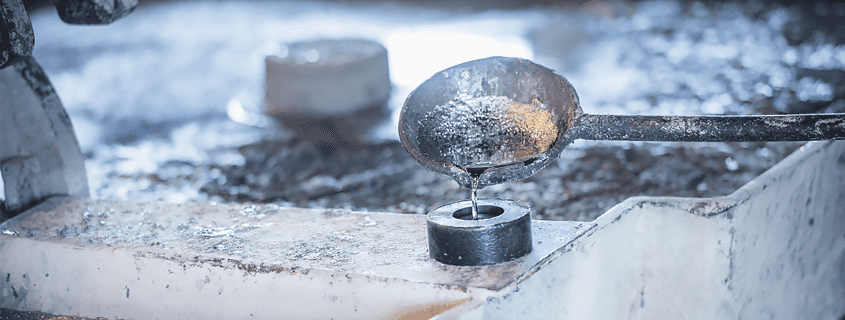
The Battery Recycling Company, a secondary lead smelter, recycles used motor vehicle batteries and produces approximately 60 tons of lead per day.
Inspectors found fault with reporting policies, and operation and maintenance of the facilities dust collection system. After stressing that the company needs to improve its handling of the toxic substances it processes to protect workers, their families, and the surrounding area, EPA Regional Administrator Judith A. Enck said: “The EPA legal action requires the Battery Recycling Company to improve its operations to protect people’s health and the environment. Our work is not done. EPA’s evaluation of the company’s compliance with federal environmental laws is active and ongoing.”
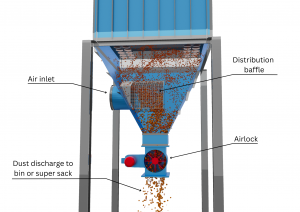
The plant which is regulated by both the Puerto Rico Environmental Quality Board (EQB), and the EPA, has been ordered to improve monitoring and reporting operations in addition to taking preventative actions and making operational improvements. The company was cited by the EPA and the EQB for having installed and tested new pollution control equipment on two of its furnaces in both 2007 and 2010 without notification. These points are significant because operational and physical changes occurred which increased the amount of pollution the facility generates. In addition, the inspectors found that the leak detection system in place to alert plant personnel of a of potentially devastating fugitive lead emissions was not fully operational. The inspectors also that the main rotary air lock on one of the dust collection system was not functioning at full capacity and was allowing lead dust to escape into the atmosphere.
Lead is a toxic metal that can cause damage to a child’s ability to learn and a range of health damage in adults. Lead exposure can have serious, long-term health consequences in adults and children. Even at low levels, lead in children can cause I.Q. deficiencies, reading and learning disabilities, impaired hearing, reduced attention spans, hyperactivity and other behavior problems. Lead exposure can also cause health problems in pregnant women and harm fetuses.
The company has been ordered to ensure the proper operation of its leak detection system at all times to prevent fugitive lead dust emissions. Daily particulate readings must take place at each of the dust collection system’s Baghouses, and be recorded to ensure the facility is complying with all applicable air regulations concerning lead and other substances released into the air. Additionally, they must provide results from 2010 performance tests conducted to assess the efficiency of the facility’s pollution control systems on two of its furnaces to the EPA, and update its existing pollution control models and send these for review with the EPA.
About the Author
| Dominick DalSanto is an Author & Environmental Technologies Expert, specializing in Dust Collection Systems. With nearly a decade of hands-on working experience in the industry, Dominick’s knowledge of the industry goes beyond a mere classroom education. He is currently serving as Online Marketing Director & Content Manager at Baghouse.com. His articles have been published not only on Baghouse.com , but also on other industry related blogs and sites. In his spare time, Dominick writes about travel and life abroad for various travel sites and blogs.
Director of Operations | Dust Collection Specialist | Industrial Filtration Consultant
Dominick DalSanto is an author and environmental technologies expert specializing in dust collection systems. He has nearly a decade of hands-on working experience in the industry. Dominick is the sales director and sales technical advisor for an industrial dust collection equipment manufacturer. Personally took the lead on key projects each year from sales engineer to field advisor to project manager to business relations. Born in San Bernardino County, California, and raised in Chicago, he currently resides in Buenos Aires, Argentina.
https://baghouse.com/wp-content/uploads/2011/08/post35.png6431237Dominick DalSantohttps://baghouse.com/wp-content/uploads/2025/10/BH-Logo-Alt-01-300x70.pngDominick DalSanto2011-08-24 12:47:152026-06-22 13:53:17Lead Smelter Ordered By EPA to Repair Dust Collection Systems
By Dominick DalSanto Environmental Technologies Expert & Author Baghouse.com
Why Periodic Leak Testing of Filter Bags is Vital
Operating a dust collection system with leaking filter bags defeats its sole intended purpose. A few leaking filter bags or even one within a collector/system can result in a substantial emissions increase. Leak testing of your Baghouse filter bags needs to be a regular part of any maintenance program to ensure system efficiency, and maintain compliance with emissions/safety regulations and avoid the fines and/or safety hazards that come with it.
All filtros de bolsa will eventually wear all out and need to be replaced. Baghouse maintenance programs should include periodic leak testing to ensure a few or even one faulty bag does not reduce the operating efficiency of the entire system. On occasion, a defective filter will fail early and need to be replaced. In other instances there may be a temporary or unanticipated event that can cause of premature failure of Baghouse filter bags. Once identified these should be investigated to ensure the incident does not occur again, and determine the extent of the damage done to the system. Examples may include: abrasion, thermal durability, and chemical attack.
Resistencia a la erosión from several different sources often leads to excessive wear (and therefore premature failure) of the filter bags. The most obvious is caused by excessive particulate loads in the gas stream. This may have been caused by the unexpected failure, or shutdown/maintenance of a pre-filter (such as a cyclone, or air scrubber for NOx and SOx). Poor design may also lead to particulate laden air striking the filters in certain spots more than others such as near the cuff, or dirty-air inlet. Other sources of abrasion damage include: improperly installed filters that rub against each other, and excessive cleaning cycles.
Degradation of the filter bags’ Thermal Durability may also be a potential cause of early failure. When operating temperatures that rise above the designed limits of the fabric, whether for short or long term, filters will begin to degrade and eventually fail. Changes in the plant process, fuel source, maintenance shutdowns of other systems, etc…may result in temperature spikes that will irreparably damage Baghouse filters.
Chemical attacks can also result in bag failure. These can occur when gas stream characteristics are not taken into consideration when selecting the filter fabric and/or treatments/finishes. Other times unexpected changes occur in the gas stream that cause changes in the composition of the gas. Operating temperatures may also fluctuate, dropping below the dew point allowing condensation of the chemicals on the fabric.
Filter Bag Leak Testing – How it is Done
To perform a standard leak test several things need to be done before the actual test can take place. First, since testing requires temporary isolation from the facility process, and shutdown, you must determine the best time for each unit and/or compartment to be tested. Second, safety measures for plant personnel must be taken into account when estimating total down time. Units must be given sufficient time for cooling, atmospheric testing to check for harmful gases, and personnel assigned to perform both the test and fulfill any and all safety regulations regarding confined space entry (both OSHA, and In-house). Once the preliminary steps have been taken, the actual testing can begin.
A vital part of any Baghouse system maintenance plan is regular leak testing of the filter bags.
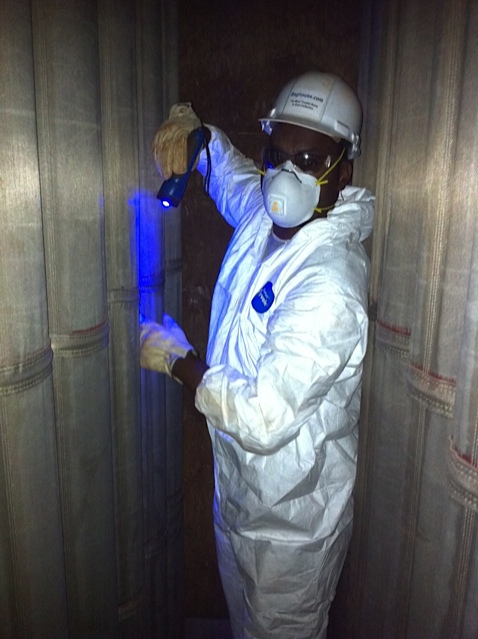
First, florescent leak detection powder is added upstream of the unit such as at a maintenance access in the ductwork. Then after sufficient time has past for the powder to work its way through the system, the unit is shutdown. Once it is possible, a technician will enter into the unit with a UV light source i.e. a black light to examine the filter bags for leaks. The powder fluoresces under the UV light, thereby making it easy for the technician to see even the smallest of holes. The technician makes note of any faulty filters, which can then be replaced.
Regular Maintenance is Key to Getting the Highest Efficiency from Your Baghouse
Baghouse systems are the most efficient, and cost effective solution for particulate matter control in industrial settings – but only if they are maintained properly. A vital part of any Baghouse system maintenance program is regular leak testing of the filter bags. By conducting this and other maintenance tasks, your Baghouse system will operate smoothly, and provide the best of results.
Director of Operations | Dust Collection Specialist | Industrial Filtration Consultant
Dominick DalSanto is an author and environmental technologies expert specializing in dust collection systems. He has nearly a decade of hands-on working experience in the industry. Dominick is the sales director and sales technical advisor for an industrial dust collection equipment manufacturer. Personally took the lead on key projects each year from sales engineer to field advisor to project manager to business relations. Born in San Bernardino County, California, and raised in Chicago, he currently resides in Buenos Aires, Argentina.
https://baghouse.com/wp-content/uploads/2011/08/post36.png6431237Dominick DalSantohttps://baghouse.com/wp-content/uploads/2025/10/BH-Logo-Alt-01-300x70.pngDominick DalSanto2011-08-16 12:17:482026-09-23 13:16:00Filter Bags & Leak Testing – How Important is it?
Tired of endlessly searching the internet for the right dust collection bags for your Baghouse only to be frustrated at a lack of results? Looking for someone who can help you make sense of the near endless filter bag options available for your dust collector? If so, then you have finally arrived at your final destination. Baghouse.com is the only place you need for your dust collection products and services.
Better Dust Collection Bags & Better Services with Baghouse.com
Firstly, we can source any kind of bags for your dust collection system that you may need. Secondly, our sales staff backed up by our team of trained engineers has the expertize needed to provide you not with “possibilities” but with real solutions to your dust collection needs. Thirdly, Baghouse.com maintains one of the industry’s finest field support teams. These trained and experienced construction professionals are able to handle anything from consulting and routine maintenance, to full turn-key installation and troubleshooting of your dust collection system. And finally, since Baghouse.com offers total solutions to dust collection needs, we are able to offer all of these services and products at highly competitive rates compared to many other firms.
How to Receive a Free Quote For Dust Collection Bags or Services
To receive a free Baghouse.com quote for dust collection bags, dust collector accessories, or dust collector services is easy. For a quote on de bolsas del colector de polvo, we will need you to provide us with some information about your bags. First, what kind of bags you are looking for, such as cartridges, bags, or pleated. Second, we need to know the dimensions you need, flat width, diameter, length. Third, tell us what material you need, (e.g. polyester, PTFE, etc…) any finish (or treatment) and any special construction such as support rings, top and bottom construction, etc. Finally, tell us how many you need, and when they need to be delivered by, and we will begin working on your quote right away.
If you are not sure about the details, you can always mail us a sample bag from your plant. Once we receive it we can figure out all the specs we need to give you a quote.
Perhaps you know what kind of bags you have in your Baghouse, but you think there might be advantages to switching to a different kind. We can also make recommendations for you based on the exact process you are running. Once we know the characteristics of your process, temperature, moisture, acidity/alkalinity, dust load, and CFM we will be able to make recommendations to you for the best filter for your dust collection system.
Here is a list of some of our most popular dust collection bag fabrics and finishes/treatments and Baghouse services. For more information please contact us by email, or call us at (702) 848-3990.
Director of Operations | Dust Collection Specialist | Industrial Filtration Consultant
Dominick DalSanto is an author and environmental technologies expert specializing in dust collection systems. He has nearly a decade of hands-on working experience in the industry. Dominick is the sales director and sales technical advisor for an industrial dust collection equipment manufacturer. Personally took the lead on key projects each year from sales engineer to field advisor to project manager to business relations. Born in San Bernardino County, California, and raised in Chicago, he currently resides in Buenos Aires, Argentina.
https://baghouse.com/wp-content/uploads/2011/08/How-Do-You-Find-the-Right-Dust-Collection-Bags-for-Your-Baghouse.png8161456Dominick DalSantohttps://baghouse.com/wp-content/uploads/2025/10/BH-Logo-Alt-01-300x70.pngDominick DalSanto2011-08-15 15:50:522026-11-08 15:59:43How Do You Find the Right Dust Collection Bags for Your Baghouse?
Baghouse vs. Electrostatic Precipitator: Which Is the Better Industrial Dust Filter?
Electrostatic precipitators, wet/dry-air scrubbers, and Baghouse technologies all vie for the title of the best available dust filter technology. Some people will say that depending on who you ask, you will hear a wide range of different answers. But the truth remains that in most cases, Baghouse technology is the best solution for dust collection needs on several different levels, initial investment, reliability, efficiency, and operating costs/benefits. Yes, Baghouse with its filter bags can rightly be called the ultimate dust filter.
Don’t take our word for it, see what other industry experts have to say about the advantages of Baghouse technology vs. ESP technology:
"In my practice I tend to use ESP's primarily for smaller (under 10,000 CFM) smoke and oil mist applications. Baghouse dust collector filters are much less expensive and simpler to operate and maintain for large applications. They are also very versatile because of the wide variety of filter media available...ESP can only hold a relatively small amount of collected particulate on it's plates before it becomes inefficient or even inoperative..."
Sales & Customer Service Professional
for a Major APC Firm
"Both control devices have their merits and shortfalls. If the air stream contains a sticky substance, i.e. that seen in some OSB mills and fiberglass manufacturing facilities, then a wet ESP is the preferred control device. The same can be said if the exhaust stream temperature is greater than 600-deg F. On the down-side, although a wet ESP can handle challenging applications, dealing with the effluent can be a real challenge, both from both a practical and an environmental standpoint. Baghouses are easier to maintain and operate than a wet or dry ESP. If the production process can accommodate it, a bag allows for easy reuse/recycling of the captured particulate (compared to a wet ESP)."
VP of Field Services Division
of a Industrial Steel Fabrication Company Specializing in Pollution Controls Technology
"We service both devices on a daily basis. Keep in mind that the esp parts (cells, ionizers) are VERY expensive. And from my experience, not very durable."
Environmental Services Professional
with an Industrial Environmental Technology and Maintenance Firm
Only in limited applications are there potential benefits to using an ESP over a fabric collector. Add to that the generally higher cost of EPS maintenance and installation, and we have plenty of reasons to give the award for the ultimate dust filter to the Baghouse over the electrostatic precipitator.
Director of Operations | Dust Collection Specialist | Industrial Filtration Consultant
Dominick DalSanto is an author and environmental technologies expert specializing in dust collection systems. He has nearly a decade of hands-on working experience in the industry. Dominick is the sales director and sales technical advisor for an industrial dust collection equipment manufacturer. Personally took the lead on key projects each year from sales engineer to field advisor to project manager to business relations. Born in San Bernardino County, California, and raised in Chicago, he currently resides in Buenos Aires, Argentina.
Originally published: August 11, 2011 Last updated: September 7, 2026
A dust collector should not be maintained as an isolated piece of equipment. Airflow, ductwork, filters, cleaning systems, fans, hoppers, discharge equipment, process conditions, and controls all affect one another. When one part of the system changes or begins to fail, the symptoms may appear somewhere else.
That is why effective dust collection system maintenance requires looking beyond the component that failed and asking a more important question: What changed elsewhere in the system that could have caused this problem?
Why Is a Holistic Dust Collector Maintenance Strategy Important?
A dust collection system is essentially a chain:
Capture hood → Ductwork → Dust collector → Filters → Cleaning system → Hopper/discharge → Fan → Exhaust or return air
A change at almost any point can affect the rest.
Suppose production increases and additional pickup points are connected to an existing system. The collector itself hasn’t changed, but the new operating conditions may alter airflow through the ductwork and collector, air-to-cloth ratio, filter loading, system static pressure, and capture velocity at individual hoods.
Or consider a rotary airlock that stops discharging properly. The problem occurs beneath the collector, but accumulated material can eventually reach the filter area, interfere with dust removal, increase differential pressure, and contribute to filter problems. Dust collector hoppers are intended to move collected material toward discharge equipment, not serve as long-term storage.
This is why replacing the component showing the symptom doesn’t always solve the underlying problem.
What Operating Conditions Should You Monitor?
There isn’t one measurement that tells you everything about a dust collection system. Instead, maintenance teams should establish normal operating conditions and watch for changes in several related parameters.
Important indicators can include:
EPA guidance similarly identifies particulate concentration, opacity, differential pressure, inlet temperature, exhaust gas flow, cleaning-system operation, and fan current as useful indicators of fabric-filter performance.
The key is to know what normal looks like for your system so you can recognize when something begins to change.
Can Differential Pressure Help Identify System-Wide Problems?
Yes, but differential pressure should be interpreted together with airflow and other operating conditions.
Presión diferencial measures resistance between the dirty-air and clean-air sides of the collector. As dust accumulates on the filters, resistance normally increases until the filters are cleaned. A sudden decrease can indicate a filter leak or rupture, while increasing pressure that no longer recovers after cleaning can point toward filter blinding, ineffective cleaning, or other operating changes.
But there is an important limitation. Differential pressure is affected by airflow. A DP reading should therefore be evaluated in the context of how much air is actually moving through the collector.
Why Is My Baghouse Corroding?
If a baghouse is corroding prematurely, first determine where the corrosion is occurring and what conditions exist at that location.
External corrosion may result from environmental exposure, damaged coatings, water intrusion, or installation conditions. Internal corrosion, however, often requires looking at the process itself.
Potential causes include changes in gas chemistry, moisture entering the system, condensation, acid gases, temperature changes, leaking doors or access points, and process modifications upstream of the collector.
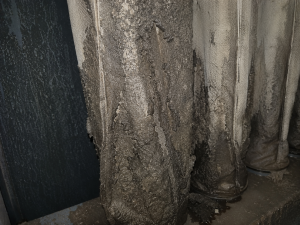
Primer plano de filtros de un colector de polvo cegados por la humedad y la acumulación de polvo provocadas por la condensación dentro del sistema.
Temperature deserves particular attention. If the gas stream falls below its dew point, condensation can form inside the collector. Depending on the compounds present in the gas stream, that moisture can become highly corrosive.
Instead of simply repairing or recoating the affected metal, investigate why the corrosive condition developed in the first place.
Ask questions such as:
⦿ Has the process chemistry or raw material changed?
⦿ Has the inlet temperature changed?
⦿ Is outside air leaking into the collector?
⦿ Is moisture entering through compressed air or the process?
⦿ Are upstream scrubbers or other process equipment operating correctly?
⦿ Is the collector repeatedly passing through condensation conditions during startup or shutdown?
Otherwise, repairing the corroded area may only reset the clock until the same damage returns.
Why Are My Dust Collector Filters Failing Prematurely?
When filter bags or cartridges fail much earlier than expected, replacing them with another set without investigating the cause can become an expensive cycle.
First confirm that the filters themselves are correct for the application. Verify the filter media, dimensions, construction, temperature rating, chemical compatibility, and installation.
If those are correct, expand the investigation. Premature failure can be caused by excessive air-to-cloth ratio, increased dust loading, abrasive inlet conditions, moisture or chemical attack, temperature excursions, incorrect filter installation, failed cages, ineffective dust discharge, or an improperly operating cleaning system.
For pulse-jet collectors, also check the compressed-air system. The supply needs to provide adequate pressure and volume, and the compressed air should be free of excessive water and oil. Pulse valves, diaphragm valves, solenoids, blowpipes, and controller settings should also be evaluated.
Where the filter fails can provide an important clue. Abrasion near the bottom of a bag, damage around the tubesheet, chemical deterioration across the media, or repeated failures in one collector section can each point toward different root causes.
How Can Ductwork Cause Dust Collector Problems?
The ductwork determines how air and dust reach the collector, so poor duct design can create problems that appear to originate inside the collector.
Common issues include excessive or insufficient conveying velocity, sharp elbows, poorly designed branch connections, unnecessary restrictions, damaged dampers, leaking ductwork, material buildup, and system modifications that were made without recalculating airflow.
For example, adding another production line to an existing dust collection system may seem as simple as connecting another branch duct. In reality, that new branch changes the resistance and airflow distribution throughout the system.
The result may be poor capture at some hoods, excessive velocity at others, increased collector airflow, or a dust collector operating beyond the conditions for which it was originally selected.
Whenever production equipment or ductwork changes, the dust collection system should be reevaluated as well.
Can Hopper and Discharge Problems Affect Filter Performance?
Dust collector hoppers are used to hold the collected dust temporarily before it is discharged through the airlock.
Absolutely. A collector can separate dust effectively and still perform poorly if that dust has nowhere to go.
Plugged rotary airlocks, screw conveyors, double-dump valves, or other discharge devices can allow material to accumulate in the hopper. Eventually, that material can be re-entrained into the airflow or reach the filter area, increasing filter loading and differential pressure.
How Do Process Changes Affect an Existing Dust Collection System?
Plants evolve. Production increases. Equipment gets replaced. New pickup points are added. Materials change. Conveying systems are modified. Operators adjust dampers. Filters are changed to a different media.
Meanwhile, the same dust collector may remain in service for decades. Eventually, the system may be operating under conditions substantially different from its original design.
Whenever there is a significant process change, ask: Does our existing dust collection system still match the process it is serving today?
That evaluation may include measuring actual airflow, checking capture and conveying velocities, reviewing system static pressure, calculating current air-to-cloth ratio, evaluating dust loading, and confirming that the fan and collector still have sufficient capacity.
Use Trends Instead of Waiting for Failures
One of the biggest improvements a facility can make to its maintenance program is moving from reactive measurements to trend-based monitoring.
A differential-pressure reading of 4 in. w.g., for example, doesn’t tell you much by itself. But knowing that the collector historically cleaned down to 2.0 in. w.g., then began recovering only to 2.5, 3.0, and eventually 4.0 tells a much more useful story.
The same principle applies to airflow, compressed-air pressure, temperature, fan current, particulate levels, and hopper level.
Modern sensors and remote monitoring systems can continuously track these parameters and alert maintenance teams when conditions begin moving outside established ranges. Connected monitoring has already been used in industrial applications to identify issues such as loss of compressed air, rising differential pressure, reduced airflow, and hopper plugging before they became larger maintenance events.
How Should You Troubleshoot a Dust Collection System? (Step-by-Step)
When a problem appears, resist the temptation to immediately replace the component that seems responsible.
Start with the symptom, then work outward through the system:
Establish what changed. Compare current operating conditions with your historical baseline.
Verify the measurement. Before acting on an unusual DP, airflow, temperature, or pressure reading, confirm that the instrument and sensing lines are working correctly.
Inspect the affected component. Look for the obvious mechanical problem first.
Look upstream. Could process changes, dust loading, ductwork, moisture, temperature, or incoming material be creating the problem?
Look downstream. Could the fan, exhaust, hopper, airlock, or conveying equipment be affecting system performance?
Review recent changes. Ask whether production rates, materials, filters, control settings, ductwork, equipment, or maintenance practices changed before the problem appeared.
Correct the root cause and establish a new baseline. After repairs, document DP, airflow, temperatures, cleaning settings, and other important operating parameters so you know what normal performance looks like going forward.
Don't Maintain the Dust Collector. Maintain the Dust Collection System.
A failed filter, corroded housing, plugged hopper, or high differential-pressure alarm may be where you see the problem, but it isn’t necessarily where the problem started.
A better maintenance strategy considers the entire path from the pickup point to the exhaust. Establish normal operating conditions, monitor trends, document process changes, and investigate how each component affects the rest of the system. This makes it easier to identify root causes, avoid repeatedly treating symptoms, and plan maintenance before a problem turns into unplanned downtime.
If your facility is experiencing recurring filter failures, poor pickup airflow, high differential pressure, corrosion, dust buildup, or other unexplained performance problems, Baghouse.com can evaluate the complete dust collection system rather than just the individual collector. Our inspections can include airflow and pressure measurements, collector and ductwork evaluation, filter and cleaning-system inspection, and a personalized report identifying problems and recommended corrective actions.
Director of Operations | Dust Collection Specialist | Industrial Filtration Consultant
Dominick DalSanto is an author and environmental technologies expert specializing in dust collection systems. He has nearly a decade of hands-on working experience in the industry. Dominick is the sales director and sales technical advisor for an industrial dust collection equipment manufacturer. Personally took the lead on key projects each year from sales engineer to field advisor to project manager to business relations. Born in San Bernardino County, California, and raised in Chicago, he currently resides in Buenos Aires, Argentina.
https://baghouse.com/wp-content/uploads/2018/03/Systemic-Approach.jpg311589Dominick DalSantohttps://baghouse.com/wp-content/uploads/2025/10/BH-Logo-Alt-01-300x70.pngDominick DalSanto2011-08-11 12:30:272026-09-09 12:22:17Why Should You Maintain Your Dust Collection System as a Complete System?







 Firstly, we can source any kind of bags for your dust collection system that you may need. Secondly, our sales staff backed up by our team of trained engineers has the expertize needed to provide you not with “possibilities” but with real solutions to your dust collection needs. Thirdly, Baghouse.com maintains one of the industry’s finest field support teams. These trained and experienced construction professionals are able to handle anything from consulting and routine maintenance, to full turn-key installation and troubleshooting of your dust collection system. And finally, since Baghouse.com offers total solutions to dust collection needs, we are able to offer all of these services and products at highly competitive rates compared to many other firms.

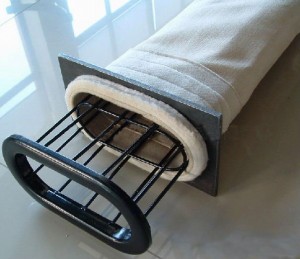 Electrostatic precipitators, wet/dry-air scrubbers, and Baghouse technologies all vie for the title of the best available dust filter technology. Some people will say that depending on who you ask, you will hear a wide range of different answers. But the truth remains that in most cases, Baghouse technology is the best solution for dust collection needs on several different levels, initial investment, reliability, efficiency, and operating costs/benefits. Yes, Baghouse with its filter bags can rightly be called the ultimate dust filter.

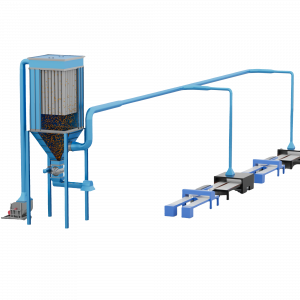 Capture hood → Ductwork → Dust collector → Filters → Cleaning system → Hopper/discharge → Fan → Exhaust or return air

 If a baghouse is corroding prematurely, first determine where the corrosion is occurring and what conditions exist at that location.