Originally published: August 11, 2011 Last updated: September 7, 2026
A dust collector should not be maintained as an isolated piece of equipment. Airflow, ductwork, filters, cleaning systems, fans, hoppers, discharge equipment, process conditions, and controls all affect one another. When one part of the system changes or begins to fail, the symptoms may appear somewhere else.
That is why effective dust collection system maintenance requires looking beyond the component that failed and asking a more important question: What changed elsewhere in the system that could have caused this problem?
Why Is a Holistic Dust Collector Maintenance Strategy Important?
A dust collection system is essentially a chain:
Capture hood → Ductwork → Dust collector → Filters → Cleaning system → Hopper/discharge → Fan → Exhaust or return air
A change at almost any point can affect the rest.
Suppose production increases and additional pickup points are connected to an existing system. The collector itself hasn’t changed, but the new operating conditions may alter airflow through the ductwork and collector, air-to-cloth ratio, filter loading, system static pressure, and capture velocity at individual hoods.
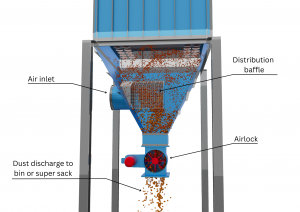
Or consider a rotary airlock that stops discharging properly. The problem occurs beneath the collector, but accumulated material can eventually reach the filter area, interfere with dust removal, increase differential pressure, and contribute to filter problems. Dust collector hoppers are intended to move collected material toward discharge equipment, not serve as long-term storage.
This is why replacing the component showing the symptom doesn’t always solve the underlying problem.
What Operating Conditions Should You Monitor?
There isn’t one measurement that tells you everything about a dust collection system. Instead, maintenance teams should establish normal operating conditions and watch for changes in several related parameters.
Important indicators can include:
EPA guidance similarly identifies particulate concentration, opacity, differential pressure, inlet temperature, exhaust gas flow, cleaning-system operation, and fan current as useful indicators of fabric-filter performance.
The key is to know what normal looks like for your system so you can recognize when something begins to change.
Can Differential Pressure Help Identify System-Wide Problems?
Yes, but differential pressure should be interpreted together with airflow and other operating conditions.
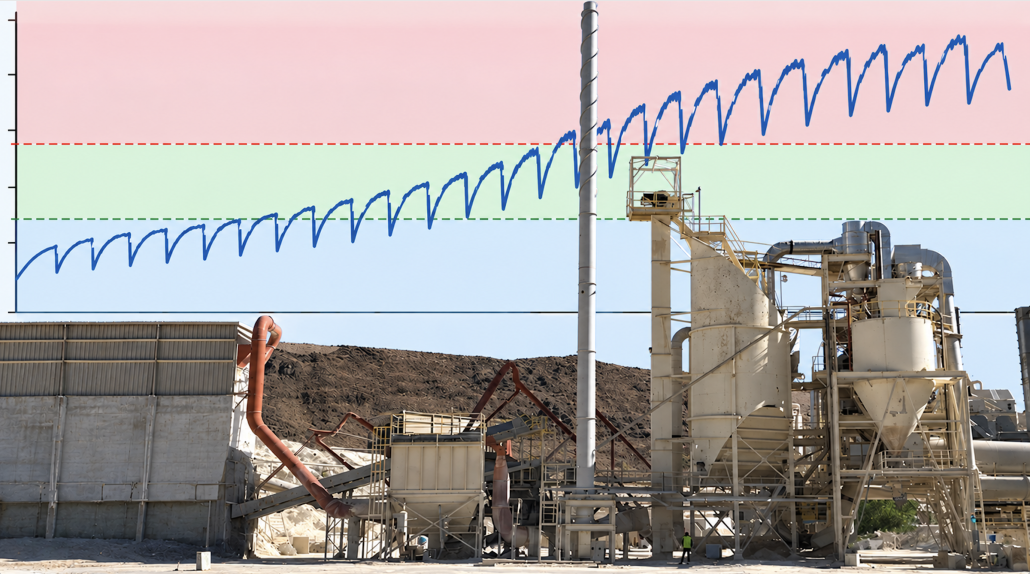
Presión diferencial measures resistance between the dirty-air and clean-air sides of the collector. As dust accumulates on the filters, resistance normally increases until the filters are cleaned. A sudden decrease can indicate a filter leak or rupture, while increasing pressure that no longer recovers after cleaning can point toward filter blinding, ineffective cleaning, or other operating changes.
But there is an important limitation. Differential pressure is affected by airflow. A DP reading should therefore be evaluated in the context of how much air is actually moving through the collector.
Why Is My Baghouse Corroding?
If a baghouse is corroding prematurely, first determine where the corrosion is occurring and what conditions exist at that location.
External corrosion may result from environmental exposure, damaged coatings, water intrusion, or installation conditions. Internal corrosion, however, often requires looking at the process itself.
Potential causes include changes in gas chemistry, moisture entering the system, condensation, acid gases, temperature changes, leaking doors or access points, and process modifications upstream of the collector.
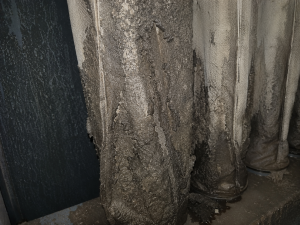
Primer plano de filtros de un colector de polvo cegados por la humedad y la acumulación de polvo provocadas por la condensación dentro del sistema.
Temperature deserves particular attention. If the gas stream falls below its dew point, condensation can form inside the collector. Depending on the compounds present in the gas stream, that moisture can become highly corrosive.
Instead of simply repairing or recoating the affected metal, investigate why the corrosive condition developed in the first place.
Ask questions such as:
⦿ Has the process chemistry or raw material changed?
⦿ Has the inlet temperature changed?
⦿ Is outside air leaking into the collector?
⦿ Is moisture entering through compressed air or the process?
⦿ Are upstream scrubbers or other process equipment operating correctly?
⦿ Is the collector repeatedly passing through condensation conditions during startup or shutdown?
Otherwise, repairing the corroded area may only reset the clock until the same damage returns.
Why Are My Dust Collector Filters Failing Prematurely?
When filter bags or cartridges fail much earlier than expected, replacing them with another set without investigating the cause can become an expensive cycle.
First confirm that the filters themselves are correct for the application. Verify the filter media, dimensions, construction, temperature rating, chemical compatibility, and installation.
If those are correct, expand the investigation. Premature failure can be caused by excessive air-to-cloth ratio, increased dust loading, abrasive inlet conditions, moisture or chemical attack, temperature excursions, incorrect filter installation, failed cages, ineffective dust discharge, or an improperly operating cleaning system.
For pulse-jet collectors, also check the compressed-air system. The supply needs to provide adequate pressure and volume, and the compressed air should be free of excessive water and oil. Pulse valves, diaphragm valves, solenoids, blowpipes, and controller settings should also be evaluated.
Where the filter fails can provide an important clue. Abrasion near the bottom of a bag, damage around the tubesheet, chemical deterioration across the media, or repeated failures in one collector section can each point toward different root causes.
How Can Ductwork Cause Dust Collector Problems?
The ductwork determines how air and dust reach the collector, so poor duct design can create problems that appear to originate inside the collector.
Common issues include excessive or insufficient conveying velocity, sharp elbows, poorly designed branch connections, unnecessary restrictions, damaged dampers, leaking ductwork, material buildup, and system modifications that were made without recalculating airflow.
For example, adding another production line to an existing dust collection system may seem as simple as connecting another branch duct. In reality, that new branch changes the resistance and airflow distribution throughout the system.
The result may be poor capture at some hoods, excessive velocity at others, increased collector airflow, or a dust collector operating beyond the conditions for which it was originally selected.
Whenever production equipment or ductwork changes, the dust collection system should be reevaluated as well.
Can Hopper and Discharge Problems Affect Filter Performance?
Dust collector hoppers are used to hold the collected dust temporarily before it is discharged through the airlock.
Absolutely. A collector can separate dust effectively and still perform poorly if that dust has nowhere to go.
Plugged rotary airlocks, screw conveyors, double-dump valves, or other discharge devices can allow material to accumulate in the hopper. Eventually, that material can be re-entrained into the airflow or reach the filter area, increasing filter loading and differential pressure.
How Do Process Changes Affect an Existing Dust Collection System?
Plants evolve. Production increases. Equipment gets replaced. New pickup points are added. Materials change. Conveying systems are modified. Operators adjust dampers. Filters are changed to a different media.
Meanwhile, the same dust collector may remain in service for decades. Eventually, the system may be operating under conditions substantially different from its original design.
Whenever there is a significant process change, ask: Does our existing dust collection system still match the process it is serving today?
That evaluation may include measuring actual airflow, checking capture and conveying velocities, reviewing system static pressure, calculating current air-to-cloth ratio, evaluating dust loading, and confirming that the fan and collector still have sufficient capacity.
Use Trends Instead of Waiting for Failures
One of the biggest improvements a facility can make to its maintenance program is moving from reactive measurements to trend-based monitoring.
A differential-pressure reading of 4 in. w.g., for example, doesn’t tell you much by itself. But knowing that the collector historically cleaned down to 2.0 in. w.g., then began recovering only to 2.5, 3.0, and eventually 4.0 tells a much more useful story.
The same principle applies to airflow, compressed-air pressure, temperature, fan current, particulate levels, and hopper level.
Modern sensors and remote monitoring systems can continuously track these parameters and alert maintenance teams when conditions begin moving outside established ranges. Connected monitoring has already been used in industrial applications to identify issues such as loss of compressed air, rising differential pressure, reduced airflow, and hopper plugging before they became larger maintenance events.
How Should You Troubleshoot a Dust Collection System? (Step-by-Step)
When a problem appears, resist the temptation to immediately replace the component that seems responsible.
Start with the symptom, then work outward through the system:
Establish what changed. Compare current operating conditions with your historical baseline.
Verify the measurement. Before acting on an unusual DP, airflow, temperature, or pressure reading, confirm that the instrument and sensing lines are working correctly.
Inspect the affected component. Look for the obvious mechanical problem first.
Look upstream. Could process changes, dust loading, ductwork, moisture, temperature, or incoming material be creating the problem?
Look downstream. Could the fan, exhaust, hopper, airlock, or conveying equipment be affecting system performance?
Review recent changes. Ask whether production rates, materials, filters, control settings, ductwork, equipment, or maintenance practices changed before the problem appeared.
Correct the root cause and establish a new baseline. After repairs, document DP, airflow, temperatures, cleaning settings, and other important operating parameters so you know what normal performance looks like going forward.
Don't Maintain the Dust Collector. Maintain the Dust Collection System.
A failed filter, corroded housing, plugged hopper, or high differential-pressure alarm may be where you see the problem, but it isn’t necessarily where the problem started.
A better maintenance strategy considers the entire path from the pickup point to the exhaust. Establish normal operating conditions, monitor trends, document process changes, and investigate how each component affects the rest of the system. This makes it easier to identify root causes, avoid repeatedly treating symptoms, and plan maintenance before a problem turns into unplanned downtime.
If your facility is experiencing recurring filter failures, poor pickup airflow, high differential pressure, corrosion, dust buildup, or other unexplained performance problems, Baghouse.com can evaluate the complete dust collection system rather than just the individual collector. Our inspections can include airflow and pressure measurements, collector and ductwork evaluation, filter and cleaning-system inspection, and a personalized report identifying problems and recommended corrective actions.
Director of Operations | Dust Collection Specialist | Industrial Filtration Consultant
Dominick DalSanto is an author and environmental technologies expert specializing in dust collection systems. He has nearly a decade of hands-on working experience in the industry. Dominick is the sales director and sales technical advisor for an industrial dust collection equipment manufacturer. Personally took the lead on key projects each year from sales engineer to field advisor to project manager to business relations. Born in San Bernardino County, California, and raised in Chicago, he currently resides in Buenos Aires, Argentina.


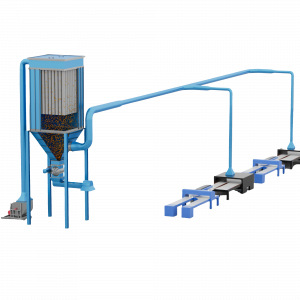 Capture hood → Ductwork → Dust collector → Filters → Cleaning system → Hopper/discharge → Fan → Exhaust or return air
 If a baghouse is corroding prematurely, first determine where the corrosion is occurring and what conditions exist at that location.