

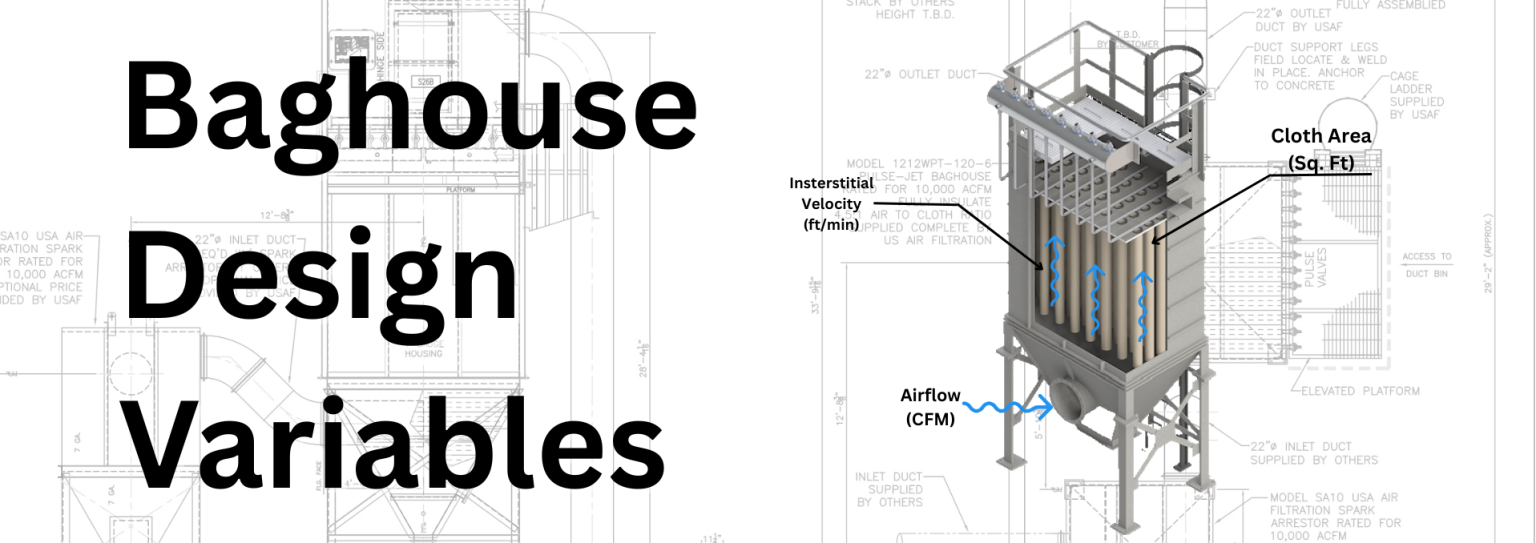
What Is the Air Velocity Calculator?
The Air Velocity Calculator determines the speed of air moving through your system’s ductwork, which is measured in feet per minute (fpm). In baghouse design, maintaining proper air velocity is critical to ensure that dust stays suspended and doesn’t settle within the ducts. To effectively transport dust through the system, the conveying air must reach a specific threshold known as the minimum air conveying velocity. This tool helps you verify if your duct sizing and airflow rate will achieve the ideal velocity for the type of dust you are collecting.
How to Use This Calculator
Using this tool requires two specific data points from your dust collection system design:
CFM (Cubic Feet per Minute): Enter the total volumetric airflow rate of your system.
Duct Diameter (inches): Enter the internal diameter of the specific duct section you are evaluating.
Once you input these values and click CALCULATE, the tool will output the resulting air velocity in fpm. You can then use the buttons below the calculator to email yourself a PDF summary of the results or request a free system sizing consultation from our engineering team.
Understanding the Formula
Air velocity is calculated by dividing the volumetric airflow (CFM) by the cross-sectional area of the circular duct (in square feet).
The formula used in this calculator is:
Variables Explained:
Velocity: The resulting speed of the air in feet per minute (fpm).
CFM: The volumetric airflow rate.
D: The Duct Diameter in inches.
24: This denominator represents the conversion of the diameter to a radius ($D \div 2$), and then inches to feet ($\div 12$), ensuring the final area is calculated in square feet to match the CFM metric.
$\pi$: The mathematical constant (~3.14159) used to calculate the area of a circle.
AIR VELOCITY CALCULATOR
What Is Duct Air Velocity?
 Air velocity is the speed of air moving through the ductwork. It affects the amount of dust that can be conveyed through the system. The size of the ductwork, the type of collected dust, and the airflow rate determine the ideal velocity. This velocity within the system is measured in feet per minute, or ft/m.
Importance of Air Velocity In Baghouse Design
Proper air velocity ensures that dust stays suspended and doesn’t settle in the ducts.
In order to transport the dust through the system, the conveying air must reach a value called the minimum air conveying velocity. If the air velocity is below this value, the dust will ultimately settle at the bottom of the duct.
The capture velocity is the conveying air velocity at the point of introduction of the solids in the duct, usually a hood or a direct duct connection to a piece of equipment. In order to be able to transport the dust, the velocity must be greater than the minimum conveying velocity of the dust. Air velocity within the system is measured in feet per minute, or ft/min.
Note: This calculation is a good starting point, but duct material, layout, and type of dust must be considered. Consult with a dust collection expert to get a safe and efficient design.
Contact Us
3172 N. Rainbow Blvd. Unit #5105
Las Vegas, NV 89108
Phone: (702) 848-3990
Explore Our Filtration Solutions
About Baghouse.com
Baghouse.com is a leading manufacturer of baghouse dust collection systems and equipment with 40+ years of experience serving all industries.