Dust build up inside a duct connected to a dust collector

Question: What is “normal” differential pressure in a baghouse?

Answer: In most applications a baghouse dust collector should run between between 3″ to 6″ w.g. under normal use. Once levels rise above 6″ (roughly) and the cleaning system cannot return it any lower (even when turned to continuous cleaning or “Test” mode) it is a sign that the filters are beginning to be blinded and likely need to be changed. It is not advisable to run a baghouse with a DP higher than 6″ for any length of time as this will have an impact on the function of the entire system. Running at such a high DP will lead to a number of problems including vacuum loss at the pickup points of the system (loss of suction), lower air speeds in the ductwork, higher emissions, and higher energy usage.

If you are seeing levels below 3″ after having run the baghouse for sometime you liking are getting false DP readings. When brand new bags are installed in a dust collector they should provide approximately 1″ of resistance alone. Once they begin to load dust that number will rise to between 2″ – 3″ no matter how much you clean them.

A clean on demand baghouse controller (i.e. clean on pressure) is the best way to keep a dust collector running in the recommended DP range. (see article: 3 Cheap Ways to Increase Efficiency in Dust Collection Systems)

Dust build up inside a duct connected to a dust collector

Maintaining the minimum conveying velocity in the dust collection system prevents dust drop out and build up inside the ductwork

Question: What is minimum conveying velocity in my baghouse and why is it important

Answer: The minimum airspeed required to keep dust particles suspended in the conveying system (i.e. dust collection system). When the air in any part of the dust collection system slows below the minimum conveying velocity the dust will begin to drop out of airstream and settle to the bottom of the ductwork (known as product drop out).

Maintaining the airspeed throughout the system above the minimum conveying velocity is required to prevent the accumulation of dust in the ductwork. Overtime, dust can accumulate into large piles, eventually blocking off part of the ductwork and reducing suction downstream in the system, further compounding the problem. Blockages can also cause the passing airstream to accelerate (forcing same air through a smaller space) that can lead to abrasion issues and eventually wear holes into the ductwork. Large accumulations of dust can eventually collapse sections of the ductwork due to the added weight.

Preventing product drop out is even more serious in applications involving combustible dust. Any accumulations of dust within the ductwork provide a potential fuel source for any ignition source that may find its way into the ductwork such as sparks. Additionally, if a fire starts in one part of the system it could continue to propagate throughout the rest of the system being fed by the accumulations in the ductwork. Further, if the system is operating below capacity due to blockages, dust may accumulate elsewhere in the facility including on elevates spaces that can then become fuel for both primary and secondary dust fires and explosions.

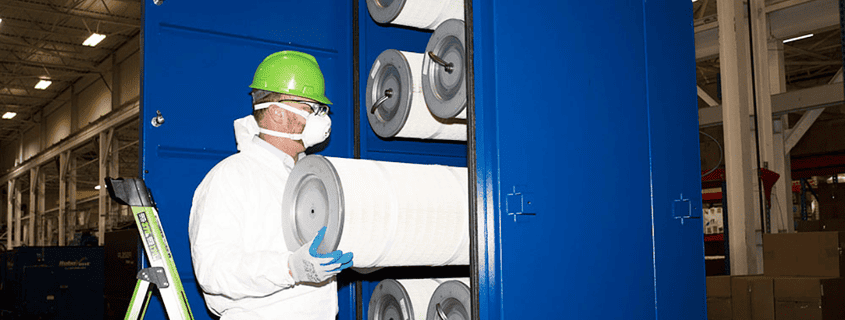
Maintenance personnel changing cartridge collector

Question: Why are my baghouse filters so expensive to replace?

Answer: Many simply buy their replacement filters from the OEM or sales rep that supplied their baghouse. Often times, manufacturers and sales rep organizations deliberately sell their units cheaper and then make convince their customers that they are locked into using a proprietary filter design that only they can supply and thus they charge outrageously high prices for them. Other times, they convince their customers to use an outdated or rarely-used technology so hard to find form other manufacturers that it nearly guarantees them your repeat business for replacement parts. This is common with many cartridge collector OEMs, whereby they win the initial unit sale by undercutting other manufacturers (often by recommending a undersized dust collection system) and then plan on making their profit on the expensive replacement filters later on. This marketing technique is commonly called the “razor blade” system, for its well-known use by makers of disposable razors and cartridges.

Need New Filters?

We offer replacement baghouse filters, cartridges, and pleated filters for all makes and models of dust collectors, including the most popular brands Farr, Donaldson / Torrit, Wheelabrator, and more. Often we can offer significantly better prices than buying from the original dust collector manufacture, sometimes as much as 50% less! If you do not believe us, give us a try and let us give you a quote for your next set of replacement baghouse filters.

Question: How long will my baghouse filters last?

Answer: Baghouse filters have an average service life of 1-3 years in most applications. Some can go beyond that without major increases emissions, while others may last less than a year in more difficult applications. The main reason to replace baghouse filters is because when old they begin to leak and thus the system is no longer collecting particulates as its designed to do. Filters can also be damaged prematurely by sparks/embers that can cause fires or even explosions. Upset conditions in the process may cause a spike in temperature (beyond the maximum for the filter fabric) or may create an acid flash or similar chemical attack on the bags. Finally, bags may be damaged during maintenance or by other external forces.

The main signs that your filters need to be replaced are that they are can no longer be cleaned effectively by the baghouse and/or they start leaking.

Baghouse filters that are blinded

Blinded filters must be replaced.

Question: What does it mean when my baghouse filters are “blinded”?

Answer: Blinded filters means the filters are so loaded with dust that they can no longer be cleaned by the baghouse cleaning system and must be replaced.

During normal operation dust particles accumulate on the surface of the filters and form a dust cake, which is then cleaned by the pulses of compressed air during the cleaning cycle. Overtime, some dust particles pass through the surface layer and become embedded deep within the fibers of the filter fabric where it cannot be removed by the cleaning pulses. Eventually, the fabric becomes so filled with dust particles that it severely restricts the movement of air through the filter. When this occurs the filter is said to be “blinded”.

When a baghouse can no longer clean itself down to a lower DP range (e.g. below 6” of DP) even with constant cleaning (i.e. continuous cleaning mode or test mode) it is likely that the filters are blinded and must be replaced.

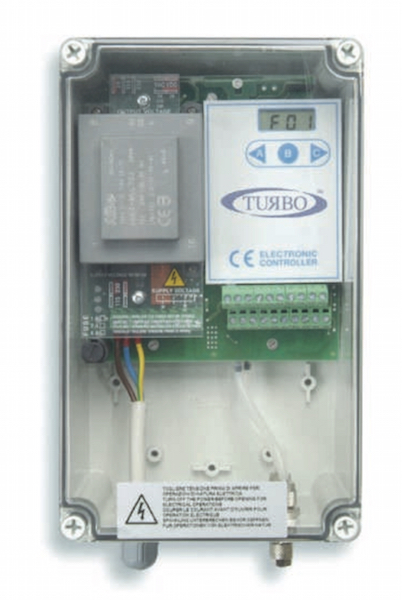
a baghouse dust collector control board

With Clean on Demand Controllers  the “On-Time” setting  must be set correctly or else bag cleaning will suffer. On on Turbo baghouse controllers (and on many others) you need to first find the preset that corresponds to the on-time setting (here shown as F1), push select, and then enter the proper value (.1-.15 ms)

Question: What does the “On-Time” setting on my baghouse control board do?

Answer: On-Time determines how long the pulse valve is open for during a cleaning cycle. This setting is VERY important for proper cleaning of the baghouse filters on a pulse jet dust collector. If set too long then the air pulses will be weak and waste compressed air, lower pressure in the air header (causing delays while it builds back up or weakening the following pulses) or even damage the filters. If set too short not enough air volume will be released to clean the entire bag. It will also cause uneven dust loading on the bags, which in turn can cause a long list of problems in the collector.

Question: What should I set as the “On-Time” on my baghouse control board?

Answer: As a general rule, this should be set to between .01 – .015 ms (milliseconds). For certain specific applications (such as pleated filters, or certain “sticky” dusts) your dust collector OEM might provide you with a slightly different setting.

Question: What is clean-on-demand and why should I use it instead of just setting a timer?

Answer: Clean on demand (or clean on pressure) is a means of controlling a pulse jet baghouse cleaning system. It is the most effective way to operate your dust collector and it can lead to considerable savings in several areas.

Using a clean on demand baghouse controller, operators set high and low differential pressure points (usually 5.5″ and 3″ respectively). When the DP reading hits the high point the control board begins firing the pulse valve(s). It will continue firing them in order until the DP drops below the low point.

In contrast to a simple timer board, a clean on demand controller only cleans the bags only when necessary to maintain stable operation. This prevents over cleaning (which increases wear and produces higher emissions), reduces compressed air use (costly in most plants), and reduces wear on the diaphragm valves. Additionally, clean on demand controllers are able to adapt to changes in dust loads (common in most applications) something timers cannot do.