Why dust collectors and all environmental technology are important to our economy
By Dominick DalSanto
Dust Collector Technology Expert and Sales Director
Baghouse.com
This month the U.S. Environmental Protection Agency issued for the first time ever rules regulating carbon emissions for power plants. These new regulations have brought controversy, with many claiming that regulating carbon emissions in not only unnecessary, but will terrifically affect the US economy for the worse. Other claim that the effect will be more than offset by the benefits of reducing the pace of climate change, which they hold is primarily caused by greenhouse emissions.
It is not our point to delve into the issues involved in the EPA’s Clean Power Plan, or even climate change in general. However, it has spurred yet another fierce debate about pollution laws and regulations, air pollution control technologies and their economic effects on the nation. It leads one to thinking about industrial dust collection and what it costs the country’s economy. Do environmental rules protect or hurt the economy?
While there are many facets to this debate, we wanted to look at just one area today; how much revenue the does the dust collection industry directly cost or add to the US economy each year?
Dust Collector Systems, and Other PM Control Systems Add Billions to Economy Each Year
While politicians debate over increased regulation, there really should be no debate about whether the environmental technology industry is a valuable contributor to the country’s economy. The facts show that, regardless of the political rhetoric on both sides, the sector contributes a great deal to U.S. economic growth.
Today, the global environmental technologies market (including dust collection), which is broad and encompasses products and services for air, water, and soil pollution control, is around $800 billion. The U.S. is the largest supplier and consumer of this equipment and services in the world. Approximately 119,000 firms generate $300 billion in revenues supporting close to 1.7 million jobs. (1)
Trade Surplus From Environmental Exports
The U.S. exported pollution controls worth nearly $40 billion and generated a trade surplus of nearly $13 billion in 2007. In terms of exports as a percentage of total U.S. ET production, the leading sub-sectors are: resource recovery (58 percent); instruments and information systems (46 percent); water equipment and chemicals (36 percent); waste management equipment (25 percent); and air pollution control (16 percent). (Figure 1)
The air pollution control equipment sub-sector, not including engineering and consulting, generates revenues of more than $18 billion each year. A further breakdown of the numbers shows that dust collection equipment exports — dust collector systems, dust collector filters, baghouses, etc. — in 2008 added up to more than $300 million. Adding in engineering and consulting services pushes that number over $1 billion. With an economy that is feeling the pressures of excessive foreign debt, trade imbalances, and lackluster growth, this sector of the U.S. economy certainly is carrying its own weight.
The Outlook: Advantages and Challenges Lie Ahead
As the situation stands now, the U.S. ET sector, including dust collection technology, holds some distinct advantages over foreign competitors. However, that advantage has been slipping away, little by little, and assuring future growth will prove to be a challenge.
While the United States market remains the largest single ET market, it’s also the most mature. Foreign markets, particularly those in developing countries, continue to grow at a higher rate, offering the most opportunity for U.S. companies.
According to a report by the Office of Energy and Environmental Industries’ Environmental Technologies Trade Advisory Committee, which is made up of governmental agencies responsible for fostering growth of U.S. exports, there are several notable barriers to increasing U.S. trade in this area. They include lengthy and/or nontransparent approval processes, incompatible standards, and legal and regulatory framework issues. Nonetheless, the report also states that the U.S. is well-positioned to compete on the international scene due to factors such as market share, workforce experience, and a highly advanced development process that leads to innovation.
The U.S. share of foreign ET markets went from 5.7 percent in 1997 to 9.8 percent in 2007, giving the industry a positive trade surplus. Although the rate of growth slowed, it has been returning steadily, influenced, in part, by the booming global demand for renewable energy technology.
Another large driver of the growth in developing markets has been the increased number of governmental pollution regulations. While in other industries environmental laws and regulations are seen as a source of extra cost and burden, the opposite is true for the ET sector. Complying with these regulations requires investment in products and services that help prevent, remediate, and alleviate environmental degradation. The ET industry supplies those goods and services.
Less-Obvious Financial Benefits
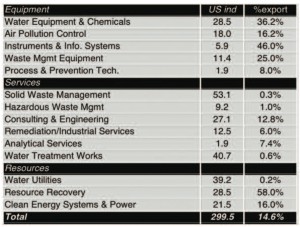
U.S. environmental technology exports in 2008
A clean and healthy environment (specifically clean air) has a host of benefits to people that directly affect them economically. Preventing environmental degradation prevents pollution-related health problems and premature death, and improves the health and productivity of the U.S. work force.
While it can be difficult to quantify in monetary terms the effect of keeping people healthy and giving them better lives, several studies do exist that show that even in these terms environmental control regulations, specifically particle pollution control (e.g. dust collectors) have had a massive impact. A 2011 EPA peer-reviewed study concluded that the 1990 Clean Air Act Amendments have yielded direct benefits that tremendously exceed their costs. The study’s central benefits estimate in 2020 exceeds costs by a factor of more than 30-to-1, and the high benefits estimate exceeds costs by 90-to-1. (2)
The Path to Growth?
Now more than ever, to get back on the path to recovery, this economy needs to do what it has always done best — innovate and lead. Few sectors of the economy are better suited to do this than the ET industry. With new laws and regulations making environmental compliance tougher, U.S. firms are — out of necessity — finding, developing, and creating new ways to continue expanding while reducing environmental impacts. This experience has provided U.S. companies with the opportunity to get an edge over the competition, and they must take advantage.
The size of the world market for environmental goods and services – $782 billion – is comparable to the aerospace and pharmaceutical industries and presents important opportunities for U.S. industry. In 2008, the United States’ environmental technologies and services industry supported 1.7 million jobs. The industry generated approximately $300 billion in revenues and exported goods and services worth $44 billion – larger than exports of sectors such as plastics and rubber products. Air pollution control equipment alone generated revenues of $18 billion in 2008, including exports of approximately $3 billion.
Without a doubt, over-regulation and governmental bureaucracy can stifle economic growth. However, the ET industry, rather than being part of this systemic problem, is, in reality, part of the solution. This industry is a highly adaptive, com- petitive, and useful one that has proven its worth by creating mil- lions of jobs and billions in profits and trade surpluses. If every sector of the economy had similar characteristics, it would be back on the path to growth.
| Dominick DalSanto is an author & dust collector technology expert, specializing in baghouse systems. With nearly a decade of hands-on working experience in the industry, Dominick’s knowledge of the industry goes beyond a mere classroom education. He is currently serving as sales director at Baghouse.com. His articles have been published not only on Baghouse.com , but also on other industry related blogs and sites. In his spare time, Dominick writes about travel and life abroad for various travel sites and blogs.
References
1. Environmental Business International, San Diego, CA. U.S. Environmental Exports By Sector 2008 ($ billion)
2. http://www.epa.gov/air/sect812/prospective2.html

Director of Operations | Dust Collection Specialist | Industrial Filtration Consultant
Dominick DalSanto is an author and environmental technologies expert specializing in dust collection systems. He has nearly a decade of hands-on working experience in the industry. Dominick is the sales director and sales technical advisor for an industrial dust collection equipment manufacturer. Personally took the lead on key projects each year from sales engineer to field advisor to project manager to business relations. Born in San Bernardino County, California, and raised in Chicago, he currently resides in Buenos Aires, Argentina.