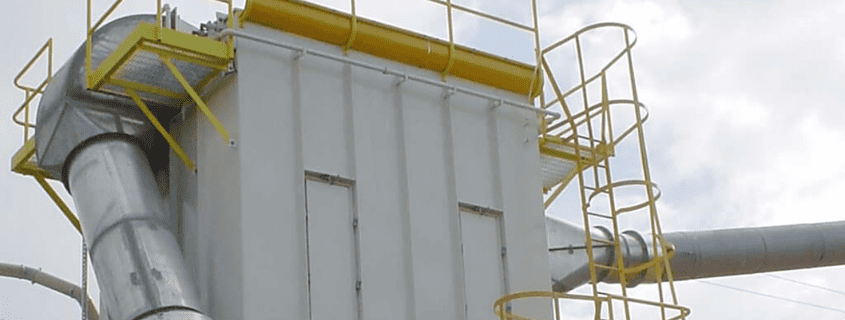
Performing any kind of work on a baghouse can be hazardous work. Often set in industrial locations, dealing with baghouse systems can present a number of dangers to personnel. Thankfully, these maintenance tasks can be accomplished safety if proper safety precautions are followed.
A new article authored by Baghouse.com that has been published on a leading environmental and safety magazine EHSToday.com that offers 5 often overlooked baghouse safety proceedures for performing any type of work on dust collection systems. You can read the article here: 5 Essential Baghouse Maintenance Safety Precautions I encourage all of our readers to take a moment and read this article and consider how well are you doing regarding baghouse safety.
About the Author
| Dominick DalSanto is an Author & Environmental Technologies Expert, specializing in Dust Collection Systems. With nearly a decade of hands-on working experience in the industry, Dominick’s knowledge of the industry goes beyond a mere classroom education. He is currently serving as Online Marketing Director & Content Manager at Baghouse.com. His articles have been published not only on Baghouse.com , but also on other industry related blogs and sites. In his spare time, Dominick writes about travel and life abroad for various travel sites and blogs.
Director of Operations | Dust Collection Specialist | Industrial Filtration Consultant
Dominick DalSanto is an author and environmental technologies expert specializing in dust collection systems. He has nearly a decade of hands-on working experience in the industry. Dominick is the sales director and sales technical advisor for an industrial dust collection equipment manufacturer. Personally took the lead on key projects each year from sales engineer to field advisor to project manager to business relations. Born in San Bernardino County, California, and raised in Chicago, he currently resides in Buenos Aires, Argentina.
At a time when most power plants are worried about meeting new EPA regulations, one Colorado coal-fired power plant that boasts about being top ten lowest emissions in the nation due to modern dust collection systems (or baghouse) looks to improve even more; claims other plants give coal a bad name.
Baghouse.com – September 31st, 2011, Forth Colins, Colorado – Rawhide Energy Station located 26 miles north of Fort Collins, CO is held in high esteem as an example of what a 21st century coal-fired power plants should be. The plant that is owned by four local municipalities through the Platte River Power Authority (PRPA), currently ranks in the top ten in the country for lowest emissions despite being a 280 megawatt facility.
What has led enabled Rawhide Energy Station to stand out among its fellow coal-fired plants by maintaining such high environmental standards, while still proving to be a profitable enterprise? Plant staff believe its the dedication they take to environmental responsibility that is echoed throughout the entire operation.
“The whole coal industry gets a bad name when there’s a big difference between a facility like this and a facility that doesn’t even spray or have a bag house,” stated plant manager Jason Frisbie. “These are existing technologies that would make all these plants much cleaner than they are right now. Proven.” The plant staff count a history of always investing in new technologies to attain even lower emissions than required by current regulations.
Rawhide Energy Station’s Extensive Pollution Control Systems
Rawhide Energy Station currently averages SO2 emissions of .081 pounds per million BTUs (British Thermal Units), about one tenth of the average of .765 PPM. The plant currently operates several pollution control systems concurrently to handle the various pollutates generated by the coal combustion process. The most extensive of these is the boiler itself which, is a Combustion Engineering (now Alstom Power) tangentially fired (T-fired) boiler equipped with a new low-NOx burner system in fall of 2005. For additional NOx collection, the plant operates a dry spray absorber. For SO2 collection the plant uses a Joy Niro dry scrubber system, and an activated carbon injection system for mercury (Hg) control. Two bag houses with approximately 6,500 PTFE membrane 34 foot filter bags are used to achieve particulate matter (PM2.5) collection efficiencies. The bag house collectors also assist in the collection of excess dry scrubbing product from the scrubbers, and are integral in the operation of the activated carbon injection system used for mercury (Hg) collection.
The plant uses a lot of coal – about 1.25 million tons a year -brought in by rail from Wyoming.They also maintain a 60 day reserve in case supply is ever interrupted. The main type of coal used to operate the plant’s main boiler is Powder River Basin (PRB) coal, a sub-bituminous type of coal that is mined from large deposits in Wyoming and Montana. This type of coal, while producing less BTUs per ton than other types, is highly valued due its substantially low sulfur content, which aids in keeping SO2 emissions low.
However, there is a trade off with using low sulfur coal. Sub-bituminous coal leads to increased difficulty in collecting mercury emissions, which recently have become regulated by the EPA (Environmental Protection Agency). The PRPA has taken steps to reach compliance with these new regulations even before they come into effect, by installing a activated carbon injection system for mercury control. The system works by injecting activated carbon, which absorbs the hard to collect elemental forms of mercury (Whereas bituminous coal creates mainly oxidized forms that are easier to collect). The mercury-ladden carbon is then collected in the bag house on the surface of the ePTFE (Teflon) membrane filter bags, which in turn when cleaned allows for the collection and disposal of the mercury along with other collected particles such as fly-ash. This technology represents the newest environmental focus of the industry with the new EPA regulations coming into effect in the near future. However as we can see, the Rawhide Energy Station already prepared well in advance for the coming regulations, in line with the plants self-motivated philosophy of striving to operate more environmentally-friendly.
WIth all of these APC (air pollution control) technology, surely, the plant must suffer from extensive downtime for system install and additional maintenance. However is that the case?
“We Focus on Preventive…and Predicted Maintenance “
By placing a high value on preventive maintenance, the plant has been able to achieve a relatively high average capacity factor (how much the plant puts out compared its full potential). The plant currently have a lifetime equivalent availability factor of around 98%with its capacity factor about 88.8%. “A lot of plants manage about 70 percent,” say Doug Adair maintenance manager for the plant. This has not come about without a lot of forethought and planning. The plant usually plans for a full-scale shut down ever three to five years. This enables the plant to prevent small problems (such as replacing filters in the bag house) from becoming larger ones (damage to plant systems from higher emissions due to lower bag house performance).
In addition to the main coal-fired boiler, the plant also fields four GE Frame 7EA natural gas-fired turbines totaling 260 MW (three installed in 2002 and a fourth added in 2004). These are used to provide additional power during peak hours.
“We focus a lot on preventive maintenance and predicted maintenance,”
– Doug Adair Maintenance Manager
Company Mindset Contributes to Stellar Record
It all starts with the people and a teamwork culture that shares ownership of the facility. Jason Frisbie, the division manager of Power Production at Rawhide, noted that, “while the operating statistics and utilization of technology continues to pay off, the primary reason for Rawhide’s success can be attributed directly to the dedicated and professional staff at the station.”Here is an example of Rawhide’s unique management culture. Each employee, including the plant manager, is assigned a cleaning area that requires that person’s attention for an hour a week. Individuals feel a sense of accomplishment when they’re done, and everyone has a facility that all are proud of. Another benefit of a good clean, safe work environment is that it’s easier to spot problems with the equipment and easier to fix those problems as well.
Despite seeing demand drop substantially from its peak two years ago, during which time the plant ran all its gas turbine units in addition to the coal-fired unit, the plant continues to provide plenty of work for over one hundred full-time employees.
The peak position may be the control room — no one gets in there until they’ve had at least 15 years experience. Many have 25, almost as long as the plant’s been up and running.”So Homer Simpson couldn’t work here,” City Councilwoman Sarah Levison joked during a recent plant tour.”You are correct,” Adair said. “Homer Simpson couldn’t work here.”
“Homer Simpson couldn’t work here.”
– Maintenance Manager Doug Adair commenting on the level of experience required of the plant’s operators
Unique Environmental View Leads to Unconventional Success
Following the pattern of the unique environmental philosophy, the plant in addition to its extensive pollution control equipment, also takes a more symbolic approach to build its environmentally-friendly image. In the early days of the area now know as Fort Collins, thousands of wild Bison roamed this area, and called it home. According to Albert Hamilton, Platte River Power Authority’s first general manager, “Bison should be returned to the grasslands to symbolize the ruggedness of the American West and to demonstrate that power plants can coexist in harmony with native plants and wildlife.”
The plant established a program called “Adopt-a-Buffalo” in 1983 to bring back some of that sense of oneness with nature to the plant. From the first twenty bison, the herd has produced numerous award winning animals. Profits from sales offset the cost of the program. Plant staff help take care of the herd, providing water and feed for the herd.
The program’s success is satisfying proof for plant management that they efforts to protect the environment are working. “Any corporation, any company, doesn’t have to destroy what’s around them to be successful,” says spokeswoman Rae Todd.
More About The Rawhide Energy station:
In 1973, the cities of Longmont, Fort Collins, Loveland and Estes Park joined to create Platte River Power Authority. The PRPA operates the Rawhide Energy Station north of Fort Collins provides for all the previously mentioned municipalities. Each municipality sets the rates for its own jurisdiction.
About the Author
| Dominick DalSanto is an Author & Environmental Technologies Expert, specializing in Dust Collection Systems. With nearly a decade of hands-on working experience in the industry, Dominick’s knowledge of the industry goes beyond a mere classroom education. He is currently serving as Online Marketing Director & Content Manager at Baghouse.com. His articles have been published not only on Baghouse.com , but also on other industry related blogs and sites. In his spare time, Dominick writes about travel and life abroad for various travel sites and blogs.
Director of Operations | Dust Collection Specialist | Industrial Filtration Consultant
Dominick DalSanto is an author and environmental technologies expert specializing in dust collection systems. He has nearly a decade of hands-on working experience in the industry. Dominick is the sales director and sales technical advisor for an industrial dust collection equipment manufacturer. Personally took the lead on key projects each year from sales engineer to field advisor to project manager to business relations. Born in San Bernardino County, California, and raised in Chicago, he currently resides in Buenos Aires, Argentina.
https://baghouse.com/wp-content/uploads/2011/09/post31.png6431237Dominick DalSantohttps://baghouse.com/wp-content/uploads/2025/10/BH-Logo-Alt-01-300x70.pngDominick DalSanto2011-09-30 09:33:022026-06-22 13:53:05Dust Collection System in Thermal Power Plant – Coal Plant Example
Golden Stack Testing Nuggets: The EPA Admits Error in Proposed Mercury MACT Rule. Calculation used to determine emissions limits for mercury and other toxic air substances was off by nearly 1,000.
Here is an interesting article about the EPA’s new mercury standards from our good friend Ron McCulloch the “blue collar MBA” with Golden Specialty Inc. Ron and his firm are among the most trusted names in stack testing services in the nation.
This posts comments on a recently discovered error in the EPA Mercury MACT rule. After initially being discovered by the non-profit trade organization Utility Air Regulation Group (UARG), the EPA has finally admitted the there was indeed an error in the way they calculated the limits for the MACT (maximum achievable control technology) floor for both the mercury and air toxics standards (MATS) rules.
An EPA official admitted that the error was indeed present. But she claimed that it had not had a substantial effect on the final rule. She further stated that the EPA had corrected the mistake and apologized for the error.
The error deals with the formula used for converting measurements reported in terms of lb/GWh to lb/MWh is “incorrect by a factor of 1,000” claims the UARG.
About the Author
| Dominick DalSanto is an Author & Environmental Technologies Expert, specializing in Dust Collection Systems. With nearly a decade of hands-on working experience in the industry, Dominick’s knowledge of the industry goes beyond a mere classroom education. He is currently serving as Online Marketing Director & Content Manager at Baghouse.com. His articles have been published not only on Baghouse.com , but also on other industry related blogs and sites. In his spare time, Dominick writes about travel and life abroad for various travel sites and blogs.
Director of Operations | Dust Collection Specialist | Industrial Filtration Consultant
Dominick DalSanto is an author and environmental technologies expert specializing in dust collection systems. He has nearly a decade of hands-on working experience in the industry. Dominick is the sales director and sales technical advisor for an industrial dust collection equipment manufacturer. Personally took the lead on key projects each year from sales engineer to field advisor to project manager to business relations. Born in San Bernardino County, California, and raised in Chicago, he currently resides in Buenos Aires, Argentina.
Confusing regulations, conflicting methods of application, and unpredictable enforcement of industrial emissions regulations often leave many companies scratching their heads at what they did wrong. This article is part of a series about industrial air permits and their relationship with your dust collection system. See earlier article: Industrial Air Permits – Overcoming the Difficulties
(Baghouse.com – September 10th, 2011) – Governmental environmental regulations are often praised for the role they play in helping to keep our planet clean, and protecting us from hazardous by-products of our modern industrialized world. However, as these regulatory bodies increase in size, and influence, many claim that they have become inefficient, bogged down due to their overly bureaucratic organization, and even as “corrupt” as the big business polluters they are charged with protecting the public against.
We can see this in a recent article from Ethanol Producers Magazine; the article highlights the plight of a group of ethanol plant operators, and their constant struggles to understand and comply with needlessly complex environmental regulations, and permits issues by state and federal agencies. The article explains how sometimes permitting agencies require certain standards to be met in their permit proposals, that do not have any regulation behind them. These unnecessary requirements are simply confusing are not are not fair and are the result of over-regulating, states Jessica Karras-Bailey, an associate with RTP Environmental Associates Inc.
While certain states may have stricter emissions standards that others, in general the problem lies with permit issuing agencies, and officials going above and beyond what is required by federal and state legislation. In one cited example, an ethanol plant permit proposal would have required truck with grain shipments to follow a specific pattern within the site (taking a right turn, drive in a counterclockwise direction, and then leave by taking a left turn). Failure to enact this provision would have left the plant in non-compliance with the permit, leading to heavy fines and possibly forced closures. Provisions such as this obviously left management confused, wondering why such a requirement was mandated by existing regulations, as well as how they could possibly implement such a thing in a practical way.
Instances such as this highlight the almost “Mystic Elements” that these permits can sometimes require of plant operators. Often times companies are simply at a loss, not knowing what action to take, all the while fearing the repercussions that might come from not complying with these regulations.
In the instance cited above, the plant management turned to a consulting firm that specializes in helping facilities come into compliance with pollution control regulations, and with negotiating with permitting agencies. They were able to learn why the state’s permitting officials had placed this peculiar requirement in the permit (air dispersion modeling reasons). After that, the firm was able to negotiate with the agency, explaining that from a practical standpoint, it simply was not possible, and find a more flexible solution that was acceptable to both parties. “But it’s not always easy,” stated the consultant, and we tend to agree with that conclusion.
Air Permitting Compliance Help & Advice
Do governmental pollution regulations have you feeling like this at times? EPA clean air regulations (NAAQS, NESHAP, etc…) for particulate matter (PM2.5), mercury, and other VOCs can be easily met by operating a proper dust collection system at your facility.
In researching this article, Baghouse.com contacted several consulting firms that specialize in helping facilities with the environmental permitting process, and advise them on ways to bring their sites into compliance with said regulations. We managed to speak with Brian Burdorf at Trinity Consultants, Inc. based in Dallas, Tx. about some of the more common issues that companies encounter during the permitting process, and what actions these firms can take to ensure compliance. We asked for some specific standards that among the hardest for companies to meet, and which ones can be affected by dust collection system performance the most.
Burdorf, mentioned that most difficult sections of current U.S. clean air regulations for companies to come into compliance with are the National Ambient Air Quality Standards (NAAQS), and associated U.S. EPA dispersion modeling requirements for demonstrating compliance with nitrogen dioxide (NO2), sulfur dioxide (SO2), and fine particulate matter (PM2.5). In addition, with regards to dust collection systems, he adds that the National Emission Standards for Hazardous Air Pollutants (NESHAP), Maximum Achievable Control Technologies (MACT), and New Source Performance Standards (NSPS)for industrial-commercial-institutional steam generators (boilers), electric utility steam generating units (utilities), portland cement manufacturing, and similar industrial processes are particularly challenging for companies to meet.
Theses standards, many of which have been updated, or otherwise expanded in recent years, require higher emissions standards that are increasingly complex, and difficult to achieve with existing or antiquated dust collection systems.
What Can You Do to Ensure Your Dust Collection System Reaches Compliance?
The role of dust collection systems in controlling pollution is growing more vital with each passing year. With tougher limits being proposed/adopted by regulatory bodies for particulate matter within the NAAQS, NESHAP, MACT, and NSPS, many formerly compliant sites are being forced to upgrade their existing systems, or install completely new equipment (such as replacing ESPs with Baghouse technology). With so many industries being affected by these rules, naturally the rules are complex, and often apply differently to different industries, and require different tactics for different industries and processes to reach compliance.
If you are confused and intimidated by the seemingly insurmountable challenge presented by the air permitting process for your facility, fear not for you have several options available to help you overcome these challenges. This topic will be covered in of our next article in this series here on Baghouse.com. We will discuss which exact regulations apply for different industries, what part certain technologies (Baghouse, filters, mercury capture systems etc.) will play in meeting the standards of tomorrow, and how you can plan to meet these standards not only for the present, but also for the future as well. If you have any specific questions that cannot wait until then, feel free to contact us here at Baghouse.com for assistance and we will be glad to help.
Dominick DalSanto is an Author & Environmental Technologies Expert, specializing in Dust Collection Systems. With nearly a decade of hands-on working experience in the industry, Dominick’s knowledge of the industry goes beyond a mere classroom education. He is currently serving as Online Marketing Director & Content Manager at Baghouse.com. His articles have been published not only on Baghouse.com , but also on other industry related blogs and sites. In his spare time, Dominick writes about travel and life abroad for various travel sites and blogs.
Director of Operations | Dust Collection Specialist | Industrial Filtration Consultant
Dominick DalSanto is an author and environmental technologies expert specializing in dust collection systems. He has nearly a decade of hands-on working experience in the industry. Dominick is the sales director and sales technical advisor for an industrial dust collection equipment manufacturer. Personally took the lead on key projects each year from sales engineer to field advisor to project manager to business relations. Born in San Bernardino County, California, and raised in Chicago, he currently resides in Buenos Aires, Argentina.
September 2nd, 2011 | Baghouse.com – Bowing to pressure from all directions, President Obama announced Friday that he was ordering the EPA (Environmental Protection Agency) to scrap plans to tighten the federal clean air regulations regarding ozone and smog. The controversial proposal has long been singled out as an unnecessary “job killer” by opposition republican law makers, and a wide range of industry groups.
In the prepared statement issued on Friday after a federal report on private sector employment show virtually no growth for August. The President said that after considering the the burdens that governmental regulations place on business, he had decided to withdraw the proposed new ozone limits. “At the same time, I have continued to underscore the importance of reducing regulatory burdens and regulatory uncertainty, particularly as our economy continues to recover. With that in mind, and after careful consideration, I have requested that Administrator Jackson withdraw the draft Ozone National Ambient Air Quality Standards at this time. Work is already underway to update a 2006 review of the science that will result in the reconsideration of the ozone standard in 2013. Ultimately, I did not support asking state and local governments to begin implementing a new standard that will soon be reconsidered,” Obama said.
The EPA’s proposed tighter ground-level ozone standards were deemed to burdensome by Pres. Obama and overruled.
The proposed new standards would have lower the the acceptable amount of ground-level ozone in the National Ambient Air Quality Standards (NAAQS) from the current 75 ppb (parts per billion) to between 60 – 70 ppb. The new standards were projected to have cost between $19 billion to $90 billion in compliance costs depending how strict the amendments would be.
The announcement was applauded by many who stood in opposition to the proposed changes. “The president’s decision is good news for the economy and Americans looking for work. EPA’s proposal would have prevented the very job creation that President Obama has identified as his top priority,” said Jack Gerard, president and CEO of the American Petroleum Institute. National Association of Manufacturers President and CEO Jay Timmons said, “Manufacturers have made it very clear that this discretionary action by the EPA to revise the ozone standard would harm the economy and threaten job creation. Today the Administration took yet another step in delaying the standard and manufacturers hope this is a sign that the Administration is hearing our concerns.”
The decision to revise the standards came after years of legal challenges to the existing levels for ozone. President Bush had previously followed the same course when he overruled EPA suggestions and set the standard to the current limit of 75 ppb, stricter than the previous levels set in 1997 but below EPA scientists recommendations to protect public health.
Despite the proposed enormous costs of implementing the new regulations, the EPA says that is worth the cost, since the ground-level ozone standard is the environmental regulation most closely linked to public health. Ozone is the main contributing ingredient to smog, which is a powerful lung irritant that cause periodic public health warnings due to its role in causing and/or aggravating asthma and other lung conditions. Supporters say this would despite huge costs to industry, create billions in savings in health care, lost productivity, and other areas.
Ground-level Ozone pollution contributes to the creation of smog, a powerful lung irritant and asthma trigger
The decision while looked upon as a cop-out by many environmentalists, does not spell doom for the regulations. Currently, the standards are set to be reviewed by the EPA in 2013. The EPA when issuing standards is bound by the Clean Air Act (the federal statute that established the EPA in 1970) to not consider the cost of implementation when formulating standards. Additionally, the American Lung Association has a pending lawsuit against the EPA over the regulations that it says are contrary to scientific findings on the matter. President Obama’s recent review of the standards was given as a solution to the lawsuit. However with those plans scrapped for now, the ALA is ready to continue their legal battle to get the regulations tightened. EPA administrator Jackson had said in July that the standard would not survive a legal challenge because it did not follow the recommendations of the agency’s scientific advisers.
However, resistance to the proposed regulations continues to run deep despite calls for its passage from health groups. “We ask the President and his Administration to abandon their current reconsideration efforts until a review is required in 2013 and to carefully consider the drastic consequences this standard will have on job growth and the struggling economy,” Timmons said.
Howard Feldman, director of regulatory and scientific affairs with the American Petroleum Institute, said in August, “A Manufacturers Alliance/MAPI study found that EPA’s ozone proposal could result in 7.3 million U.S. jobs lost by 2020 and could add $1 trillion in new regulatory costs per year between 2020 and 2030.”
“The discretionary proposed ozone regulation is not workable and would impose a severe burden on manufacturers and the entire American economy at a time when workers and businesses are really struggling,” Feldman said.
“Existing emission controls have led to significant improvements in air quality and will continue to produce cleaner air,” said Feldman. “We need to allow existing regulations to work before we consider adding new ones.”
And what does this mean for U.S. industry in general? While the administration’s decision to hold of on tightening the NAAQS for now will result in lower compliance costs in the short term, facilities should not assume this means that these standards will not return in the near future. Environmental regulation most certainly will continue to increase in the near future, and companies would be wise to invest in sufficient Air Pollution Control (APC) technology in anticipation.
About the Author
| Dominick DalSanto is an Author & Environmental Technologies Expert, specializing in Dust Collection Systems. With nearly a decade of hands-on working experience in the industry, Dominick’s knowledge of the industry goes beyond a mere classroom education. He is currently serving as Online Marketing Director & Content Manager at Baghouse.com. His articles have been published not only on Baghouse.com , but also on other industry related blogs and sites. In his spare time, Dominick writes about travel and life abroad for various travel sites and blogs.
Director of Operations | Dust Collection Specialist | Industrial Filtration Consultant
Dominick DalSanto is an author and environmental technologies expert specializing in dust collection systems. He has nearly a decade of hands-on working experience in the industry. Dominick is the sales director and sales technical advisor for an industrial dust collection equipment manufacturer. Personally took the lead on key projects each year from sales engineer to field advisor to project manager to business relations. Born in San Bernardino County, California, and raised in Chicago, he currently resides in Buenos Aires, Argentina.
https://baghouse.com/wp-content/uploads/2011/09/post34.png6431237Dominick DalSantohttps://baghouse.com/wp-content/uploads/2025/10/BH-Logo-Alt-01-300x70.pngDominick DalSanto2011-09-05 11:39:432026-06-22 13:53:11Obama Orders EPA to Scrap Proposed Ozone Regulations Due to Economy