Originally published: January 14, 2013
Last updated: August 27, 2026

Si los operadores tienen lecturas incorrectas, podría resultar en daños al sistema, un aumento de las emisiones o incluso en riesgos de incendio y polvo combustible
Differential pressure is one of the most useful measurements available for understanding what is happening inside an industrial dust collector. It measures the resistance to airflow across the filters. More importantly, changes in differential pressure can help identify filter loading, cleaning problems, airflow changes, and developing maintenance issues before they become larger problems.
This article outlines the importance of baghouse differential pressure and what baghouse problems it can be used to diagnose.
What Is Differential Pressure in a Dust Collector?
Differential pressure, often shortened to DP or ΔP, is the difference in static pressure between the dirty-air and clean-air sides of the filters. It is commonly measured in inches of water gauge (in. w.g.).
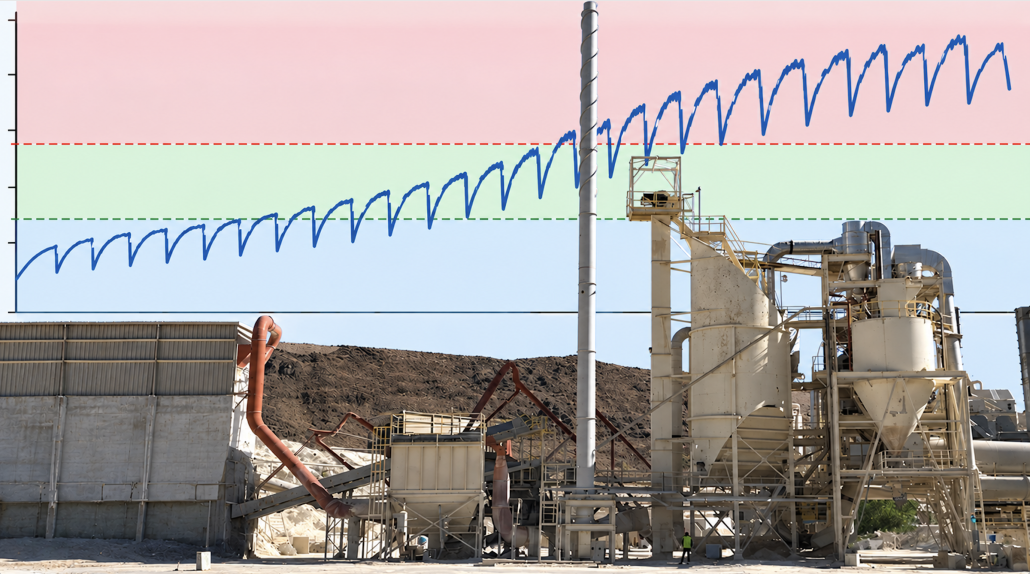
As dust accumulates on the filter surface, resistance to airflow generally increases. Cleaning removes part of that accumulated dust and reduces resistance.
This basic relationship makes DP useful for baghouses, cartridge collectors, and other fabric-filter systems. The EPA identifies pressure differential as an important indicator of fabric-filter performance, along with parameters such as particulate outlet concentration, temperature, airflow, cleaning-system operation, and fan current.
What Is a Normal Differential Pressure for a Dust Collector?
There is no universal normal DP for every dust collector. As an example, some pulse-jet collectors may use cleaning setpoints around 3 to 5 in. w.g., with cleaning beginning near the upper setpoint and stopping near the lower one.
That’s why we would never recommend taking a generic number from the internet and using it as your maintenance setpoint. Instead, compare your readings against the collector manufacturer’s design information and, whenever possible, establish a baseline while the system is known to be operating correctly.
Pay Attention to the Trend, Not Just the Number
Imagine your collector normally operates between 3 and 5 in. w.g. A reading of 4.5 doesn’t tell you much by itself. But if DP used to return to 3.5 after cleaning and now only drops to 4.5, that’s useful information.
The same applies to cleaning frequency. A collector controlled by DP may remain within the same apparent range while cleaning cycles become increasingly frequent. EPA guidance notes that changes from established baseline conditions, including the upper and lower pressure-drop values, can reveal developing performance problems. (EPA Nepis)
What Does High Differential Pressure Mean?
High DP means there is greater resistance across the filters than expected. Common causes include:
The first question should be: Does DP decrease when the filters are cleaned? If it does, the cleaning system is having an effect. If it remains high, inspect the cleaning system, filters, process conditions, and airflow rather than simply increasing cleaning frequency.
Moisture deserves particular attention. Condensation or wet process conditions can make dust adhere to filter media and create a problem that additional pulsing cannot solve.
High DP can also reduce airflow if the fan does not have enough available static pressure to overcome the additional resistance. That can result in poor capture at the hoods even though the fan itself is operating normally.
What Can Your Differential Pressure Trend Tell You?
The table below is intended as a troubleshooting starting point rather than a universal diagnosis.
Should You Clean Filters Based on Differential Pressure?
Make Differential Pressure Part of Your Maintenance Routine
Record your collector’s normal DP range, understand what happens during cleaning, and investigate meaningful changes. Most importantly, don’t automatically assume that high DP means “replace the filters” or that low DP means “everything is fine.”
Differential pressure works best when it is used together with other variables, like airflow, emissions, filter condition, cleaning-system performance, process conditions, and maintenance history.
When you know what normal looks like, DP becomes one of the quickest ways to recognize when something isn’t normal.
If you still have questions about how this information applies to your specific application, please get in contact with one of our dust collection experts. They will be happy to assist you!