


The impeller design determines how a centrifugal fan handles airflow, pressure, efficiency, and particulate loading. Backward-inclined wheels are generally efficient and commonly selected for relatively clean-air applications. Radial-blade wheels are more rugged and can handle dust, fibers, and other materials passing through the fan, making them suitable for certain dirty-side installations. Radial-tip wheels offer a compromise between material-handling capability and efficiency and are often used in moderately dust-laden applications. There isn’t one wheel design that’s best for every dust collector. The correct choice depends on dust concentration, particle characteristics, required airflow, pressure, and maintenance considerations.
Centrifugal Fans & Blowers
LOOKING FOR A FAN FOR YOUR DUST COLLECTION SYSTEM?
Centrifugal fans, also known as industrial centrifugal blowers, are among the most widely used fans because they are more cost-effective than axial fans and simpler in terms of construction. In addition to material handling applications, centrifugal air blowers are popular for dust collection systems.
More importantly, Baghouse.com centrifugal fans are sturdy, reliable, and capable of operating under various conditions.
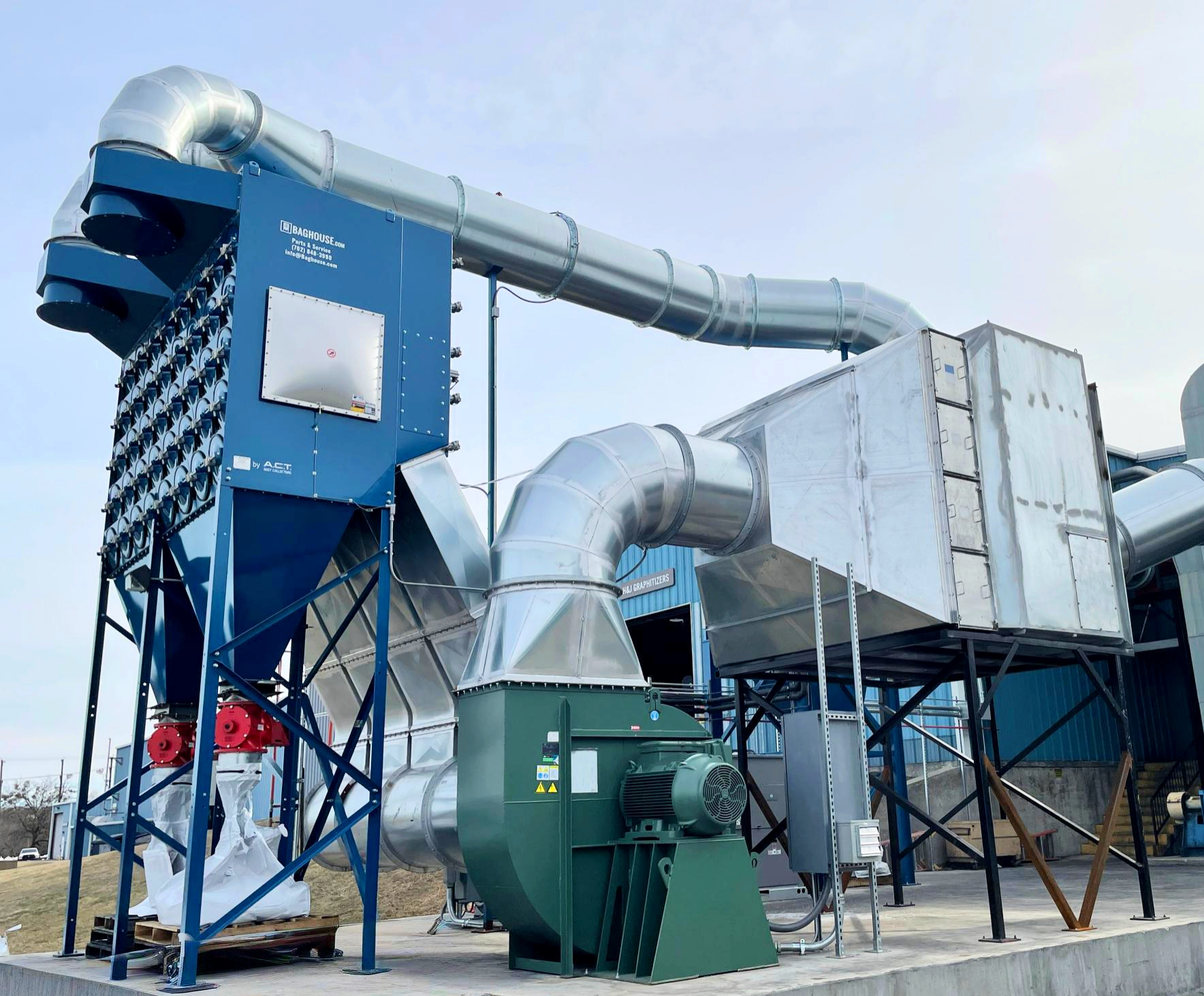
Industrial Fan Design Features and Construction Options
Fans in these systems create the airflow necessary to transport contaminated air through ducts and into filtration units like baghouses, cyclones, or cartridge collectors. Baghouse.com fans are engineered for both clean-side and dirty-side applications.
Some of the design features are:
- Bearings and motors isolated from the process.
- Shaft seals with ceramic felt elements.
- Housing clean-out doors. Split housings.
- Safety guards and electrical disconnect.
- Material handling design features for dirty side fan placement.
- Ambient air inlet filter and silencer.
Available Materials of Construction:
- Carbon Steel
- Stainless Steel
- Coated Carbon Steel
- FRP


FAN & BLOWERS TYPES
A range of industrial dust control and collection fan types are used depending on the airflow, pressure, and particulate characteristics of the application. High Pressure Backward Inclined Fans and Compact Pressure Blowers are often selected for systems requiring high static pressure to move air through dense filtration media.
For general use, Series 20 GI Fans, General Purpose Fans, and Junior Fans offer performance and flexibility in a variety of configurations. Dirty-air or particulate-laden applications may require more robust models like the Series 20, 30, and 45 General Industrial fans. Materials of construction vary by application, including carbon steel, stainless steel, and abrasion-resistant coatings for extended durability.
OUR FANS ARE BUILT FOR DEMANDING APPLICATIONS

Multiple Applications & Industries
Dust collection blowers are designed to capture airborne particles from industrial processes such as cutting, grinding, sanding, and powder handling.

Design Considerations
Dust collection fans must address safety, air quality, and durability under demanding conditions.

Finding the Right Model for You
A range of industrial dust control and collection fan types is used depending on the airflow, pressure, and particulate characteristics of the application.

Regulatory Compliance
Our dust collection blowers are engineered for consistent performance and OSHA and NFPA regulatory compliance.

FANS FOR HIGH TEMPERATURE APPLICATIONS
High-temperature applications require components designed to limit and reduce heat transfer to critical components for extended life in these environments. To help simplify your selection process, Baghouse.com uses standard & customizable high-temperature product offerings to promote air circulation for a cooling effect in critical component areas, with interfaces sized for thermal expansion.
Frequently Asked Questions About Fans & Blowers
1. What's the difference between a fan and a blower in an industrial dust collection system?
Both fans and blowers move air, but the distinction generally comes down to the pressure they are designed to produce. Centrifugal fans are commonly used in dust collection systems to move large volumes of air through hoods, ductwork, and filtration equipment. Industrial blowers are often designed for higher-pressure applications, such as pneumatic conveying or specialized process air systems. The terminology can overlap, so the important specifications are the required airflow (CFM), static pressure, operating temperature, and characteristics of the material being handled. Selecting equipment based on its name alone can result in poor performance or unnecessary energy consumption.
2. How do I determine the correct fan size for my dust collector?
Proper fan sizing starts with calculating the total airflow required to capture and transport dust from every collection point. This is typically expressed in cubic feet per minute (CFM). Next, you need to determine the system’s total pressure requirements, including resistance from hoods, ductwork, fittings, filters, and other components. The fan must deliver the required CFM at the calculated operating pressure, not simply have a maximum airflow rating that matches your needs. I recommend reviewing the manufacturer’s fan performance curve and accounting for actual air density, operating temperature, filter loading, and expected system changes before selecting a fan.
3. Should my dust collector fan be installed on the clean-air side or dirty-air side?
Clean-side fans are installed downstream of the dust collector, where most particulate has already been removed. This allows the use of efficient backward-inclined or airfoil-type wheels that are generally better suited to relatively clean air. Dirty-side fans are installed upstream of the collector and must handle dust-laden air directly. These applications often require radial-blade, paddle-wheel, or radial-tip designs, sometimes with abrasion-resistant construction. The best arrangement depends on the dust characteristics, system layout, operating conditions, and applicable combustible dust safety requirements.
4. Why is my dust collector fan running but not providing enough suction?
Poor suction can result from clogged filters, blocked ductwork, leaking connections, incorrectly positioned dampers, worn fan components, or changes in production equipment. A slipping belt, incorrect fan rotation, or improperly configured variable frequency drive (VFD) can also reduce performance. I recommend checking the collector’s differential pressure, fan speed, motor current, and airflow measurements before assuming the fan is undersized. The objective is to identify where the system is losing performance rather than replacing equipment unnecessarily.
5. What's the difference between backward-inclined, radial-blade, and radial-tip fan wheels?
6. Can I increase my dust collector's airflow by installing a larger fan or increasing fan speed?
Possibly, but increasing fan capacity without evaluating the rest of the system can create additional problems. Higher airflow can increase duct velocities, change filter loading, affect capture performance, and increase motor power requirements. Before upgrading the fan, I recommend checking the existing fan curve, motor horsepower, duct sizing, filter area, and collector operating limits. If the fan is controlled by a VFD, increasing its speed may be an option, but only within the equipment’s mechanical and electrical ratings. A fan upgrade should be based on the performance requirements of the complete dust collection system, not simply the desire for more CFM.
7. How can I reduce the energy consumption of my industrial dust collector fan?
One of the most effective approaches is to match fan output to actual system demand. A properly designed VFD control strategy can reduce fan speed when less airflow is needed, potentially delivering substantial energy savings compared with constant-speed operation using throttling dampers. Other improvements include reducing unnecessary duct restrictions, repairing air leaks, maintaining filters, correcting belt problems, and keeping the fan operating near its best efficiency point. However, airflow should never be reduced below the levels required for effective dust capture and transport. The U.S. Department of Energy recommends evaluating fan efficiency as part of the entire air-handling system rather than treating the fan as an isolated component.
8. What causes excessive vibration or unusual noise in an industrial fan?
Common causes include material buildup on the impeller, worn bearings, misaligned shafts, loose mounting bolts, damaged blades, belt problems, and unbalanced rotating components. In dirty-side applications, abrasive dust can gradually wear the fan wheel, creating imbalance and reducing performance. Poor inlet or outlet duct arrangements can also produce turbulence, noise, and vibration, even when the fan itself is mechanically sound. I recommend tracking vibration trends and bearing temperatures as part of routine maintenance. If vibration increases suddenly or becomes severe, shut down the equipment safely and investigate before restarting.
9. What maintenance should I perform on my dust collector fan, and how often?
Industrial fans should be included in a preventive maintenance program based on operating hours, environmental conditions, and manufacturer recommendations. Routine inspections should cover bearing lubrication, vibration, belt tension and alignment, motor condition, mounting hardware, and signs of corrosion or abrasion. Dirty-side fans may require more frequent inspections for material buildup and impeller wear, particularly in abrasive or fibrous applications. I also recommend periodically measuring fan speed, motor current, airflow, and static pressure to identify changes before they lead to failures. Establish a normal operating baseline and adjust inspection intervals based on equipment condition rather than relying on a universal maintenance schedule.
10. What should I consider when selecting a fan for abrasive, corrosive, or high-temperature dust?
Standard carbon steel fans aren’t suitable for every industrial environment. Abrasive dust may require wear-resistant liners, hardened components, or specialized impeller designs. Corrosive applications may benefit from stainless steel, protective coatings, or other compatible materials. High-temperature applications require careful evaluation of wheel construction, shaft seals, bearing protection, thermal expansion, and allowable operating speed.
For combustible dust, appropriate ignition-risk controls and spark-resistant construction may also be necessary, although spark-resistant construction alone does not provide explosion protection. I recommend providing the fan supplier with detailed information about dust characteristics, gas temperature, chemical composition, required airflow, and pressure conditions before selecting equipment. The uploaded manufacturer’s brochure describes specialized construction options for these demanding applications.
Related Services



Contact Us
Need to schedule a repair or PM appointment? Just fill out the form below. Or call us at CALL (702) 848-3990 to schedule an emergency repair.
Contact Us
3172 N. Rainbow Blvd. Unit #5105
Las Vegas, NV 89108
Phone: (702) 848-3990
Explore Our Filtration Solutions
About Baghouse.com
Baghouse.com is a leading manufacturer of baghouse dust collection systems and equipment with 40+ years of experience serving all industries.