Routine maintenance is critical to ensure your dust collection system operates efficiently.
Regular maintenance is required to keep your baghouse dust collector operating efficiently. But just like any other maintenance involving industrial equipment and machinery, baghouse maintenance can pose hazards for personnel. Workers who regularly change out filter bags or perform inspections, repairs, and other routine procedures must follow the correct safety procedures to remain safe.
This article offers five safety protocols that represent areas that are commonly overlooked or sacrificed for the sake of time and effort. These precautions, while not representing an exhaustive list of all necessary safety protocols, are vital to ensure worker safety when servicing baghouse equipment.
1. Lockout/Tagout All Equipment Operations
Before nearly all maintenance work on any particular baghouse can be performed, a total shutdown and lockout/tagout must be put in place. This ensures that the baghouse is not activated or energized by mistake while the technician is performing his duties.
Securing the baghouse for personnel entry can be accomplished in several ways. Primarily, this is done by locking out the blower (system fan), shutting off/sealing ducting to the collector, or both. With multiple baghouses or baghouse compartments (such as Reverse-Air or Shaker designs), maintenance personnel must ensure that the correct compartment has been shut down. Additionally, it may be wise to shut down adjacent compartments to avoid the problem of negative pressure inside the collector, which can result from poor seals between the collector and ductwork shared by various compartments or material handling systems, such as screw conveyors from the hopper.
2. Ensure a Safe Working Environment though Atmospheric Testing and Heat Reduction
Prior to any maintenance work that requires entrance into the baghouse, make certain that a safe environment exists within the collector. The internal atmosphere should be tested to ensure there are no harmful ambient levels of gases/particles such as SO2, CO, NO2, or any other specific compounds that the plant process is known to produce, e.g., lead, dioxins, etc.
Testing also should confirm that there is a sufficient level of breathable oxygen (OSHA: 19.5 percent). However, if the level is below the normal air concentration of 20.8 percent, it is a good idea to investigate as to why that is before any confined space entry.
Many baghouses process gas streams above ambient temperature. Even when the process does not produce higher-than-ambient temperatures, maintenance personnel still must ensure that temperatures within the baghouse are sufficient for a safe working environment. In some cases (such as in power plants), cooling the baghouse to safe levels may require hours offline with all access ports (such as doors and hatches) open to increase ventilation. This process cannot be hurried and should not be overlooked. Disorientation within the baghouse due to atmospheric conditions can lead to impaired judgment, which in turn can lead to falls, trips, or even to toxic exposure, heat stroke, and eventually death.
3. Confined Space Safety Guidelines
The inside of a baghouse is almost always classified as a “confined space” for safety reasons. With this in mind, special procedures must be followed when working in these hazardous areas, including:
· Entrance Permits – Permits ensure that all members of management know what work is being done, where, and at what time.
· Communication – Establish a reliable method of communication with those working within the confined space, e.g., voice, radio, signal, etc., that does not require the watchman to enter the hazardous confined space.
· Retrieval Plan – Formulate a retrieval plan in case of problems. The plan should not involve the watchman entering the confined space. If something goes wrong and the watchman enters, there will be a greater potential loss of life since the watchman also may be in jeopardy.
4. Dust Explosion Prevention
Most dusts have a high potential for exploding when dispersed into the air. These dangers should not be overlooked when performing maintenance inside and/or near the baghouse. All hot work (welding, acetylene cutting, grinding, etc.) should be performed away from the collector if possible.
Maintenance personnel also must ensure that power tools and impact hand tools (such as hammers, chippers, etc.) that could present a sparking hazard are not used in high dust concentrations. When such work is being performed on the structure itself, make certain the dust concentrations within the enclosure are well below combustible levels. Even if the air inside is clear, excessive vibration may dislodge elevated deposits of dust that can then lead to a conflagration.
Finally, employees should refrain from smoking while performing all work.
5. Personal Protective Equipment (PPE)
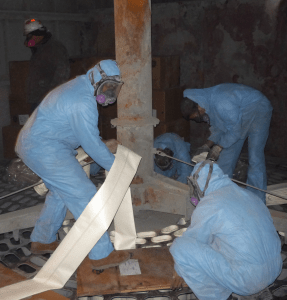
Workers should always employ all necessary PPE when performing baghouse maintenance. In most cases, this includes basic protection such as safety glasses, gloves, and earplugs, but also includes job-specific PPE such as protective coveralls (Tyvek suits) and respirators with the proper filter type. In certain situations, full-face respirators may be necessary.
Before entry into the baghouse, all PPE should be checked. This includes fit-checking respirators, cleaning all glasses, and checking for damage on any and all equipment.
Industrial maintenance and construction remain the deadliest sector of the economy year after year. However, with proper training, oversight, and attention to safety, service on industrial equipment such as baghouses can be performed safely and efficiently.

Director of Operations | Dust Collection Specialist | Industrial Filtration Consultant
Dominick DalSanto is an author and environmental technologies expert specializing in dust collection systems. He has nearly a decade of hands-on working experience in the industry. Dominick is the sales director and sales technical advisor for an industrial dust collection equipment manufacturer. Personally took the lead on key projects each year from sales engineer to field advisor to project manager to business relations. Born in San Bernardino County, California, and raised in Chicago, he currently resides in Buenos Aires, Argentina.