A pneumatic conveying system uses moving air to transport powders and bulk solids through a pipeline.
Pneumatic conveying is used throughout cement, fly ash, food processing, chemical, minerals, plastics, and other bulk-material industries because material can be moved through enclosed piping with relatively few moving components.
Although the concept of moving material with air can be quite straightforward, the engineering behind it can get complicated quickly. Here are some of the questions we commonly receive when explaining the design, planning an expansion, or troubleshooting pneumatic conveying systems.
¿Cómo funciona un sistema de transporte neumático?
A pneumatic conveying system moves dry bulk material through a pipeline using an air stream. Depending on the application, the air may push the material using positive pressure or pull it using vacuum.
Positive-pressure systems are commonly used when material needs to travel longer distances or at higher rates. Vacuum systems are particularly useful when collecting material from multiple pickup locations and can help contain dust because leakage tends to move inward rather than outward.
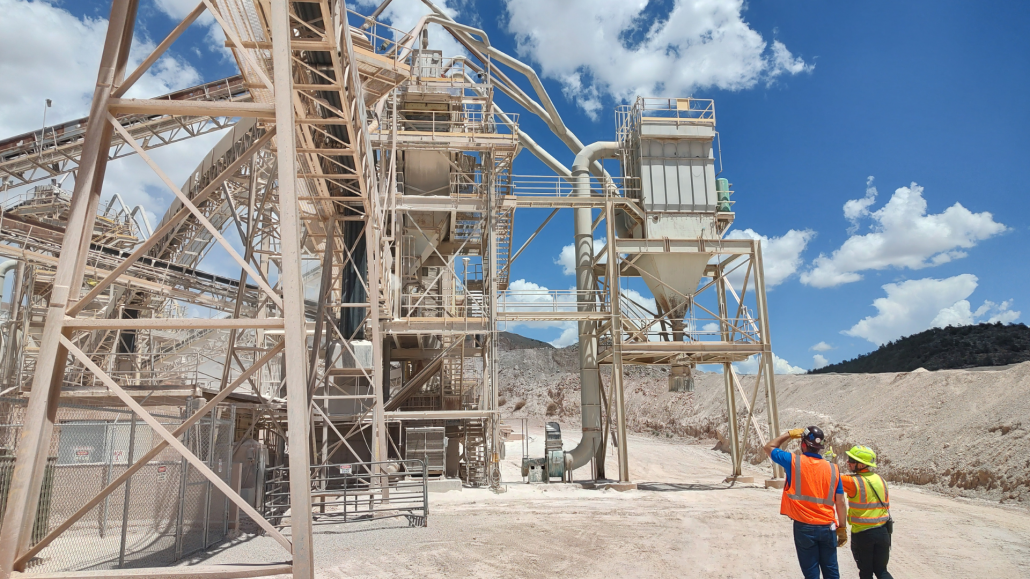
A typical pneumatic conveying system uses an air mover, conveying lines, feeding equipment, a receiving silo, and filtration equipment to move and separate dry bulk material.
At the receiving end, the material must then be separated from the conveying air. This is commonly done with a filter receiver, baghouse, cartridge collector, or cyclone, depending on the application.
What's the Difference Between Dilute Phase and Dense Phase Conveying?
The main difference is how the material travels through the pipe.
En las dilute-phase conveying, particles are generally suspended in a relatively high-velocity air stream. Typical dilute-phase gas velocities of approximately 4,000 to 8,000 fpm, although the correct velocity depends heavily on the material.
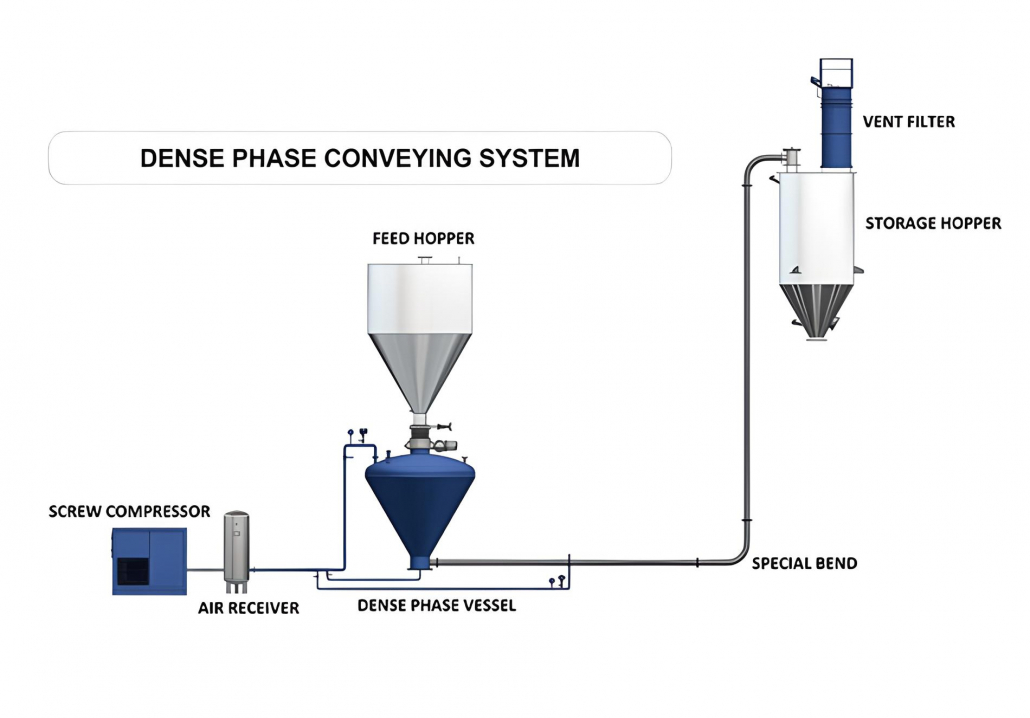
Dense-phase conveying moves a greater concentration of material at lower velocities. Depending on the design and material, it may move in plugs, slugs, dunes, or another dense-flow pattern.
Dense-phase (bulk phase) conveying is a method of pneumatic conveying that moves materials in a slow, controlled flow using high pressure and low air velocity, transporting bulk solids in dense, concentrated slugs through the pipeline.
In dilute-phase conveying, particles are generally suspended in a relatively high-velocity air stream.
An important concept here is saltation velocity. This is related to the point at which particles can no longer remain adequately suspended in horizontal conveying. The source material describes dilute/lean phase as operating above the material’s saltation velocity, while dense-phase operation occurs below it.
Dense phase can be attractive for abrasive or fragile materials because lower velocity can reduce pipeline wear and product degradation. However, not every material behaves well in dense phase. Material testing may be needed before committing to a commercial design.
What Type of Pneumatic Conveying System Should I Use?
The right pneumatic conveying system depends on the material being handled, required conveying rate, distance, available pressure, and how the material needs to enter and leave the system. As the image below shows, there are several ways to move bulk material, including suction conveyors, airslides, jet feeders, air-lock feeders, screw pumps, pressure vessels, and airlifts. Each operates within a different range of pressure, conveying distance, and material-to-air ratio.
There isn’t one conveying method that’s best for every plant. The system should be selected around the material properties and actual conveying requirements, rather than choosing a conveying technology first and trying to make the process fit it.
Common pneumatic conveying system configurations include vacuum, pressure, multi-point distribution, and suction systems, each designed around different material handling and transfer requirements.
Vacuum or suction systems are useful when material must be collected from multiple pickup points, but their available pressure limits how far they can convey. Positive-pressure systems can operate at higher pressures and are generally better suited for longer conveying distances.
For example, some positive-pressure fly ash systems can convey material over 1,000 meters and, in certain applications, up to 2,000 meters.
Different pneumatic conveying methods operate within different ranges of solids loading, pressure, conveying distance, and material transfer capacity.
How Do You Determine the Correct Conveying Line Diameter?
You need to consider the required material rate, material properties, conveying distance, vertical lift, bends, available pressure, required air volume, and the pressure loss through the complete system.
The process is often iterative. You start with an assumed pipe diameter and calculate the expected pressure drop. If the required pressure exceeds what the blower or compressor can provide, increasing the pipe diameter may reduce the pressure requirement. If pressure drop is much lower than expected, a smaller diameter may be possible. This is why simply saying, “We move 10 tons per hour, so we need a 6-inch line,” isn’t enough information to properly design a system.
How Does Pipe Diameter Affect Conveying Velocity?
For a given airflow, increasing pipe diameter reduces air velocity.
The basic relationship is:
Velocity (FPM) = Airflow (CFM) ÷ Pipe Area (ft²)
For example, suppose a system moves 1,500 CFM through a 6-inch pipe. A 6-inch pipe has an approximate cross-sectional area of 0.196 ft²:
1,500 ÷ 0.196 ≈ 7,650 FPM
If that same 1,500 CFM moves through an 8-inch pipe, with an approximate area of 0.349 ft²:
1,500 ÷ 0.349 ≈ 4,300 FPM
That’s a major velocity reduction. If velocity drops too far in a dilute-phase system, material can fall out of suspension, accumulate in the pipe, and eventually plug the line.
How Much Conveying Velocity Do I Need?
The required velocity depends on properties such as particle size, particle density, bulk density, shape, moisture, cohesiveness, and whether the material is fragile or abrasive.
You should establish the material’s saltation velocity through calculation, testing, previous experience, or work with an equipment supplier like Baghouse.com.From there, the designer establishes the pickup velocity and evaluates how velocity changes along the pipeline.
The goal is to provide enough velocity for stable conveying without using substantially more velocity than the application requires.
Why Does My Pneumatic Conveying Line Plug?
Plugging often means the balance between material feed, conveying air, velocity, and pressure has been lost. Possible causes include insufficient air volume, feeding material faster than the system was designed to handle, a change in material properties, excessive vertical lift, poor piping geometry, or a restriction in the line.
Dense-phase systems have additional considerations. For example, certain material characteristics or piping arrangements can create large, relatively impermeable slugs that the conveying air cannot move effectively. Back-to-back elbows and problematic vertical transitions can contribute to these conditions.
When a previously reliable system begins plugging, ask an important question first: "What changed?” Production rate, material, moisture, feeder speed, air supply, pipe routing, or downstream equipment may have changed even though the conveying line itself looks the same.
Why Is My Pneumatic Conveying Pipe Wearing Out So Quickly?
Check the velocity. Abrasive material repeatedly striking pipe walls, particularly at elbows and changes in direction, can cause severe wear. Additionally, wear increases very rapidly as velocity increases, which is why lowering conveying velocity can dramatically improve pipeline life.
Pipe diameter can sometimes be stepped up farther along the conveying line to control increasing velocity as conveying air expands.
For dilute-phase conveying, allow roughly 6–10 pipe diameters around a step and avoid a diameter increase immediately after a change in direction. A vertical section is preferable when practical.
For especially abrasive products, elbow design and wear-resistant components may also be necessary.
A spherical vortex chamber protruding from the elbow diverts part of the flow where it forms a loosely packed mass that slowly rotates in the direction of flow, gently deflecting particles around the bend.
Can a Rotary Airlock Reduce Pneumatic Conveying Capacity?
Yes. A rotary airlock needs to introduce or discharge material while maintaining a pressure differential, but some air leakage is inevitable.
Higher differential pressure increases leakage through the clearances, while increasing rotor speed can increase the dynamic component. That leakage matters when sizing the blower. Air returning through the rotary valve can represent airflow that is no longer available for conveying. You should account for the resulting SCFM when determining the required pressure-blower capacity.
Can I Use Inclined Piping Instead of the Horizontal/Vertical Combination?
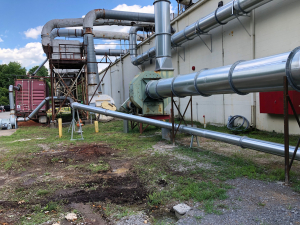
In general, the recommendation is to try to maintain horizontal and vertically upward convey lines wherever possible. If there is a situation where an inclined line is necessary, it can be addressed by more experienced system designers.
As a general guide, if the angle of the incline is less than 15 degrees from the horizontal or from the vertical, the line is treated as being horizontal or vertical. As the angle of incline approaches 45 degrees, additional pressure drops are included and the velocity profile in the inclined section is more scrutinized. The preference would be to have sloping upward lines be included towards the end of the system rather than early in the system to have the benefit of the higher velocity at that location.
How Does the Dust Collector Affect Pneumatic Conveying?
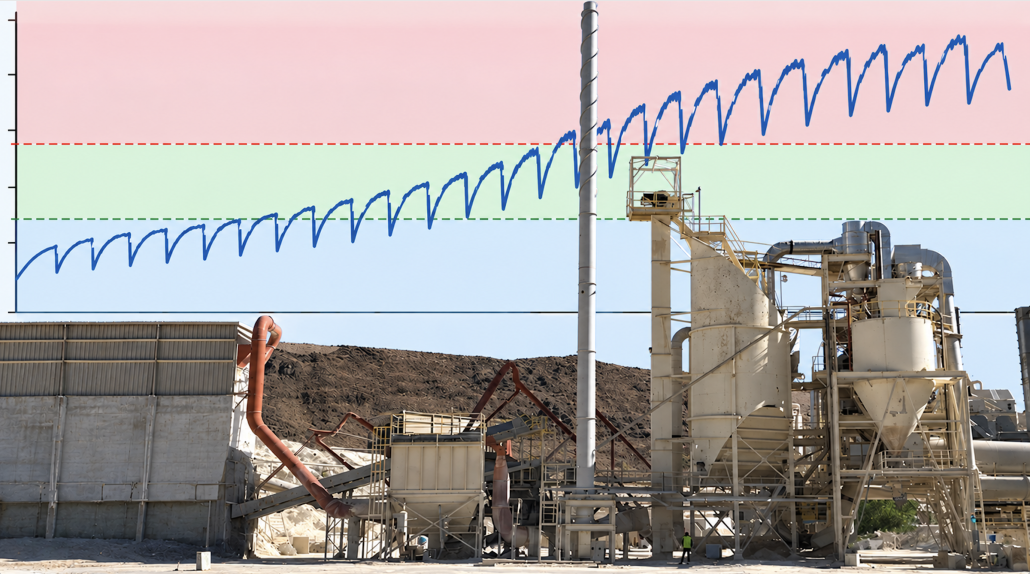
At the destination, the conveying air has to separate from the transported material and pass through the filtration system. Filter resistance, filter area, dust loading, inlet arrangement, cleaning performance, and pressure drop therefore matter to the pneumatic system.
Baghouses are commonly used as pneumatic receivers. If the receiver is undersized or the filters become heavily loaded, resistance increases. That changes the pressure conditions the conveying system must operate against.
This is why we evaluate the pneumatic conveying system and dust collector together, particularly when troubleshooting capacity problems or designing a new system.
What Information Is Needed to Design or Troubleshoot a Pneumatic Conveying System?
Before changing a blower, pipe size, or feeder speed, gather the basic operating information:
⦿ Material and bulk density
⦿ Required conveying rate
⦿ Horizontal and vertical conveying distance
⦿ Existing pipe diameter and routing
⦿ Number and type of elbows
⦿ Airflow
⦿ Conveying pressure or vacuum
⦿ Blower performance
⦿ Rotary airlock size, RPM, and condition
⦿ Pickup and destination conditions
⦿ Dust collector differential pressure
⦿ Filter area and collector airflow capacity
⦿ History of plugging, wear, or product degradation
For difficult materials, physical testing can be extremely valuable. Modern pneumatic-conveying test facilities evaluate complete conveying behavior, rotary-valve performance, product degradation, pipe configurations, temperature effects, and other application-specific variables before final system design.
Can an Existing Pneumatic Conveying System Be Upgraded for More Capacity?
Often, yes, but the existing bottleneck needs to be identified first. Increasing blower speed may provide additional air, but that also changes conveying velocity and pressure conditions. Increasing rotary-valve speed may increase material feed while also increasing air leakage. Increasing pipe diameter lowers velocity but can create conveying problems if taken too far.
Sometimes the solution is a larger blower. In other applications, two blowers can operate in parallel. Other systems may benefit from stepped piping, airlock repairs, rerouting problematic pipe sections, modifying the receiver, or increasing filtration capacity, for example, with pleated filters.
Need Help With a Pneumatic Conveying System?
Baghouse.com designs and supplies pneumatic conveying systems for industrial dust collection and bulk-material applications. We can evaluate the material, conveying rate, airflow, pressure requirements, pipe routing, blower, rotary airlocks, receiving collector, filters, and discharge equipment as one complete system.
Get in contact with us if you are designing a new pneumatic conveying system or troubleshooting an existing one. We would be happy to help!
Experto en colectores de polvo, redactor técnico y editor en Baghouse.com
Andy Biancotti está convencido de que el conocimiento es una de las mejores inversiones para una empresa. Como Editor y Gerente de Marketing en Baghouse.com, disfruta entrevistar a ingenieros, técnicos y clientes para capturar las lecciones aprendidas en proyectos reales de control de polvo y convertirlas en recursos prácticos que ayuden a otros profesionales. Con más de dos décadas de experiencia en mantenimiento industrial, operaciones y comunicación técnica, su objetivo es simple: ayudar a las personas para que puedan operar de forma más segura, inteligente y eficiente.





 In general, the recommendation is to try to maintain horizontal and vertically upward convey lines wherever possible. If there is a situation where an inclined line is necessary, it can be addressed by more experienced system designers.