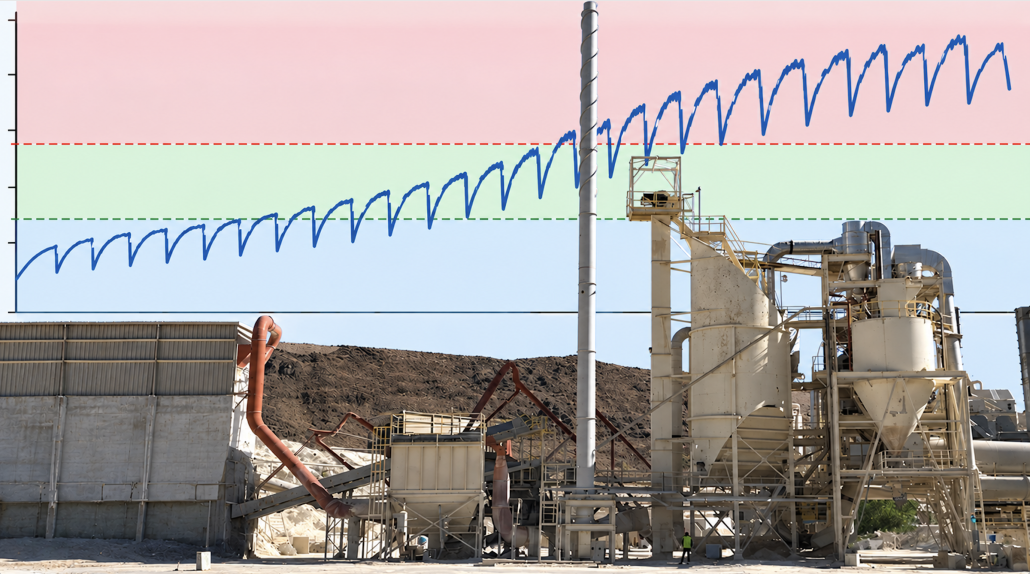

The pressure supplied by the compressed-air system must be high enough to clean the entire length of the bag during the pulse.
In our previous article The Importance of Dry and Clean Compressed Air in a Pulse Jet Industrial Dust Collector, we discussed the importance of using dry and clean compressed air. Along with this requirement, it is also very important that the compressed air is set at the correct pressure.
The pressure supplied by the compressed-air system must be high enough to clean the entire length of the bag during the pulse, but not so high that it damages the upper portion of the bag. Insufficient cleaning of the bag may gradually increase pressure drop and reduce the useful bag life.
If the compressed-air pressure is too low, which is usually more common than excessive pressure, it may be caused by wear of the compressor rings, leakage in connections, or excessive draining of the reserve of the compressors by other equipment tied to a common supply line. Additionally, if the pulse valves, air header tanks or connecting pipes on the unit itself have leaks, then the absolute pressure or the effective pressure at the blowpipe will be lower.

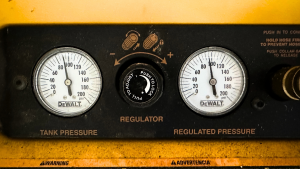
If the compressed-air pressure is too low, it may cause excesive wear of the compressor components
For most applications using felted filter media, compressed air at roughly 70 PSI (Per Square Inch) is adequate for proper cleaning of the filter elements. Pressures between 100 and 120 PSI may be recommended for some difficult applications where other options to improve cleaning efficiency are not viable. Operators running their systems at pressures above 100 PSI should first consult a dust collection expert at Baghouse.com for advice and recommendations on how to improve performance.
Compressed air pressures below 70 PSI may be required under special circumstances such as when using cartridges, pleated filter elements or with certain filter medias such as fiberglass. These situations often call for special design and sizing of the dust collector in order to function correctly.

If filters are not cleaning sufficiently, raising the air pressure may be one of several things to try to improve operation.
The following general guidelines can help you to set the the correct pressure of compressed air for your baghouse:
- — Start at 60 PSI and go up as needed by the application. At no point should it go above 100 PSI unless advised to do so by a reputable dust collection systems engineer.
- — Pleated filter systems and cartridge systems may use much lower PSI for cleaning depending on the design of the unit and the application (airflow, dust load on filters, how hard the dust is to pulse off, moisture problems, etc.)
- — If filters are not cleaning sufficiently, raising the air pressure may be one of several things to try to improve operation. However, it alone will not solve the problem in most cases. Often, fixing other problems such as high can/interstitial velocity, will improve things so that you can actually lower the PSI and have better cleaning.

Director of Operations | Dust Collection Specialist | Industrial Filtration Consultant
Dominick DalSanto is an author and environmental technologies expert specializing in dust collection systems. He has nearly a decade of hands-on working experience in the industry. Dominick is the sales director and sales technical advisor for an industrial dust collection equipment manufacturer. Personally took the lead on key projects each year from sales engineer to field advisor to project manager to business relations. Born in San Bernardino County, California, and raised in Chicago, he currently resides in Buenos Aires, Argentina.