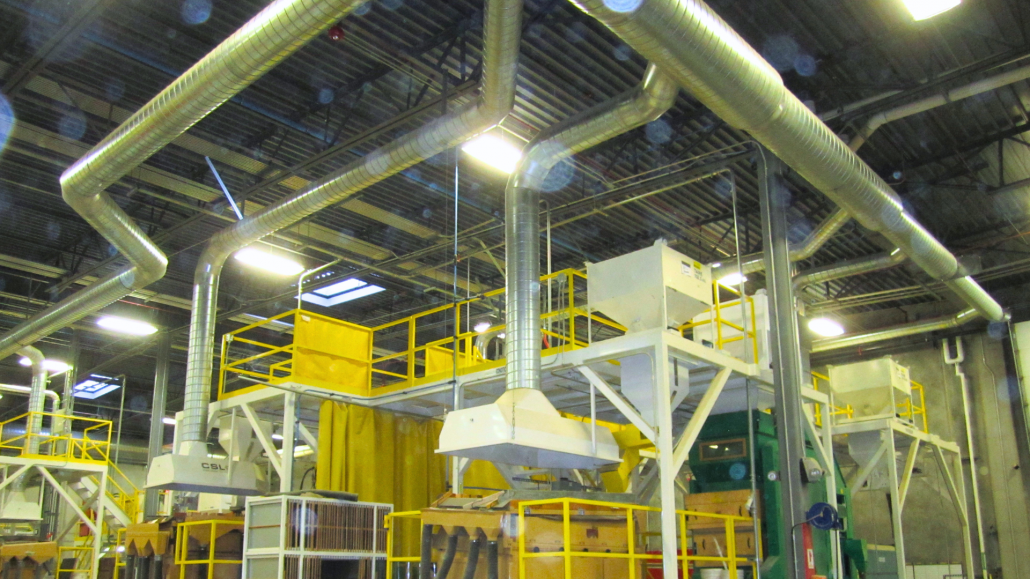
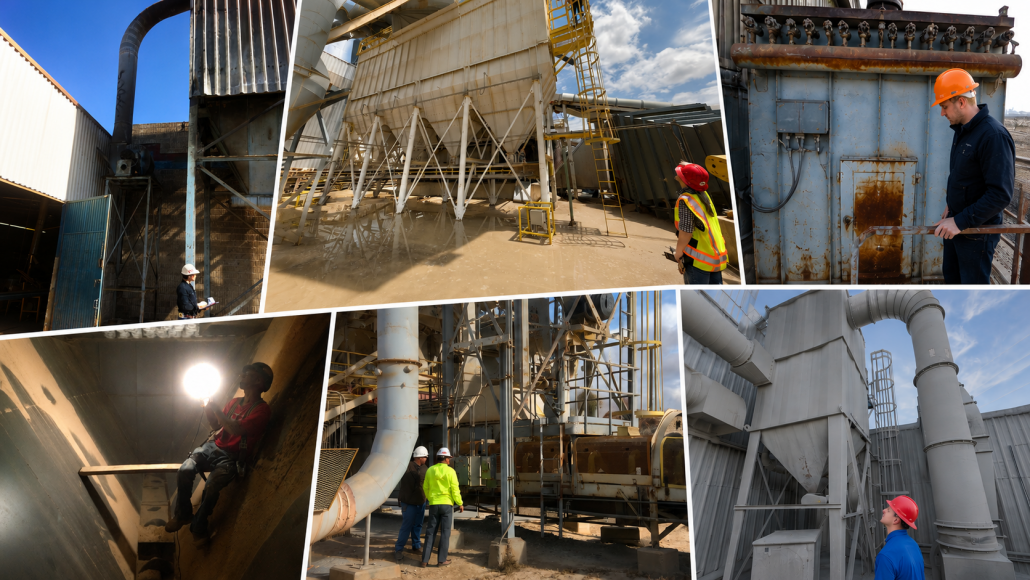
Combustible dust can be easy to underestimate because, during normal operation, nothing dramatic appears to be happening. Dust flows through the ductwork, falls into the hopper and gets discharged.
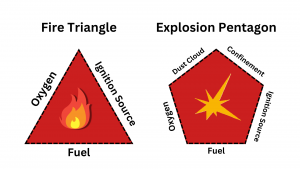
Triángulo del fuego y pentágono de la explosión
But inside that collector, several conditions needed for a deflagration can exist at the same time: combustible material, suspended dust, oxygen, confinement, and potentially an ignition source.
Eliminating every possible spark, hot particle, friction source, or electrostatic discharge from an industrial process can be difficult.
This is where combustible dust safety accessories such as explosion vents and isolation valves become important. How do explosion vents and isolation valves reduce combustible dust risks?
What Makes a Dust Collector an Explosion Risk?
A dust collector is designed to concentrate dust. Dust-laden air enters the collector, particulates are separated from the airstream, and collected material accumulates on the filters before eventually reaching the hopper. With combustible material, the collector can therefore contain a suspended concentration of combustible dust inside an enclosed vessel.
Potential ignition sources include sparks or embers from the production process, hot particles, friction, and static electricity. Processing, handling, and storing combustible materials inside enclosed equipment such as dust collectors, cyclones, mills, mixers, and bins can create an explosive atmosphere.
This means a combustible dust protection strategy has to answer two questions:
► How can we reduce the chance of ignition?
► If a deflagration occurs, what happens next? (Explosion venting and isolation address this question)
What Does an Explosion Vent Actually Do?
An explosion vent acts as an intentionally engineered pressure-relief point in the dust collector.
During normal operation, the vent remains closed. If a deflagration occurs and internal pressure reaches the vent’s designed opening pressure, the vent opens and provides a controlled path for the expanding gases, flame, and pressure.
The important distinction is that explosion venting does not prevent the initial deflagration. It reduces its consequences.
How Are Explosion Vents Sized?
The required vent area and arrangement depend on factors including:
Combustible dust testing is important to know the explosibility characteristics of the material and properly evaluate the protection system.
Process changes matter as well. If production changes, throughput increases, new materials are introduced, or the dust mixture changes, the existing explosion protection should not automatically be assumed to remain appropriate.
Where Does the Explosion Go?
An explosion vent can discharge flame, pressure, hot gases, and burning material. The resulting fireball can extend a considerable distance, creating a hazard to nearby personnel and equipment. An explosion may also disturb accumulated combustible dust in the surrounding area, potentially contributing to a secondary explosion.
⦿ For outdoor collectors, the vent can often be positioned so its discharge is directed toward a designated safe area.
⦿ Indoor collectors require additional consideration. Depending on the application, solutions may include purpose-designed vent ducting to a safe outdoor location or flameless venting.
A flameless vent combines pressure relief with a flame-arresting element designed to control the discharge of burning material while allowing explosion pressure to be relieved.
Why Do You Need Isolation If You Already Have Explosion Venting?
Imagine a properly vented dust collector connected to production equipment through ductwork. An explosion begins inside the collector and the explosion vent opens exactly as intended. The collector may be protected from excessive internal pressure, but it is still connected to the rest of the process. Flame and pressure can potentially propagate through interconnected ductwork toward other equipment or occupied areas. Isolation is used where a fireball or explosion could propagate to other equipment through connecting pipework.
So, explosion venting controls pressure within the protected enclosure, whereas explosion isolation helps prevent the event from propagating beyond it.
How Does an Explosion Isolation Valve Work?
An explosion isolation device creates a barrier between the explosion and connected portions of the system.
Isolation can be passive or active depending on the technology and application. Fast-acting isolation valves, for example, function as mechanical barriers against the explosion’s flame front. Other approaches can include passive isolation devices and chemical isolation systems.
The appropriate method depends on factors such as dust properties, airflow, duct arrangement, operating conditions, and the equipment being protected.
Watch an animation on how explosion vents and an isolation valve work with a dust collection system
Which Vendors Supply Complete Combustible Dust Accessory Packages for New Systems?
Baghouse.com can help evaluate your new or existing dust collection system and identify appropriate options, including explosion vents, flameless vents, isolation valves, spark detection and extinguishing systems, abort gates, controls, monitoring equipment, and other combustible dust safety accessories.
Frequently Asked Questions About Explosion Vents and Isolation Valves
1. What does an explosion vent do on a dust collector?
An explosion vent provides a designed relief point for rapidly increasing pressure during a deflagration. When it opens, it helps keep pressure from exceeding the protected equipment’s allowable strength. It mitigates an explosion rather than preventing ignition.
2. Does an explosion vent prevent a combustible dust explosion?
No. Explosion venting is a protection method. Prevention focuses on reducing combustible conditions and controlling ignition sources. Venting is intended to reduce the consequences if a deflagration occurs.
3. Why does a dust collector need isolation if it already has explosion vents?
Because they perform different functions. The vent relieves pressure from the protected enclosure, while isolation helps prevent flame and pressure from propagating through connected ductwork into other equipment or process areas.
4. Can an explosion vent discharge inside a building?
Conventional indoor venting can create serious hazards because flame, pressure, and burning material may be discharged into the surrounding space. Depending on the application, the system may require venting to a safe outdoor location or an appropriately designed flameless vent.
5. How are explosion vents sized?
Sizing depends on factors including vessel size and geometry, vessel strength, dust characteristics such as Kst and Pmax, vent opening pressure, vent efficiency, and associated vent ducting. It needs to be determined for the specific application.
6. What is the difference between explosion venting and explosion suppression?
Venting provides a controlled path for pressure relief. Suppression detects a developing explosion and rapidly introduces suppressant into the protected enclosure to reduce the developing pressure and effects of the explosion.
7. Are explosion vents enough to make a dust collection system safe?
Not necessarily. Depending on the process, a complete strategy may involve venting, isolation, suppression, ignition-source control, housekeeping, monitoring, and other measures. Interconnected systems often require more than one protection method.
8. How do I know which combustible dust safety accessories my system needs?
Start with the dust characteristics and evaluate the complete system, including the collector location, equipment strength, ductwork, connected equipment, airflow, process conditions, and potential ignition sources. From there, the appropriate combination of venting, isolation, suppression, monitoring, and other protection methods can be determined.
Experto en colectores de polvo, redactor técnico y editor en Baghouse.com
Andy Biancotti está convencido de que el conocimiento es una de las mejores inversiones para una empresa. Como Editor y Gerente de Marketing en Baghouse.com, disfruta entrevistar a ingenieros, técnicos y clientes para capturar las lecciones aprendidas en proyectos reales de control de polvo y convertirlas en recursos prácticos que ayuden a otros profesionales. Con más de dos décadas de experiencia en mantenimiento industrial, operaciones y comunicación técnica, su objetivo es simple: ayudar a las personas para que puedan operar de forma más segura, inteligente y eficiente.